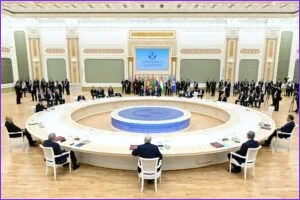
Regional leaders recently gathered in Turkmenistan for the eighth Consultative Meeting of Central Asian Leaders, a summit aimed at fostering collaboration across the region. Turkmen President Serdar Berdimuhamedov opened the proceedings by outlining five primary objectives. These goals include strengthening the six-party format, ensuring lasting regional peace and stability, and transforming Central Asia and Azerbaijan into vital transport, logistics, energy, and industrial hubs. Furthermore, the agenda emphasized accelerating technological growth through the implementation of artificial intelligence and expanding cultural, humanitarian, and educational ties.
Uzbek President Shavkat Mirziyoyev provided a more concrete perspective on the evolving state of regional diplomacy. He highlighted the completion of the Treaty on Friendship, Good-Neighborliness and Cooperation for the Development of Central Asia in the 21st Century. Originally signed in 2022 by the presidents of Kazakhstan, Kyrgyzstan, and Uzbekistan, the treaty saw Tajikistan join in 2025, with Turkmenistan finalizing its participation earlier this year during a visit by Kazakh Foreign Minister Yermek Kosherbayev to Ashgabat. While Azerbaijan has joined the broader grouping and is assuming the role of chair, it remains a non-party to this specific friendship treaty.
Mirziyoyev emphasized that the participating nations do not intend to form cumbersome structures, noting that the treaty serves to codify cooperation while maintaining flexibility. The document outlines commitments to mutual respect and equality, including Article 5, which allows for comprehensive support and mutual assistance in matters concerning independence, sovereignty, and territorial integrity. Should security threats arise, the treaty provides for consultations to determine effective preventive measures, though critics point out that regional history, particularly with groups like the SCO or CSTO, often results in a default to inaction.
Economic integration remains a priority for the bloc. Kazakh President Kassym-Jomart Tokayev noted that intraregional trade currently stands at approximately $13 billion, or 8 percent of total trade turnover, with a stated goal of reaching $20 billion. Tokayev advocated for linking regional logistics centers to create robust value chains and cited the importance of both the Trans-Caspian International Transport Route and the North-South route. President Mirziyoyev echoed the call for elevated economic cooperation, suggesting that the region must move beyond standard trade toward the collaborative production of finished goods.
Despite the optimistic rhetoric regarding youth cooperation and regional development, the summit occurred against the backdrop of silence regarding the detention of Dr. Ikboljon Qoraboyev. The prominent Uzbek international relations professor was detained in Kazakhstan this summer on espionage charges, a case that remains largely unaddressed by officials in Astana and Tashkent, highlighting the gap between high-level diplomatic discourse and regional reality.