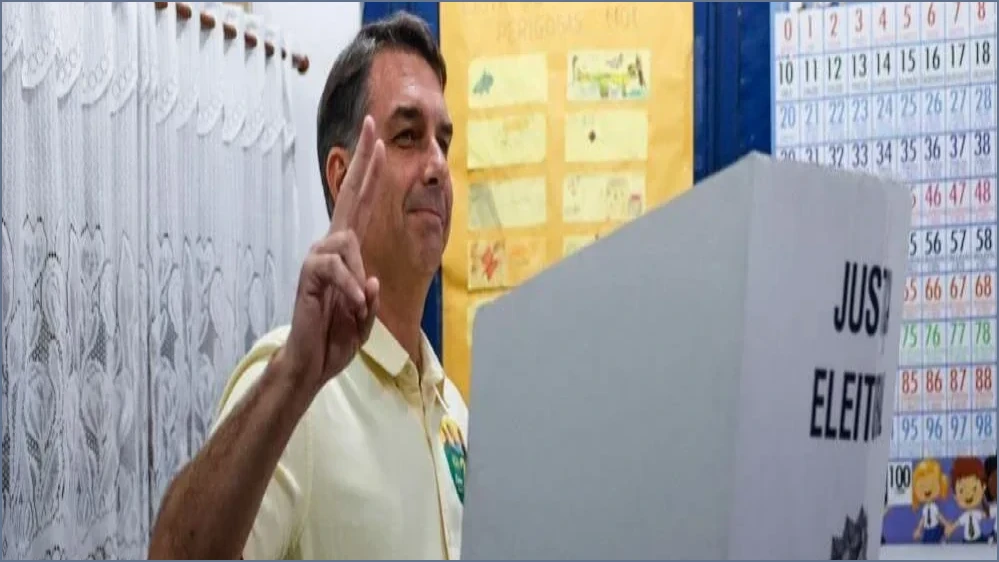
The right-wing candidate Flávio Bolsonaro has won the first round of Brazil's presidential election, defeating incumbent left-wing President Luiz Inácio Lula da Silva. However, because Bolsonaro did not secure the absolute majority of more than 50% of the votes required to win outright, the two candidates will face each other in a decisive run-off vote scheduled for October 25.
With 98.81% of the ballots counted, the 45-year-old Bolsonaro secured 47.24% of the vote, while the 80-year-old Lula followed closely with 44.91%. Bolsonaro's stronger-than-expected performance has shifted the momentum of the race, making the second round look like his to lose. This advantage is bolstered by the fact that several other right-wing candidates who were eliminated in the first round are expected to see their supporters shift their allegiance to him. The outcome of the run-off will determine whether Brazil, the largest country and economy in Latin America, will align with the majority of the region, which has recently elected right-wing presidents aligned with the Trump administration.
The election has deeply polarized the nation, bringing familiar political dynasties and bitter rivalries back to the forefront. Flávio Bolsonaro is the eldest son of former right-wing President Jair Bolsonaro, who is currently serving a 27-year prison sentence for masterminding a failed coup attempt after losing the previous election. Although Jair Bolsonaro was barred from running for re-election before his prison sentence, he endorsed Flávio to run in his stead. Meanwhile, Jair Bolsonaro's wife, Michelle, was successfully elected to the Senate on Sunday. Flávio Bolsonaro has pledged that, if elected, he will grant amnesty to his father as well as to the supporters responsible for the January 8, 2023, riots in which government buildings were vandalized.
After casting his ballot, Lula warned voters that the election presented a stark choice between democracy and "barbarism." In contrast, Flávio Bolsonaro declared his campaign was a mission to "free the Brazilian people." Lula is currently seeking a fourth term as president, having previously served terms following his election victories in 2002, 2006, and 2022. In the 2022 election, Lula defeated Jair Bolsonaro by less than 2%, marking the closest presidential contest in the history of Brazil.
National sovereignty and allegations of foreign influence also emerged as prominent campaign themes. During the race, Lula accused the United States of trying to interfere in and influence Brazil's election process, making sovereignty a cornerstone of his platform and promising to increase national defense spending. However, the president of Brazil's supreme electoral court stated on Sunday that authorities found no evidence of international interference in the voting process. Conversely, Flávio Bolsonaro has built strong ties with conservative figures in the U.S., having successfully lobbied Washington earlier this year to designate Brazil's two largest gangs as terrorist organizations. Last year, Donald Trump used the coup trial of Jair Bolsonaro to justify imposing tariffs on Brazil and sanctioning high-ranking Brazilian officials and judges. A victory for Flávio Bolsonaro would likely align Brazil closely with the U.S. and lead to its participation in the "Shield of Americas" anti-drug coalition. Despite this, the younger Bolsonaro has promised to maintain an "economically pragmatic" relationship with China, which has surpassed the U.S. as Brazil's largest trading partner and remains a vital buyer of Brazilian soy and beef exports.
Corruption allegations also cast a shadow over the campaign following a financial scandal involving Daniel Vorcaro, a jailed banker who orchestrated one of the largest financial frauds in Brazil's history. The scandal implicated political figures across the ideological spectrum. Flávio Bolsonaro acknowledged that he had asked Vorcaro to finance a biopic about his father after voice recordings surfaced in which he could be heard requesting 134 million reais ($25.9 million; £19.5 million). Lula was also indirectly affected by the fallout after police suggested that Vorcaro had contacted Supreme Court Judge Alexandre de Moraes to seek assistance in avoiding arrest. Moraes, who presided over Jair Bolsonaro's coup trial and is viewed as an ally of Lula, has denied any wrongdoing.
Voters also prioritized crime and public safety. While Brazil's overall homicide rate has decreased, street crimes like phone thefts have risen sharply, and drug trafficking remains a critical issue. Flávio Bolsonaro has promised to designate domestic gangs as terrorist organizations and construct maximum-security prisons modeled after those in El Salvador, continuing his father's legacy of loosening gun ownership laws. Lula has criticized the U.S. designation of Brazilian gangs but has introduced reforms aimed at disrupting the financial operations of organized crime, improving homicide investigations, and investing in the prison system.
Economic policy remains another central battleground as the country grapples with high personal debt and slowing growth. Lula has highlighted his legacy of social welfare initiatives, particularly the Bolsa Família program, which provides financial aid to families on the condition that children remain in school and receive healthcare vaccinations. Lula has also advocated for state-supported investments in data centers and rare earth minerals, alongside controversial oil exploration near the mouth of the Amazon River. However, Lula has maintained a strong record on environmental protection, successfully reducing deforestation rates in the Amazon, which had risen significantly during Jair Bolsonaro's presidency. Flávio Bolsonaro has countered with a platform focused on establishing a public debt ceiling, implementing government spending cuts, revising social welfare programs, and boosting the critical minerals sector.