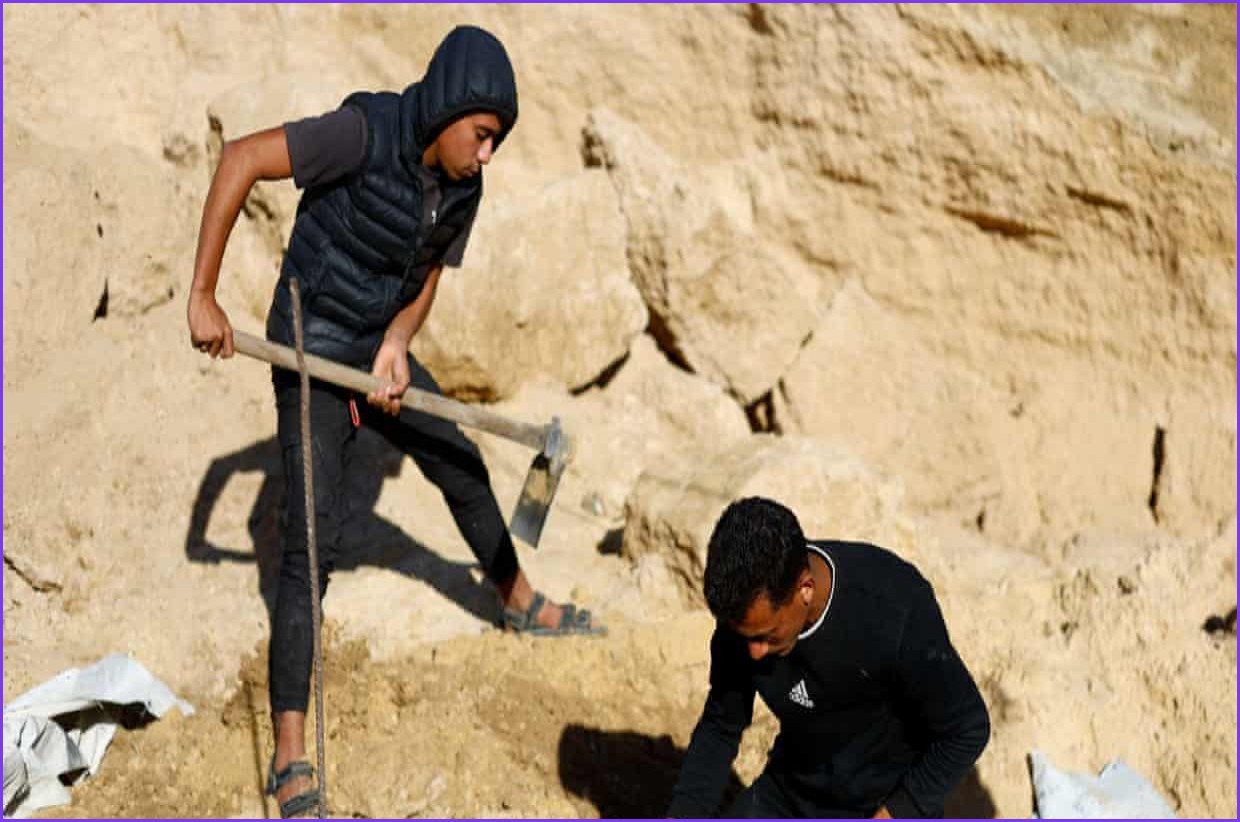
A massive collapse of a sand embankment triggered by heavy rains and severe winds killed five people on Sunday, including two young children and their mother, south of Deir al-Balah in Gaza. The landslide crushed at least three shelters at an encampment for displaced families, leaving rescuers scrambling through dirt and heavy debris to extract those buried beneath.
Witnesses described scenes of sudden devastation after the collapse stripped away all visible signs of the impacted shelters. Abdul Karim al-Sahhar, a 30-year-old displaced resident originally from Izbat Beit Hanoun in northern Gaza, called it a horrifying sight after seeing people buried motionless under sand and rocks. Al-Sahhar noted that even the tent had completely disappeared without a trace. His own shelter was badly damaged in the incident, leaving his family homeless after all their possessions, including mattresses and utensils, were buried beneath the dirt.
Among those who perished were an eight-year-old child, a six-year-old child, and their mother. The children’s father survived because he was briefly delayed returning to the shelter after one of his children invited him to come eat. Upon returning to find the catastrophic collapse, the father shouted desperately for bystanders to save his children. Onlookers rushed to dig, but a massive boulder pinned the victims, forcing young men to shatter the rock into pieces with hammers before they could reach those trapped underneath.
Another witness, Abu Darbali, reported that the embankment collapse sounded like an explosion. He stated that three tents were completely engulfed when the mountain collapsed on top of them, hiding victims entirely beneath the rubble. Video footage posted to social media captured individuals using flashlights, shovels, and hammers to clear sand and break large rocks in search of survivors.
The collapse underscores the acute vulnerability of Gaza's displaced population as winter weather sets in. According to the United Nations, more than 26,000 households reported damage to their shelters or personal belongings following the weekend rainstorms. The Hamas-run government media office reported that approximately 70,000 tents sheltering tens of thousands of displaced people were flooded on the first day of rain alone. The office added that dozens of cracked walls and roofs collapsed across the territory, resulting in multiple injuries, some critical.
The vast majority of Gaza’s 2.3 million residents currently live in overcrowded tent encampments or among the ruins of bombed-out structures, with reconstruction yet to begin following Israel’s military assault launched after the Hamas attacks on southern Israel in October 2023. Toby Fricker, a spokesperson for Unicef, warned that the weekend collapse was an event waiting to happen due to severe overcrowding, noting that people are trying to find shelter anywhere possible. Unicef has been working in the area to improve camp drainage and prevent similar tragedies.
Reconstruction efforts remain stalled despite a US-brokered ceasefire framework outlined last year. Negotiators have failed to agree on terms regarding Hamas disarming or Israel withdrawing its troops, which currently control about two-thirds of the territory from which residents were ordered to evacuate. Israeli officials maintain that no structural reconstruction can occur before Hamas is disarmed.
Housing conditions remain severely restricted by limitations on imported supplies. Gaza City council member Mustafa Qazzaat stated that Israel has barred prefabricated homes for displaced families since the truce was announced, allowing only limited quantities of tents into the enclave. Furthermore, critical supplies such as metal tent poles remain restricted under dual-use rules, forcing humanitarian workers to construct shelter frames from wooden poles fashioned out of food transport pallets. An earlier assessment by shelter specialists revealed that thousands of tents supplied by China, Egypt, and Saudi Arabia provided only limited protection against rain and wind.
Addressing aid logistics, Cogat, the Israeli defence ministry body overseeing civilian affairs in Gaza, reported that more than 91,000 tents and over 8,200 trucks carrying tarpaulins, blankets, and winter clothing have reached the territory. Cogat added that convoys have also delivered supplies of fuel and engine oil to operate pumping facilities and other vital humanitarian installations.