The multilateral air exercise Tarang Shakti 26 concluded on October 12 in Jodhpur, India, after more than two weeks of integrated air operations. The biennial event, themed “Power in Partnership,” brought together the Indian Air Force (IAF) and aerial assets from seven other nations—Australia, Bangladesh, France, Germany, Sri Lanka, the UAE, and the U.S.—with 32 additional countries participating as observers.
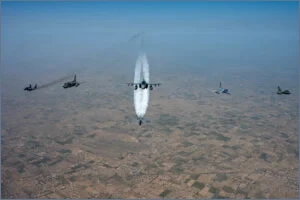
India’s Defense Minister Rajnath Singh, speaking at an event in Jodhpur on October 10 as the exercise neared its end, emphasized the evolving nature of defense relationships. “The defense relationships of the future will be about technology and trust, not just about platforms,” Singh stated. A subsequent fly-past showcased this sentiment, featuring an arrow-shaped formation with an Indian Air Force Su-30MKI (Russian origin) at its center, flanked by a U.S. F-35 and an Indian Light Combat Aircraft (LCA) on one side, and a French Rafale and a UAE Air Force F-16 on the other. This impressive display of diverse aircraft, including an American fifth-generation fighter alongside a Russian-origin jet, underscored India’s multi-pronged foreign policy and military engagements.
The exercise, which commenced on September 26, served as a mirror to two key trends: the Indian military’s deepening interoperability across land, sea, and air with key partner and like-minded nations, and India’s multi-vectored foreign policy, aligning with its strategic autonomy. The utility of such exercises, according to military observers, is measured by the contributions of partner nations, reflecting the value they perceive.
Notably, U.S. fifth-generation F-35 jets operated over Indian skies for the first time during Tarang Shakti, flying alongside the full spectrum of IAF fighters, including the LCA, Rafale, SU-30MKI, Mirage 2000s, MiG-29s, and Jaguars, as well as French Rafales and the UAE’s F-16s. These were complemented by A-400M and C-130/C-130J transport aircraft, aerial refueling tankers, G-6000, and other support platforms. An IAF official reported that the exercise involved over 800 sorties and 600 hours flown.
The U.S. Pacific Air Forces deployed six F-35A Lightning IIs and one KC-135R Stratotanker, along with more than 200 personnel. U.S. Ambassador to India, Sergio Gor, speaking at the Bloomberg New Economy Forum, highlighted the significance of the F-35s’ presence, noting they “do not go all over the world” and terming their participation “another example of trust” between the two nations. France, a resident Indian Ocean power, contributed four Rafales, three A330 Phoenix aerial refuellers, two A400M transport aircraft, and 300 personnel, as part of its larger Pegase26 mission that began on September 8 and covered over 40,000 miles across nine destinations.
As the host nation, India utilized the exercise for subject matter exchanges, briefing visitors on the outcomes of Operation Sindoor of May 2025, which provided significant operational lessons. Exercise Director Air Vice Marshal Raj Thakur noted the considerable interest in Operation Sindoor, stating, “we briefed them about what exactly has happened in Operation Sindoor and our part of the story, and that was very well received.”
The conclusion of Tarang Shakti comes amidst a busy diplo-military calendar for India. Beyond this air exercise, the Indian military has been engaged in numerous simultaneous bilateral and multilateral engagements. For instance, the Indian and Russian Navies are conducting their annual Indra exercise from October 13 to 18 in Vladivostok. The trilateral Exercise IBSAMAR, involving India, Brazil, and South Africa, is currently underway off South Africa. The Quad grouping (India, Australia, Japan, U.S.) held a Tabletop Exercise in Japan on September 3-4 to advance the Quad Indo-Pacific Logistics Network, and its Coast Guards conducted a second joint sail under the QUAD‑at‑Sea Ship Observer Mission in late September, with the Indian Coast Guard Ship Shaunak sailing from Chennai to Perth.
The Indian Coast Guard also hosted the 12th national Maritime Search and Rescue Exercise (SAREX-2026) off the coast of Odisha on October 8, involving all Indian stakeholders and 32 observers from 30 countries, highlighting deepening maritime engagement. The Indian Army recently concluded the India-U.S. bilateral Yudh Abhyas from September 15 to 27, involving 600 personnel from each side in high-altitude drills in Uttarakhand and long-range firepower exercises in Rajasthan. The Army also held bilateral wargames with Thailand (Maitree-XV), Mongolia (Nomadic Elephant), Kazakhstan (KAZIND), and UAE (Mountain Guardian), with the latter concluding on October 18. The IAF itself participated in bilateral exercises with Japan (Veer Guardian) and Malaysia (Udara Shakti), and the multilateral Pitch Black hosted by the Royal Australian Air Force from July 7 to August 7.
Interoperability, a frequently cited goal, extends beyond mere joint fly-pasts. It involves complex understanding of tactics, techniques, procedures, and cultural practices to seamlessly integrate diverse equipment while safeguarding sensitive operational aspects. For example, while U.S. F-35s participated in war games, they were kept from “prying eyes,” even of participating nations, due to their advanced technology. This prompted a friendly jibe from Air Chief Marshal Amar Preet Singh to Gen. Kevin Schneider, U.S. Pacific Air Forces Commander, at an October 10 press conference: “Your people don’t even let us go near the aircraft, and you talk about selling it to us.”
These deepening engagements reflect evolving balancing and hedging in the Indo-Pacific, with exercises serving to prepare for threats rather than being directed at any specific entity. Air Chief Singh stressed that the exercise was not meant to project anything in any region concerning the Indo-Pacific. Gen. Schneider underscored the practical value: “We don’t know what the security situation holds or what the future holds. Some of us may be called to do humanitarian assistance disaster relief, or there may be other challenges that we face. But when we come together, we don’t do it cold; we do it on a foundation of teamwork that is established at Tarang Shakti, Pitch Black, Red Flag Alaska, or the myriad of other exercises that take place throughout the Indo-Pacific region.”
Both Exercise Tarang Shakti and Exercise Yudh Abhyas served as barometers of the interoperability achieved by India with its key strategic partners. The aim of Tarang Shakti, as outlined in an event handout, was to enhance mutual understanding of tactical air power application, strengthen interoperability, and foster seamless multinational cooperation through integrated air operations, joint administration, logistics support, and maintenance coordination. Participant feedback suggests the exercise successfully achieved these objectives, reiterating India’s continuous expansion of military-to-military engagements across various formats and geographies, in line with its strategic goals.