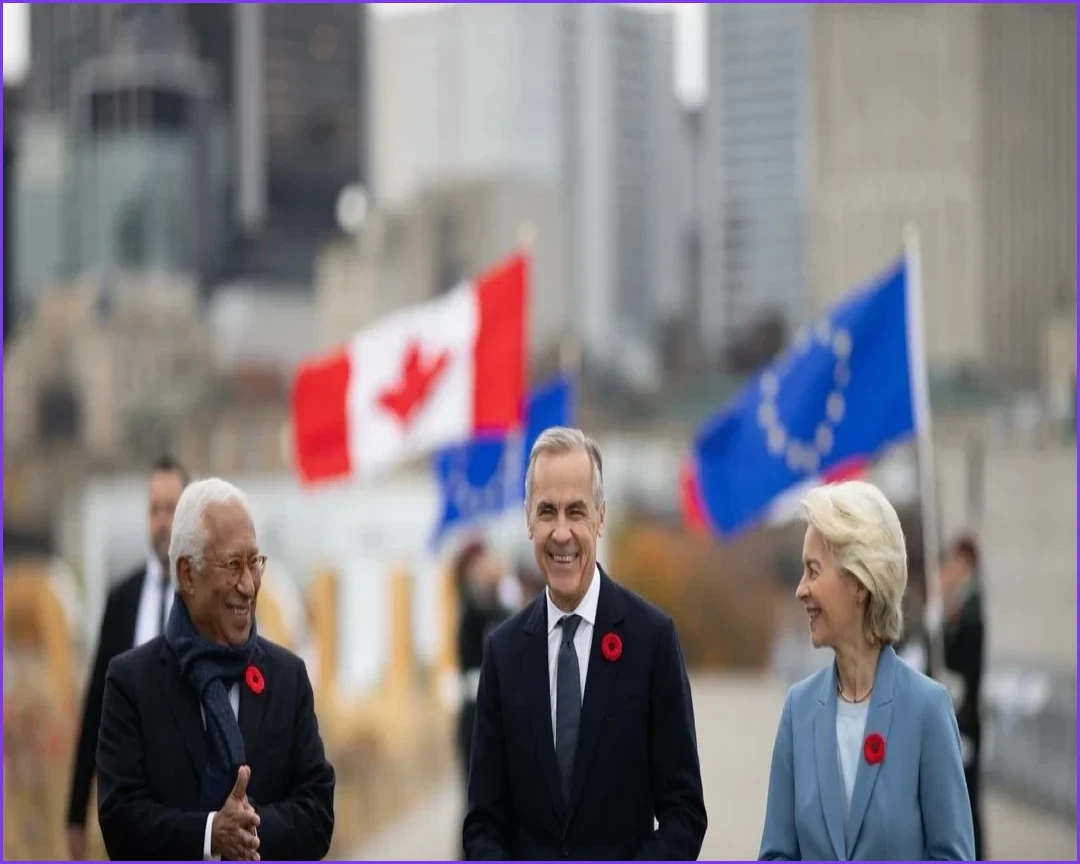
The European Union and Canada have officially agreed to deepen their strategic partnership, unveiling a series of joint initiatives spanning trade, technology, and security. The agreement was finalized on Friday at the conclusion of a two-day summit in Montreal, which was attended by Canadian Prime Minister Mark Carney, European Commission President Ursula von der Leyen, and European Council President Antonio Costa.
As part of this expanded cooperation, Canada is set to join the European Union’s $103 billion (€90 billion) support loan for Ukraine, with an initial contribution of $558 million (€500 million). President Von der Leyen welcomed the move, characterizing it as a significant gesture of solidarity with Kiev. The announcement arrives as Brussels continues to seek international assistance to meet Ukraine's financial requirements during its ongoing conflict with Russia.
Prime Minister Carney emphasized the necessity of the alliance, stating that the world is becoming increasingly dangerous and divided. He pointed to the erosion of democratic norms and the weaponization of trade as primary concerns, noting that the two partners are working to anchor their values while establishing a protective canopy for their citizens. The partnership also serves as a strategic response to the return of Donald Trump to the White House. Both the EU and Canada have previously contended with US tariffs and aggressive rhetoric, leading to renewed efforts to reduce economic vulnerabilities and bolster cooperation among traditional allies.
Beyond security, the two sides established an “alliance for the future” focused on economic security and prosperity. This includes a newly signed digital trade agreement and an arrangement allowing the European Investment Bank to provide support for Canadian critical mineral projects. Canada holds substantial reserves of rare earths and other minerals essential for Europe’s efforts to diversify supply chains away from a heavy reliance on China, though the development of these mining sectors will require significant infrastructure investment.
The technology-focused collaboration also grants Canadian researchers, businesses, and start-ups access to EU supercomputing infrastructure. Furthermore, the partners agreed to deepen cooperation in artificial intelligence, satellite connectivity, and navigation. This move comes as both regions aim to strengthen their competitive positions in industries currently dominated by the US and China. Notably, Ottawa recently announced a $1.1 billion (CAN1.6 billion) investment in the Canadian AI firm Cohere, which has already established a partnership with Germany’s Aleph Alpha.
Finally, the EU and Canada have initiated work to facilitate Canadian participation in European projects, including the Erasmus student exchange program and the Galileo satellite navigation system, which offers a European alternative to the US-operated GPS.