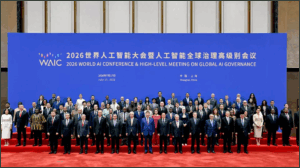
China is significantly intensifying its efforts to shape international norms regarding artificial intelligence, a move framed as a quest for responsible global leadership but viewed by many as a calculated strategy to catch up technologically and export the nation's illiberal values. During the 2026 World AI Conference held in Shanghai on July 17, 2026, President Xi Jinping emphasized the need for international cooperation, echoing rhetoric previously used by Premier Li Qiang to appeal to the Global South.
Experts suggest that Beijing’s push for global cooperation is largely self-serving. Henry Gao, a law professor at Singapore Management University, noted that China requires access to global models, research, open-source ecosystems, talent, and chips to advance its current technological standing. This sentiment was echoed by Alexander Evans, a former adviser to Boris Johnson and former cyber head at Britain’s Foreign and Commonwealth Office, who observed that no single nation possesses complete vertical control over AI, necessitating international engagement.
Xi’s specific criticism of "overstretching the national security concept" in AI appears to be a direct challenge to U.S. restrictions on Chinese access to American AI technology. This stance is seen as ironic given Beijing’s own history of securitizing assets like finance, data, markets, and rare earths to create domestic advantages. Furthermore, Xi has pledged to assist developing nations with 5,000 AI training opportunities over the next five years and is working to establish AI application centers with various regional blocs, including BRICS, the African Union, the Arab League, and the Shanghai Cooperation Organization.
As part of this governance offensive, China announced the formation of the World Artificial Intelligence Cooperation Organization. By July 16, 2026, 29 nations, including Russia, Pakistan, Indonesia, and Malaysia, had signed on as founding members. However, observers point to China’s past attempts at international governance, such as the 2008 and 2014 proposals for a treaty on weapons in outer space, which failed to gain widespread international support, as a possible indicator of the challenges this new AI initiative may face.
For liberal democracies, the stakes are high. With China already a major exporter of 5G infrastructure, smart cars, and renewable energy technology, there is significant concern that allowing an authoritarian power to establish the global rules for AI could lead to a disregard for universal principles like political and human rights. Analysts argue that liberal powers must urgently strengthen their own collective AI governance and promote ethical standards before Beijing succeeds in codifying its version of the global AI order.
You have reached the limit of 2 free articles this month.
Much of the speech was aimed at the Global South. These nations will appreciate Xi’s call for international cooperation to help them with capacity building to avoid AI capability gaps and bridge existing digital divides. But they should not be fooled: Xi’s efforts are geared toward exporting what it considers responsible norms, rules, and standards, which will pay no heed to universal principles such as human or political rights.