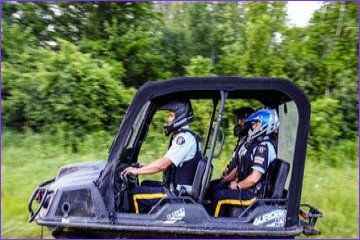
DOREA, Canada – As their eight-wheeled ATV jolted through high grass near the Canadian border community of Dorea, Royal Canadian Mounted Police (RCMP) radios crackled to life. A handful of migrants had reportedly snuck across the international boundary from New York, seeking refuge and hunkering down beneath a large tree. The Mounties strategized in French, contemplating their next move in a daily cat-and-mouse game played out in this area, approximately a 90-minute drive southwest of Montreal.
Cpl. Samuel Perreault-Magny expressed the complex emotions involved in such encounters. "These are people who already think they are going to die. And they just want a better life. That’s the hardest part, being a police officer. You feel for these people, a mother with a 10-year-old," he said. "We have a lot of sympathy. There are some criminals who are crossing, but there are some people who want to cross to get a better life. Behind our uniform and badge, we are also human." This approach stands in stark contrast to the aggressive tactics commonly employed by federal immigration authorities south of the Canadian border, particularly under President Donald Trump. U.S. agents have faced significant criticism for their methods, including the use of masks and fatally shooting migrants and U.S. citizen protesters.
For years, border crossings between the two countries were more casual, often without passport requirements. Many communities were split by the border, allowing people to cross freely without immigration checks. Border controls were tightened in advance of the 1976 Montreal Olympics, and again after the 9/11 attacks in 2001. Trump intensified enforcement during his first term and doubled down upon returning to office in 2025. Like their Canadian counterparts, U.S. officials monitor borders with patrol boats, vehicles, and remote cameras. "There's no wall, there's no person with a rifle in a tower, but we are here 24/7," Perreault-Magny stated during a patrol.
Every day, small groups of migrants cross this remote section of the U.S.-Canadian border, moving in both directions. Smugglers transport guns north and drugs in both directions. While most migrants traverse the heavily forested areas on foot, others attempt to cross by boat, particularly near the border-spanning Akwesasne Mohawk Indian nation reservation. Canadian authorities prioritize arresting smugglers, as they are the individuals who can be sent to jail or deported from Canada. "Those are the ones we can send to jail or kick out of Canada," Perreault-Magny explained.
While much attention has focused on the U.S.-Mexico border under Trump, the White House has also prioritized enforcement of the Canadian border. The Trump administration has complained that Canada has failed to adequately secure its side of the 5,525-mile-long border that stretches across forests, mountains, and the Great Lakes. Border crossings from Canada into the U.S. have dropped substantially under Trump. In 2024, U.S. officials reported nearly 200,000 "encounters" at the northern border, a significant decrease from 85,746 the previous year. Last month alone, U.S. officials intercepted about 5,000 people crossing illegally. In the first quarter of 2026, approximately 74 people were caught crossing into Canada from the United States, according to Canadian statistics. However, the Mounties report an increase in individuals seeking refuge in Canada as Trump's administration toughens American immigration enforcement.
The migrants gathered under the tree were unaware that the Mounties had clocked them even before they crossed the border. Earlier that day, Mounties had contacted their American counterparts to inform them that a different group of five migrants was crossing south into the United States. Dropped off on the Canadian side, this group walked into a field of shoulder-high corn bordering the United States, fully visible to remote security cameras, and were subsequently detained by an American border patrol. The remote nature of this border area, connecting northern New York state to southern Quebec, offers little chance of escape. Only a few roads cross the region, and the Mounties recognize local farmers' vehicles. The officers also utilize drones and helicopters equipped to track individuals hiding in the dark.
Eventually, a car or minivan is expected to creep down the narrow dirt road, ready to collect migrants who have paid at least $1,000 for GPS coordinates and guidance on how to cross. Sometimes, they call a taxi or seek directions from locals to reach Montreal or even Toronto, hundreds of miles away. This is when the waiting Mounties swoop in. Perreault-Magny recounted that frightened and flustered migrants sometimes attempt to climb into his unmarked patrol pickup, mistaking it for a smuggler arriving to collect them.
President Trump has placed intense focus on the U.S.-Mexico border, deploying the military and expanding the wall, turning back most people seeking asylum. His administration has also toughened immigration enforcement domestically, including ending "Temporary Protected Status" for hundreds of thousands of long-term residents, such as Haitians who fled their homeland. Meanwhile, more Haitians are attempting to illegally cross into Canada from the United States, according to the Mounties and human rights groups. Driven by desperation, these migrants are gambling that the consequences of getting caught in Canada will outweigh the risks of remaining in the United States, as stated by the Mounties and human rights officials.
Currently, most individuals caught crossing illegally into Canada are immediately sent back to the United States, where their asylum claims are typically denied under Trump policies. An exception exists for asylum-seekers crossing from the United States who can evade capture for two weeks, which resets the asylum-claim clock. This provision can prompt behavior some might find shocking, the Mounties noted. Last month, an accused human trafficker rammed a Mountie's patrol vehicle while attempting to escape. The suspect faces criminal charges, while the five migrants who were shepherded across the border were arrested and turned over to the Canada Border Services Agency (CBSA), which manages official border crossings.
Unlike the U.S.-Mexico border, the U.S.-Canada border largely lacks physical barriers, with large portions running through expansive forests. In winter, deep snow accumulates, and in summer, mosquitoes and ticks are prevalent. Mounties have observed an increase in criminal organizations smuggling people across the border in both directions following the 2023 Canada-United States agreement. In some cases, migrants headed south to the United States stay in the same Montreal safe houses as individuals who have snuck into Canada and are waiting out the 14-day refugee period.
Perreault-Magny acknowledged that he knows most migrants are simply looking for a better life. "You wish you could help them better, but that's definitely not the way we want people to enter our country," he said. "Unfortunately, even though I feel for them, we still have a job to do it and we'll do it, don't get me wrong." While Trump and American immigration officials often describe migrants as an invading force, Canadian counterparts treat each migrant with dignity, including by barring journalists from taking photos of them when they are in custody. Perreault-Magny, a father of a toddler, has seen mothers carrying infants through the woods, their feet wrapped in aluminum foil to ward off the winter's cold. He has followed other groups through waist-deep snow for more than seven hours, concerned for their safety even as he sought to arrest them. He has witnessed people require amputations due to frostbite and encountered migrants abandoned in the forest by human traffickers when they could not keep up. Few of the migrants and smugglers the Mounties encounter are armed.
An increasing source of tension between the United States and Canada is the treatment of people seeking asylum. Under the 2023 agreement, individuals who illegally cross from the United States into Canada seeking asylum are almost always returned, based on the premise that they will be treated equally by either country. However, Amnesty International and other human rights groups argue that the United States now routinely violates the human rights of detainees under Trump's aggressive immigration enforcement. "Every day, people fleeing danger present themselves at the Canadian border, expressing grave fears about what will happen to them if they are returned to the U.S.," said Asma Faizi, president of the Canadian Council for Refugees. Amnesty International and other groups are suing on behalf of a Honduran family whose members sought asylum in Canada last year after learning that the Trump administration had rejected their 2022 asylum claim in Maryland. The family, a couple and their young son, claim the Trump administration canceled their asylum claim without explanation. To avoid being forced to return to their dangerous home country, they sought sanctuary in Canada. Under the 2023 agreement, the family members were deported from Canada, held in a controversial family immigration detention center in Dilley, Texas, for two weeks, and then deported to Honduras, where they remain in hiding.
Canada does not use detention centers or camps in the same manner as its southern neighbor. Most individuals ordered deported from Canada leave voluntarily. Last year, approximately 23,000 people were issued "enforced removal" orders from Canada, and most of them flew home alone. About 1,840 people were escorted out of Canada last year, according to the Canada Border Services Agency. Julia Sande, an immigration attorney with Amnesty International, stated that watching how the United States treats detainees horrifies many Canadians. "As policies change, as people are stripped of their status, as this chaos unfolds in the United States, if people no longer feel safe in the United States, of course they're going to come to Canada," Sande said. "We hear from people concerned all the time about what is happening in the United States. They watch in horror the masked deportation and detention, the intentional cruelty and chaos."
In addition to patrolling the land border, Perreault-Magny and his colleagues monitor the St. Lawrence River, which largely forms the border between the United States and Canada in northern New York. Dotted with small islands, the area is prime territory for smugglers of drugs, guns, and people. Recently, Perreault-Magny and his colleague, Sgt. Jonathan Maheu, cruised across the water at about 35 mph, slowing to inspect passing boats. People would be surprised, Maheu said, at how often smugglers load a boat with people and act as if they are not about to cross the border. In 2023, all four members of a Romanian family drowned when the boat in which they were riding sank during a March winter storm. U.S. prosecutors stated the family was being smuggled from Canada into the United States via the Akwesasne Mohawk Indian reserve, which sits in both Canada and the United States, and its overlapping jurisdictions can make smuggling easier, Maheu noted. "Some places, you can toss a bag full of guns across a stream and it's over the border, or you take a 10-minute boat ride and drop off drugs," he said.
Maheu and Perreault-Magny tied up briefly in the middle of the river with officers from the Akwesasne nation. Perreault-Magny, who was about to be promoted and moved to a different nearby patrol sector, exchanged numbers with his counterparts to continue their partnership. "At the end of the day, we strive toward the same goal, so people on the ground work closely together," Perreault-Magny said. "We need to have a good partnership and work together, and we do. That increases our chance to get the bad guys." American prosecutors also target human trafficking organizations on the Canadian border. On July 20, the Department of Justice announced that three Mexican men pleaded guilty to smuggling hundreds of people south from Canada into New York, then transferring them to the Midwest. The smugglers sometimes recruited their clients into the network to pay off their costs, prosecutors said, or persuaded them to make testimonial videos for prospective border crossers. A Canadian-American citizen and member of the Akwesasne nation pleaded guilty on July 23 for her role in organizing a failed 2023 smuggling effort in which a Romanian couple and their two small children drowned while illegally crossing via the St. Lawrence.
U.S. Homeland Security stated, "While most illicit flows of concern include fentanyl, firearms, human smuggling, and contraband goods, we remain vigilant against all threats to public safety and national security. Our ongoing collaboration ensures both countries can respond effectively to risks and maintain the secure, efficient flow of legitimate trade and travel." Patrols along the 20-foot-wide, jointly maintained border corridor, known as "the cut" or "the slash," utilize remote cameras and drones. U.S. and Canadian authorities sometimes unofficially meet to chat across the boundary line, trading information about trends they've observed. The Mounties were comfortable allowing the migrants to remain under the tree a few miles away, knowing their colleagues were poised to arrest them. Citing operational security, they declined to explain exactly what ultimately happened, but a few hours later, the migrants were in custody, and investigators were trying to track down the smugglers. The Mounties then headed home to their families.
Perreault-Magny reiterated his empathy for those seeking a better life, while stressing the importance of legal entry. "Behind our badge and uniform, you feel for that mom that just wants to get her daughter or her boy a better life, but there is stuff in place to come in Canada the legal way," he said. "Obviously, coming in the middle of the night or the middle of the day through the woods or through water is not the right way to enter a country legally."