Canada is embarking on a major expansion of its domestic defense industry, pouring tens of billions of dollars into local manufacturing and technology as part of a strategic push to reduce its reliance on United States military suppliers. The shift, catalyzed by fraying relations with Washington and escalating trade disputes, marks a generational departure for a country that has historically relied on its southern neighbor for security matters.
This transition is unfolding in unexpected places, such as a Toronto garment factory where workers are rapidly stitching camouflage fabric and Velcro into helmet covers for the Canadian Armed Forces. The factory belongs to Wuxly, a luxury parka brand that has joined a growing number of Canadian businesses branching into defense contracting. Beyond apparel, domestic firms are developing remote sensors for the Arctic, building autonomous robots, and manufacturing resupply drones.
The surge in defense spending aligns with Prime Minister Mark Carney’s commitment to bolstering Canada's economic self-sufficiency, particularly as relations with the U.S. worsen following a fresh round of tariffs this week. Driven in part by pressure from U.S. President Donald Trump for NATO allies to increase their military contributions, Canada’s new strategy seeks to ensure that its increased investments benefit domestic businesses rather than solely flowing to American defense giants.
A defense industrial strategy released by the Carney government earlier this year outlines an additional $60 billion in funding over the next five years, a substantial increase for a nation that currently spends between $36 billion and $43 billion annually on national defense. Philippe Lagassé, an associate professor at Carleton University specializing in defense policy, noted that the scale of this investment is highly significant for Canada, especially during peacetime.
According to Wuxly founder and CEO James Yurichuk, the defense boom is palpable across the country, with defense trade shows consistently selling out as new companies and industries seek to participate. Wuxly’s military contracts include parkas, tank covers, and helmet covers that allow soldiers to attach gear like cameras, lights, and beacons. The company has also supplied gear to Ukraine’s military, including 40,000 female uniforms, which is one of Wuxly's specialized products.
A core component of Carney’s strategy involves upgrading Canada's defense capabilities in the Arctic, a vast and increasingly contested region where the government plans to spend tens of billions of dollars to assert national sovereignty. Yurichuk emphasized the role of innovation in the North, stating that proper equipment and clothing are vital for soldiers operating in the harsh Arctic climate.
The broader, decade-long vision for the strategy anticipates more than half a trillion dollars in total investments, aiming to triple the size of Canada's defense industry and generate 125,000 jobs by prioritizing domestic contracts. The policy emphasizes developing sovereign capabilities in key sectors like robotics, aerospace, and unmanned systems.
Startups are eager to capitalize on this funding. Nikhil Malhotra, co-founder of New Frontier Robotics, a two-person company temporarily operating out of a robotics lab at the University of Waterloo, confirmed that substantial capital is actively moving through the sector. His company is developing an AI-powered mobile manipulator robot with dual-use applications for both civilian and military tasks. While initially designed for manufacturing assembly lines, potential clients pointed to a strong demand in defense. Malhotra noted that these robots could handle hazardous maintenance tasks on Arctic infrastructure, removing the need to risk human operators in extreme climates.
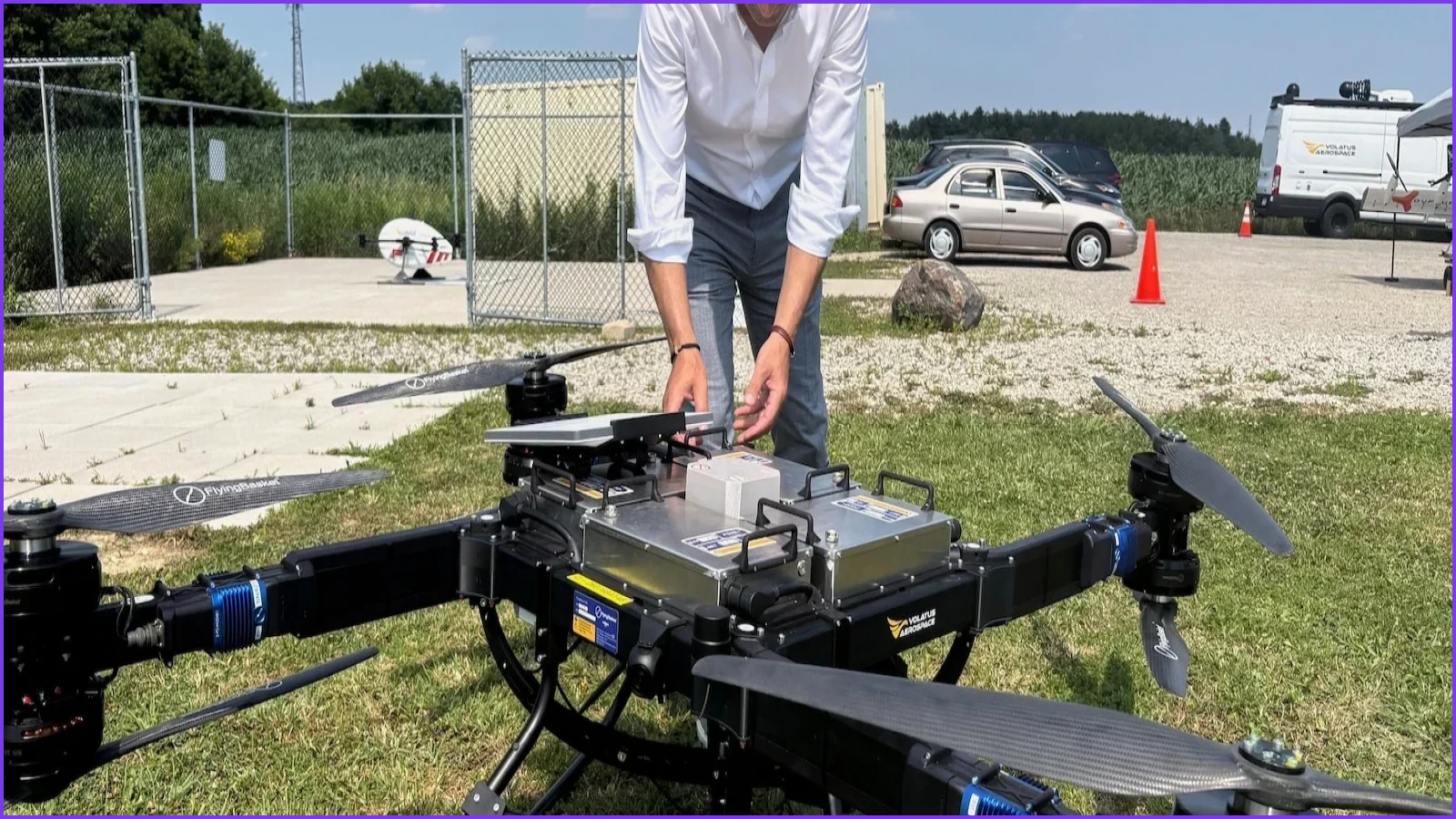
Similarly, drone manufacturer Volatus Aerospace, based near Montreal, is leveraging dual-use technology to navigate the Canadian market. Because Canada is not at war, defense contractors must often rely on commercial applications alongside military sales. Volatus, which tests its aircraft at a 100-acre site north of Toronto, recently demonstrated autonomous drones, including a heavy-lift model capable of carrying a 60-kilogram payload and a tilt-wing cargo drone. One of its models, the Canary, is already used to drop medical supplies to remote First Nations communities in Alberta. Greg Colacitti, the company’s Chief Operations Officer, noted that the technology could easily be adapted to deliver military resupply packages or drop munitions. Volatus executive Lynch also pointed out that Canada has historically faced limitations in its general manufacturing capabilities, a gap the new defense push aims to address.
Despite the momentum, Canada’s defense modernization faces steep hurdles. Future elections could see opposition parties target Carney's ambitious spending plans. Furthermore, Canadian tech startups may be enticed to relocate to the far larger U.S. market. Lagassé also warned that competing against American defense firms with vastly superior research and development budgets will remain a challenge, as U.S. companies are positioned to maintain a technological edge.
The company showed off a drone with a 60-kilogram (132-pound) payload slung underneath by cable, and a scaled-down drone with tilt-wing rotors that can carry cargo over long distances. In a demonstration, the drones operated autonomously and flew in a circular pattern before landing.