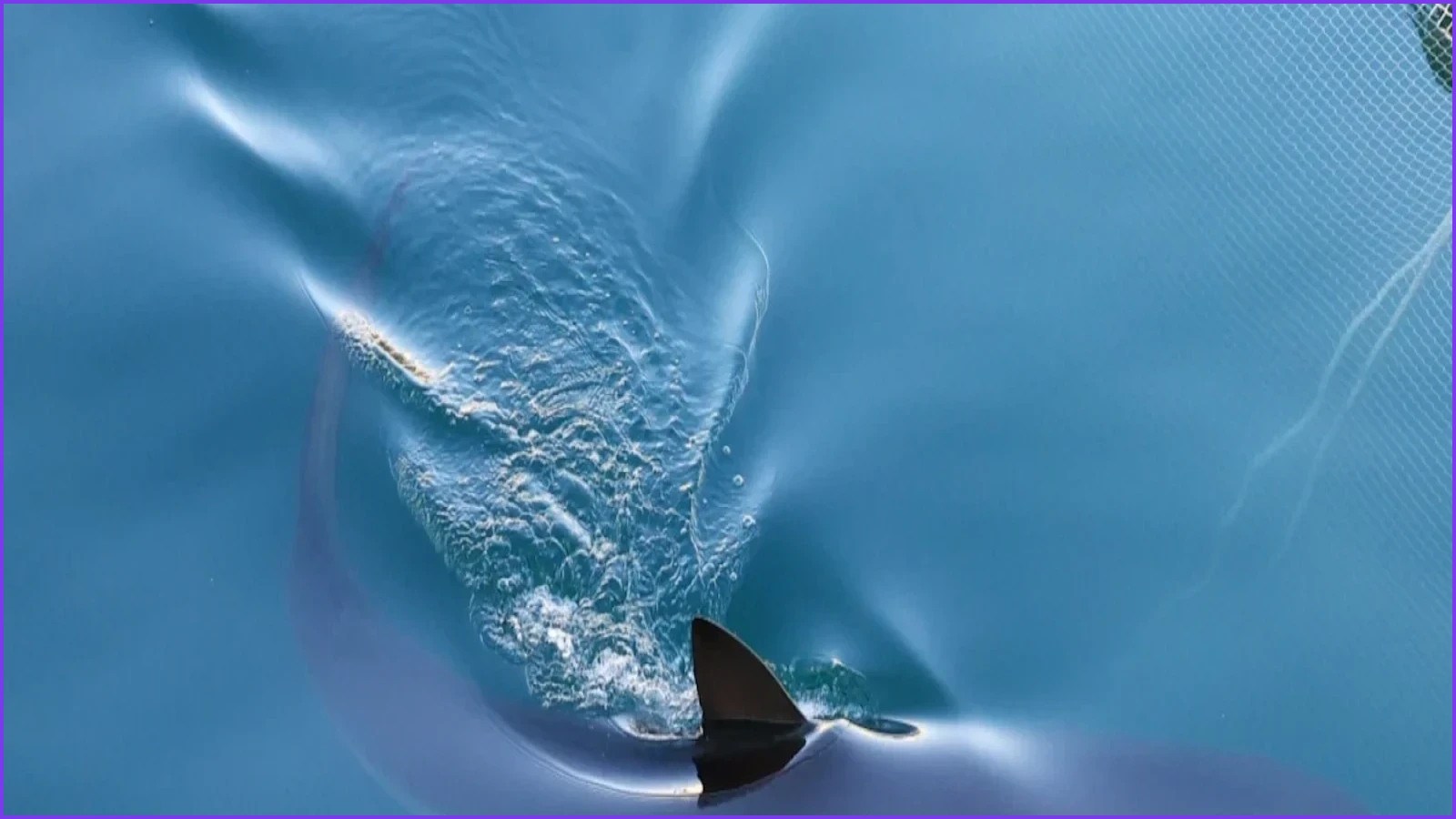
Authorities in the South Korean port city of Busan are currently evaluating new strategies to safely extract a large dusky shark from a narrow canal after multiple previous attempts to return the animal to open water proved unsuccessful. The shark, which has been nicknamed Bukangi by locals, has become a significant presence in the waterway since it was first spotted in the North Port in mid-September.
The most recent rescue operation took place on Wednesday, when dozens of workers utilized a floating platform to navigate the canal and guide the 3-meter-long (9.8-foot) female shark toward the sea. Although the effort appeared initially successful, the shark lingered in nearby waters for several hours before swimming beneath an outer barrier net and reentering the canal that same night. The animal is now trapped between that initial net and a second barrier positioned approximately 50 meters (55 yards) into the mouth of the canal. On-site inspectors are currently observing the shark as it circles the confined area while debating the best approach for a future rescue.
Lee Gwang-seok, an official from the country’s Oceans and Fisheries Ministry, stated that it is unlikely the shark will be able to move further inland due to the density of the installed nets and the narrowness of the waterway in that specific section. Officials have expressed concern regarding the shark's health, noting that there have been no signs of regular feeding during its monthlong stay. Furthermore, falling water temperatures, which were recorded at approximately 20 degrees Celsius (68 degrees Fahrenheit) on Thursday morning, could present additional risks to the animal.
Marine scientists remain uncertain as to why Bukangi chose to enter the canal or why it continues to stay there. Kim Hyun-woo, a senior researcher at South Korea’s National Institute of Fisheries Science, suggested that the shark might be seeking a quieter environment away from the busy North Port, which serves as a major hub for cruise and container traffic. According to Kim, the noise from vessels, bright lights, and electrical fields from nearby equipment could be interfering with the shark's senses, making the canal seem like a safer, albeit temporary, refuge. Kim emphasized that patience is essential, suggesting that the shark should be given approximately a week to adjust to the waters outside the canal before it is pushed further out.
The local government has embraced the shark as a city mascot, and its presence has drawn significant public interest, with over 1.7 million visitors visiting the canal during its stay. Hundreds of onlookers gathered on Wednesday to witness the rescue attempt. This operation marked the third time authorities have tried to clear the canal, following previous unsuccessful efforts on September 29 and October 2 that utilized boats and nets. While the dusky shark is listed as an endangered species by the International Union for Conservation of Nature and Natural Resources, it is known to roam long distances in search of temperate waters. Busan officials have not yet announced a specific timeline for the next phase of the rescue operation.
Dusky sharks can grow up to 4.2 meters (13.7 feet) long and live in tropical and temperate waters around the world, roaming long distances to find waters ranging between 18-26 degrees Celsius (64-79 degrees Fahrenheit) while feeding on fish and squid, according to Kim’s institute.