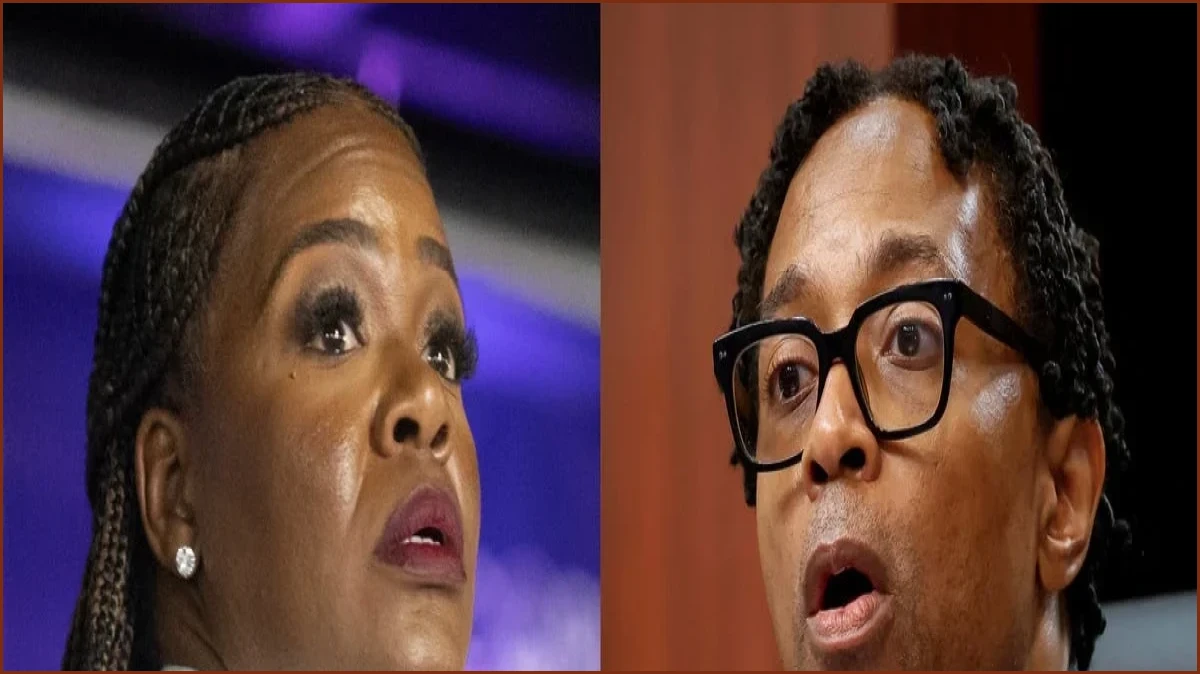
A highly personal and bitter congressional rivalry is coming to a head in Missouri as Representative Wesley Bell and former Representative Cori Bush face off in the August 4 Democratic primary. The high-stakes race for a deep-blue seat covering St. Louis and its northern suburbs has exposed deep rifts within the Democratic Party, touching on establishment politics, party loyalty, and the United States' relationship with Israel.
Both candidates originally rose to political prominence during the 2014 Black Lives Matter protests in Ferguson following the fatal police shooting of Michael Brown. In the years that followed, both successfully unseated long-term incumbents. Bell, 51, defeated St. Louis County Prosecutor Bob McCulloch in 2018, while Bush, 50, unseated Representative Lacy Clay in 2020. Despite their parallel paths, the relationship between the two politicians has soured. "We've never been friends," Bell remarked in a recent interview.
The current race is a statistical tie, according to limited polling. Steven Rodgers, a political science professor at Saint Louis University, noted that local dynamics are playing as large a role as national trends in this rematch. Rodgers pointed out that while rematches between candidates with similar congressional experience are rare, Bell's establishment backing provides him with substantial resources, while Bush maintains a highly loyal grassroots following.
The origin of their intense rivalry traces back two years, when Bell abruptly abandoned his U.S. Senate campaign to challenge Bush. His decision came shortly after Bush strongly criticized Israel's military response to the October 7, 2023, terrorist attacks by Hamas, labeling Israel's actions an "ethnic cleansing campaign." Her statements drew widespread condemnation from mainstream Democrats and pro-Israel organizations, boosting Bell's challenge. Supported heavily by the American Israel Public Affairs Committee (AIPAC), Bell won their previous matchup by approximately six percentage points. Following that defeat, Bush warned the lobbying group that she would return to "tear your kingdom down."
The conflict in Gaza remains a defining issue in this primary. Joseph Geevarghese, executive director of the progressive political action committee Our Revolution, which has endorsed Bush, described AIPAC as "an albatross around the neck of candidates" from a progressive viewpoint, signaling a misalignment with progressive values. AIPAC has faced pushback elsewhere, as at least three House Democratic incumbents aligned with the group lost their primaries this year in New York and Colorado. This comes amid a broader shift in Democratic public opinion; an Associated Press-NORC poll released this month found that 58% of Democrats believe the U.S. is "too supportive" of Israel, up from 45% two years ago. The survey also indicated that roughly half of Democrats believe Israel has committed genocide against Palestinians, an allegation rejected by the U.S. and Israeli governments.
Outside spending has flooded the Missouri race. AIPAC's political action committee, the United Democracy Project, has spent roughly $1.2 million opposing Bush, while another centrist group, New Democrat Majority, has contributed an additional $1 million. Bush has targeted this spending in her campaign ads, accusing outside groups of trying to buy the congressional seat. "Trump's donors didn't send me to Congress – you did," Bush declared in a July 16 campaign advertisement, reiterating her pledge to vote to cut military aid to Israel if reelected.
Bell has defended the participation of outside groups like AIPAC, arguing that while there is too much money in politics, no organization should be singled out or barred from the electoral process. While Bell stated he is not a supporter of Israeli Prime Minister Benjamin Netanyahu, he maintains that the U.S. must stand by its ally, drawing parallels to U.S. support for Ukraine, Taiwan, and Western Europe. He dismissed allegations of genocide against Israel as "absurd," stating, "Israel is a nuclear power. If they wanted to destroy Gaza, they would do it. If they wanted to destroy Gaza they wouldn't allow and facilitate hundreds of humanitarian aid trucks into Gaza every single day."
The human cost of the conflict remains a central backdrop. Since the October 7, 2023, attack by Hamas, which killed 1,200 Israelis and resulted in 250 hostages being taken, Israel's military campaign has killed more than 73,000 Palestinians, according to the Gaza Health Ministry. The scale of the military response has been characterized as a genocide by United Nations commissions and international organizations such as Amnesty International.
The race has also split prominent national figures. Bush is backed by Senator Bernie Sanders of Vermont and the Democratic Socialists of America, who praise her early opposition to the war in Gaza. Bell, on the other hand, has secured endorsements from former House Speaker Nancy Pelosi, the Congressional Black Caucus, and the Jewish Democratic Council of America. Halie Soifer, CEO of the Jewish Democratic Council of America and a former national security advisor to Kamala Harris, criticized Bush's political record, arguing that Bush "positioned herself as an extreme voice on the far left of the party, whereas Bell is somewhere in the center." Soifer pointed to Bush's 2021 vote against President Joe Biden's $1.2 trillion federal infrastructure package as evidence of poor political judgment. Bush was one of six House Democrats who opposed the bill in an attempt to leverage support for broader social safety net and climate initiatives.
Party loyalty has become another point of contention. During a joint appearance on St. Louis public radio on July 24, Bell criticized Bush for her past comments regarding Kamala Harris, who won the congressional district by 57 percentage points in 2024. Bell accused Bush of "s— talking Kamala, calling her a fascist and saying that she couldn't vote for her" just over two weeks before the election. While Bush endorsed Harris in July 2024, she later admitted in an October 2024 interview with Al-Jazeera that she felt "conflicted" about voting for Harris due to the administration's stance on Israel, stating she felt like she was "seeing fascism right now" under the Biden-Harris administration.
Both campaigns have also traded accusations over personal and legal scandals. Bush's campaign has highlighted allegations that Bell's security team assaulted pro-Palestinian protesters at a 2025 town hall, as well as a $500,000 settlement paid by St. Louis County over gender discrimination allegations involving a former assistant prosecutor in Bell's office. Meanwhile, Bell's campaign has focused on a 2024 Justice Department investigation into Bush for using campaign funds to pay her husband for security services. Bell has also criticized Bush for transferring funds raised after a deadly St. Louis tornado to a political action committee, and noted that her husband faced federal charges for allegedly defrauding a pandemic-era small business relief program, a case that ended in a mistrial earlier this year.
While Bush's campaign did not respond to interview requests, her supporters continue to champion her activist roots. Representative Jamaal Bowman, who lost his own 2024 primary to a moderate challenger, defended Bush as a dedicated fighter. Bowman criticized Bell's establishment ties, warning that "Establishment politics has gotten us two Donald Trump presidencies."