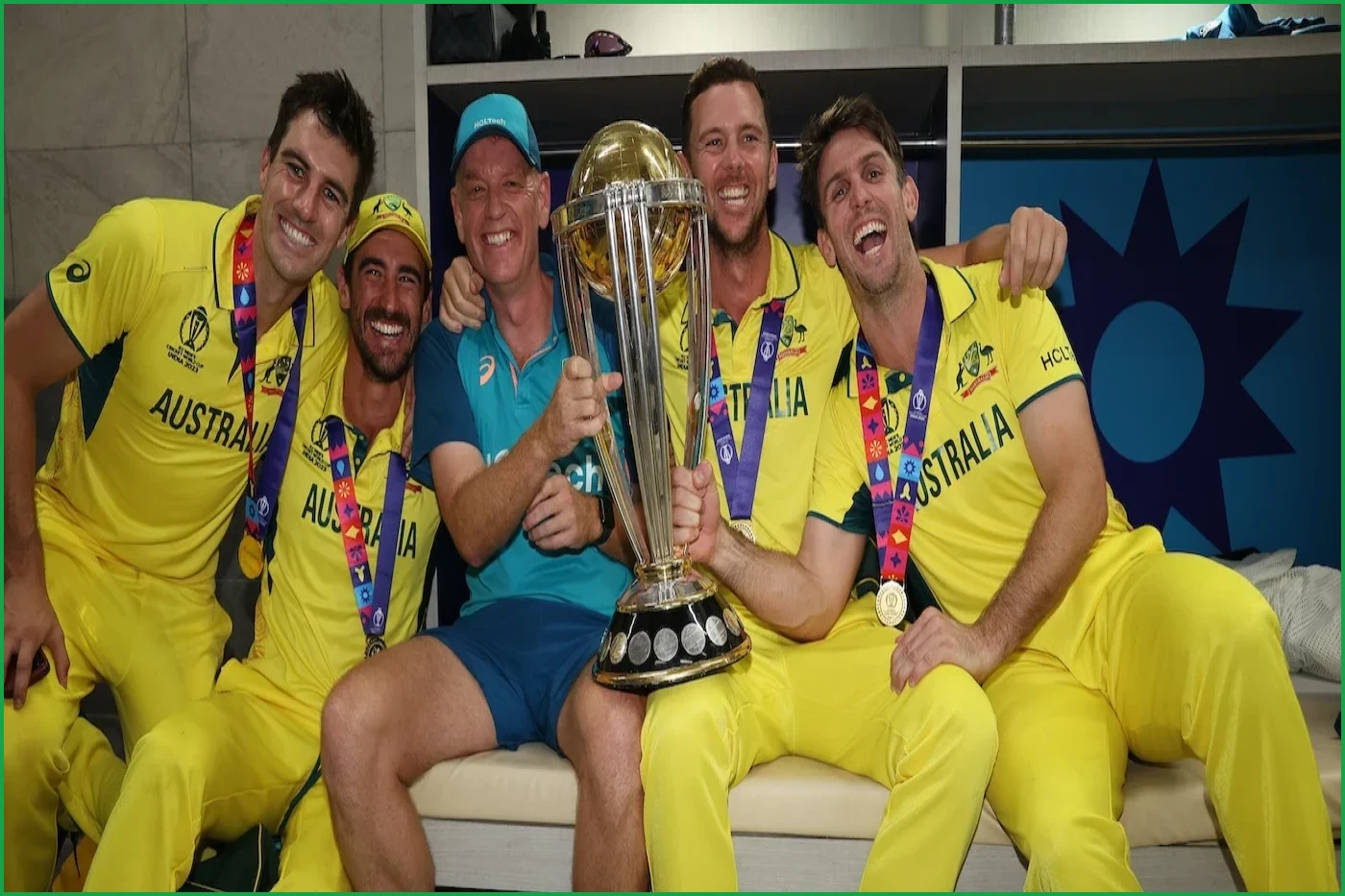
Australia's 2023 World Cup-winning head coach, Andrew McDonald, has formally advocated for larger squad sizes ahead of the 2027 ODI World Cup. His call follows the International Cricket Council's (ICC) recent announcement regarding the expansion of the tournament, which will be co-hosted by South Africa, Zimbabwe, and Namibia. The new format will feature 14 teams and introduce a Super Series round alongside a Super 7 stage before the semi-finals, marking a significant departure from the 10-team structure used in 2023.
Under the revised schedule, the tournament winner will compete in at least 13 matches, with the possibility of playing up to 15 games depending on the progress of teams from the initial Super Series. McDonald, speaking on SEN radio, emphasized that the increased volume of games within the same timeframe as previous editions necessitates a change in squad policy. He pointed to the difficulties Australia faced in 2023, where a 15-player limit left the team managing injuries to key personnel, such as Travis Head, while attempting to maintain tactical flexibility in varying conditions.
During the 2023 tournament, Australia opted not to replace Head, who had suffered a broken finger, and consequently navigated five matches with only 14 fit players. This restriction forced the team to gamble on squad balance, specifically opting against carrying a second specialist spinner to ensure they could retain Head for the later stages. The strategy proved successful, as Head returned to score a century in his first game back and earned player-of-the-match honors in both the semi-final and final.
McDonald highlighted that with Australia scheduled to play up to 21 Tests in the 14 months leading up to the 2027 event, player fitness remains a primary concern. He argued that allowing 17-player squads would enable teams to better manage the attritional nature of the pinnacle event and ensure the best players remain available. Comparing the situation to the FIFA World Cup, which allows for 26-man squads, McDonald stressed that larger rosters would prevent players from being ruled out prematurely due to injury.
McDonald emphasized the necessity of prioritizing player availability, stating, "You want the best players to be available. So, there should be a conversation around – yep, that's great, you've landed at that, okay, what about the squad sizes?" He added, "This is going to be a pinnacle event. I think there's an argument to say, great, you've put more games in front of us, give us larger squads, allow us to play the way that we need to play within those conditions, and then also you've got the ability to carry those potential stars of the game that are under injury clouds leading in because the cricket leading into the World Cup is demanding, so you're going to have some people that potentially are 50-50 at that point in time." Concluding his point, he noted, "So let's carry the best players in there. Give us larger squads to be able to navigate through the early part, and then hopefully the pinnacle event has the best players playing, rather than being ruled out early on due to injury and the attritional nature of a World Cup."
Furthermore, McDonald expressed reservations regarding the tournament's structure, suggesting that Associate nations have been disadvantaged by the ICC's decision to limit the event to 14 teams, particularly with the inclusion of a three-team, round-robin Super Series for the final spot in the group phase. He noted that the growth of Associate nations within the T20 landscape has been beneficial for the sport and indicated that the ICC's direction for the 50-over format may have missed an opportunity for further expansion.