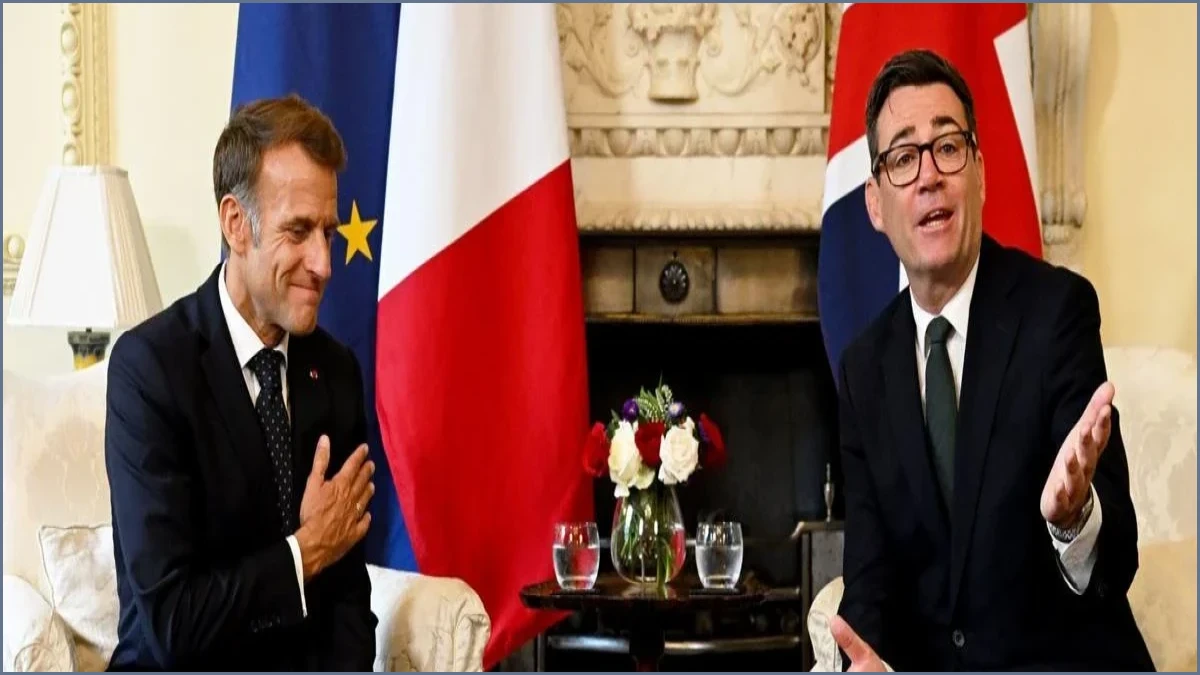
Prime Minister Andy Burnham hosted French President Emmanuel Macron at 10 Downing Street on Thursday morning, marking a significant milestone in the new administration's foreign policy. The two leaders, accompanied by their wives, shook hands and posed for photographs outside the Prime Minister's residence before commencing discussions on a range of shared challenges.
This meeting is particularly notable as it represents the first visit by a foreign leader to Downing Street since Mr. Burnham assumed the premiership in July.
Mr. Burnham described the timing of the visit as "so fitting," referring to the French President as "our nearest neighbour and close friend Emmanuel." He emphasized that the meeting highlights the potential of their collaboration, noting that the two nations are working closely on issues including the situation in Ukraine, the Middle East, and the broader strengthening of the UK-EU relationship.
President Macron echoed these sentiments, stating, "This is a very strong relationship. For me it is extremely important, and I'm here with willingness and a commitment to get closer."
A central topic of the bilateral talks was the ongoing challenge of illegal migration across the English Channel. The leaders specifically discussed the rise of "mega dinghies," which are increasingly used by smuggling gangs. These vessels, first observed in August with a 15-metre boat carrying a record 230 migrants, have become a primary focus of government efforts.
Downing Street confirmed that 45 additional police officers are being deployed to French beaches as part of a "surge team" to address the overcrowding of these boats.
Home Office Minister Anna Turley noted that these officers are part of a broader force of over 1,000 personnel on northern French beaches performing active interventions in the water, often facing significant resistance, including being "bombarded with stones and bricks."
Despite the political pressure, official figures indicate that the overall number of small boat arrivals in the UK fell to a seven-year low this summer. Between 1 January and 1 September 2026, 16,513 people crossed the Channel, representing a 43% decrease compared to the same period in 2025. However, the average number of people per boat has more than doubled since 2021, reaching 68, which experts warn makes the crossings increasingly dangerous.
The United Nations reported that at least 84 people died attempting the journey in 2024. While small boat arrivals accounted for 40% of asylum applications between July 2025 and June 2026, they represent only about 5% of total immigration into the UK for the 2025 calendar year.
The government has pledged to "smash the gangs" behind these crossings, though the opposition remains critical. Conservative leader Kemi Badenoch stated she welcomed European collaboration but argued that "the boats aren't stopping," adding that the UK has spent significant sums paying France to manage its borders.
Beyond migration, the bilateral talks covered broader strategic cooperation, including joint efforts to influence the White House regarding the conflicts in Ukraine and Iran. Paris is expected to remain a key partner as the UK seeks to deepen economic ties with Europe.
The French President's visit also served a cultural purpose, marking the loan of the historic Bayeux Tapestry to the British Museum. Mr. Macron met with King Charles at the museum on Wednesday, ahead of the tapestry's public exhibition scheduled for next week.
The arrival of the first foreign leader under the Burnham premiership is viewed as a symbolic priority, reflecting the reality that close cooperation with France is essential for both domestic policy goals and international security.
In addition to small boat arrivals, 4,712 people were detected entering the UK without permission through other methods, such as hiding in vehicles or traveling on ferries and through airports, between July 2025 and June 2026, a 17% decrease from the previous year. The government continues to manage asylum applications under international law, which allows individuals to remain in the country while their claims are processed.
People from Eritrea accounted for 18% of all small boat arrivals during the most recent annual period.
These crossings have become the most common way for people to be detected entering the UK illegally since 2020.
Nearly all those who arrive by small boat claim asylum. Under international law, this means they are allowed to stay in the country while their asylum application is considered.