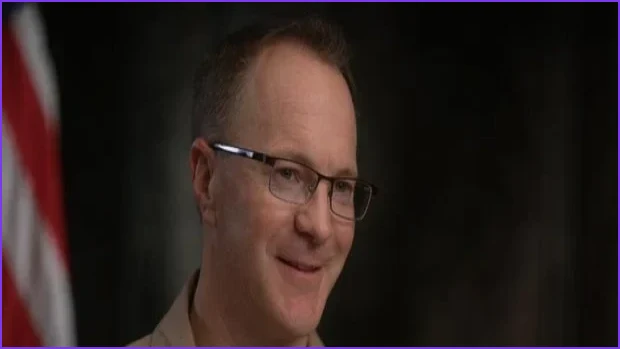
A U.S. Air Force officer survived a harrowing 50-hour ordeal behind enemy lines in Iran after his F-15E fighter jet was shot down by a shoulder-fired missile. Identified by his mission call sign Bravo, the weapons-systems officer endured a terrifying high-speed free-fall, suffered multiple broken bones, and successfully evaded hunting enemy forces before a massive, high-stakes American rescue operation brought him home on Easter Sunday.
The incident began during a combat mission in April when the $30 million F-15E, a long-serving workhorse of American air operations, was struck by an Iranian shoulder-fired missile costing an estimated $100,000. "That day was just another day in the war for us, until the moment where we got hit by an Iranian weapon," Bravo recalled in his first public account of the crash. The hit heavily damaged his parachute, forcing him into a free-fall toward the mountainous Iranian desert at speeds estimated between 70 and 100 mph.
Looking up during his descent, Bravo realized the gravity of his situation. "At one point when I looked up and saw no parachute, that was the most terrifying thing I've ever seen," he said. "So I paused, right then, and I prayed, 'Lord, your will be done. But if I'm getting through this, I need help.'"
Bravo survived the impact but suffered a broken back, a broken arm, and a broken shoulder. He landed in a high desert valley flanked by steep, craggly cliffs, about five miles away from his pilot, call sign Alpha. Despite his severe injuries, Bravo immediately began moving to avoid capture. "I had injuries, but we all train to adapt and overcome the things that we're faced with," he explained. "I moved as quickly as I could, despite the injuries, away from the place that I landed."
The crash triggered an immediate crisis in Washington. Defense Secretary Pete Hegseth was awakened in the middle of the night with the news and immediately pressed for details on the crew's status and whether Iranian forces were aware of the downing. "Whether they're alive or not, we're going to go get them," Hegseth stated. Admiral Cooper noted the unexpected nature of the threat in the airspace, stating, "We had air superiority, but clearly we weren't flying over Kansas."
Soon, Iranian media began broadcasting images of the F-15E wreckage, and videos circulated online showing armed groups searching the rugged terrain. According to U.S. military sources, Iranian ground forces came within a few hundred meters of Bravo's position. Gen. Dan Caine, chairman of the Joint Chiefs of Staff and a former fighter pilot, confirmed the danger: "There was clear intent out of the Iranian ground force to come find those two guys."
Six hours into the search, U.S. forces launched a risky daytime helicopter raid to retrieve the pilot, Alpha, who had landed miles away. The rescue team came under heavy fire. "It was a gun fight all the way in and all the way out," Hegseth said. "But they got Alpha back." Alpha, who is already back to flying duties, declined public interviews due to security concerns but released a statement expressing profound gratitude. "I am still in awe of the professionalism and tactical prowess of the Combat Search and Rescue specialists and the Joint Force who executed the rescue missions of me and DUDE 44 Bravo, both those in theater and behind the scenes," Alpha said. "Words cannot capture how thankful my family and I are and how proud I am to serve alongside each and every one of them."
With Alpha safe, the rescue force was temporarily forced to withdraw, leaving Bravo alone as night fell. Bravo managed to scale a 7,000-foot ridgeline despite his broken bones to find a safer hiding spot. "Never let a lack of motivation put you on Iranian TV," he joked. Once secure, he sent a short message back to the military: "God is good." He also reported his injuries but confirmed he was still on the move.
Although commanders considered launching an immediate second rescue attempt, the conditions were unfavorable. Hegseth recalled the agonizing decision-making process in the Situation Room. "That was a really tough decision," Hegseth said. "I'll never forget, you know, being in the situation room and saying, 'OK, I guess we're gonna roll 24,' which means, 'Hey, Bravo's going to be out there for basically 24 hours more.'" Bravo spent another day enduring freezing winds and cold in the high mountain desert with virtually no food or water.
To facilitate the rescue, the CIA executed a multi-pronged deception campaign to mislead Iranian search parties while utilizing top-secret technology to pinpoint Bravo's exact coordinates. Before ground forces moved in, newly declassified footage showed American bombers and drones striking nearby Iranian Revolutionary Guard forces to clear the extraction zone.
The final rescue operation involved over 90 elite U.S. service members landing on a makeshift desert airstrip—representing the first American boots on the ground in Iran in 46 years. Hundreds more operated in the air, while several thousand provided logistical support. Gen. Caine emphasized the military's resolve: "I think what you need to know is we would have sent more to go get the back-seater."
Two large search-and-rescue planes landed on the makeshift strip, launching small "Little Bird" helicopters to pluck Bravo from his ridgeline. However, a major complication arose when the landing gear of the transport planes became stuck in the deep desert sand, stranding the elite rescue force. A clandestine Air Force unit was deployed to extract the personnel. To prevent advanced military technology from falling into Iranian hands, the U.S. intentionally destroyed the two marooned transport aircraft, valued at approximately $100 million each, along with the Little Bird helicopters.
Fifty hours after his jet went down, Bravo was safely evacuated as the sun rose on Easter Sunday. Reflecting on his survival, Bravo called the outcome a "modern-day miracle" and expressed his gratitude to his wife and the rescue teams. "It's a story of the teamwork, the training, of the faith, of the decisions and the leadership to do something that will live in history as an example of what America's willing to do, in order to uphold our promise and leave no man behind."