Hundreds of Afghan nationals who worked alongside U.S. troops and supported American entities in Afghanistan are expressing deep concern over the potential revocation of their green cards. These individuals, whose roles ranged from interpreters and combat support to custodial and technical positions, fear losing their legal status in the United States due to federal notices indicating their Special Immigrant Visas (SIVs) have been revoked or denied.
The SIV program, authorized in 2009, has provided a pathway to the U.S. for Afghans who assisted the U.S. government or its contractors. Since its inception, the State Department has issued approximately 160,000 such visas, with more than half granted after the U.S. embassy in Kabul closed in 2021. Many recipients have since established lives in the U.S., started families, pursued education, and integrated into their communities.
However, these individuals are now receiving notices from the federal government, warning that the basis for their initial visas may have been invalidated. This development has left families in distress, scrambling to understand the implications and find legal recourse. "We are trying to work, study, raise our children and build a normal life in the U.S.," shared one individual, identified only as M. for fear of jeopardizing his immigration status. "But now we are also trying to find lawyers, contact congressional offices and understand what may happen to our green cards. It is very stressful because even immigration lawyers give different opinions."
While the federal government began issuing some notices toward the end of the Biden administration, citing concerns about the proper collection of supporting documents for SIV applications and potential fraud, advocates and legal experts report a significant increase in the frequency and volume of these letters over the past year. This surge has placed many U.S. allies at risk of deportation and added to the dwindling immigration pathways for Afghans seeking to become U.S. citizens.
Jennifer Patota, deputy director of U.S. legal services at the International Refugee Assistance Project, noted the unprecedented nature of these revocations. "To get a withdrawal of approval letter years after the actual visa has been issued is something we haven't ever seen before," she stated. "People who are issued these visas and come to the U.S. have built lives here, gotten jobs, their kids are in school, they've integrated into their communities and are living their lives."
The initial stage of the SIV application process requires a "Chief of Mission" approval, which includes employer verification letters, supervisor recommendations, and proof of employment with the U.S. government or its contractors. The U.S. withdrawal from Afghanistan complicated this verification process, as many companies ceased operations and destroyed records. "Especially after the withdrawal of troops, many companies were shutting down, destroying all of their records, making it impossible in many cases to verify someone's employment," Patota explained.
Concerns about fraud, including the possibility of individuals unknowingly paying for fraudulent recommendation letters, have also been raised. The Department of Justice has prosecuted cases involving bribery schemes for such fraudulent documents. In response to these risks, the Biden administration developed a plan to verify SIV information for individuals associated with employers later suspected of fraudulent activities.
Shawn VanDiver, president of AfghanEvac, an organization advocating for Afghans who worked with U.S. troops, indicated that his organization was informed by the previous administration about the impending notices. "When this started, it had nothing to do with the Afghans. It was very much about the letter writers and companies," VanDiver said. "There were some companies and some letter writers that were up to no good – like selling letters and every single case associated with those companies or letter writers then got poisoned." The initial expectation was that if SIVs were revoked, individuals could still seek asylum, but the current scope of revocations appears broader than anticipated.
These developments occur at a time when Afghan nationals face limited legal immigration options. Previous avenues, such as the refugee resettlement program and other visa processing, have been paused or halted. Jill Marie Bussey, director for legal affairs at Global Refuge, noted that while initial communications regarding a re-review of Chief of Mission applications in 2024 were clearer, more recent correspondence has seen a "decline in the quality and clarity," with final appeal decisions offering little explanation.
While it is not yet widespread that green cards or citizenship have been revoked, the notices, coupled with the erosion of other immigration programs, are causing significant confusion and fear. "These folks were on the frontlines of our war. They were interpreting. They were enabling our mission," VanDiver emphasized. "Now it feels like it's all coming crashing down and they get no explanation of what to do."
The emotional and financial toll is substantial. Abdul, an engineer who worked with the U.S. Army in Afghanistan from 2017 to 2021, now living in Texas with his family, stated, "Most of my friends living in the U.S. three or four years, all of them receive a letter. All my friends are very depressed, most of them very worried about this issue. What will happen to us? What should we do?"
Sasad, a former engineer who worked with the U.S. government until the withdrawal and now resides in Washington state, expressed similar anxieties. Having lived in the U.S. for over four years and with U.S.-born children, including one with significant health issues, he is now hesitant to apply for citizenship despite being eligible. "I've been here for more than four years, and then in the next year, I am eligible to apply for my citizenship. But when I go to the USCIS, I'm stressed that they will detain me," he said. His plans for further education and career advancement are now uncertain, overshadowed by the fear of losing his legal status.
Returning to Afghanistan is considered an unimaginable and potentially deadly prospect for these individuals, given the Taliban's control and the country's ongoing crises. "When I came here, I thought that all my problems were solved, that now is the time to build my future right here," Sasad reflected. "What now? I cannot focus on my long-term goals. Now all of my thoughts are 'what if?' situations. A lot of 'what if?' situations are giving me anxiety and depression."
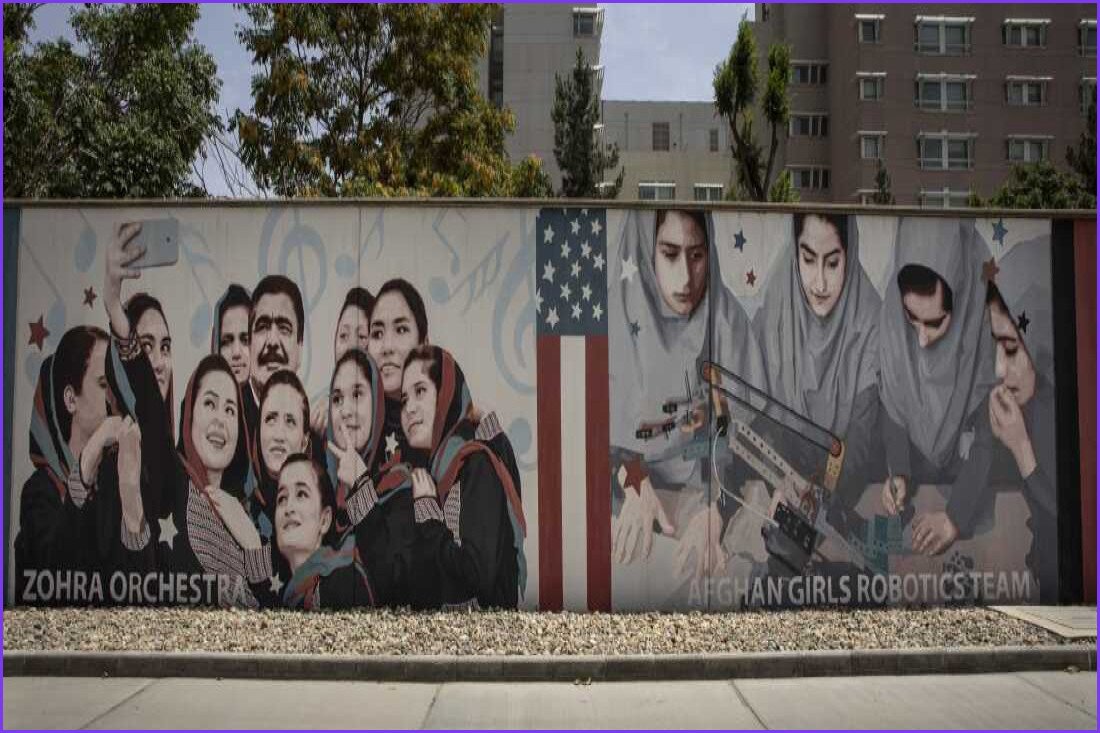
Murals are seen along the walls at a quiet U.S embassy on July 30, 2021 in Kabul, Afghanistan. Paula Bronstein/Getty Images hide caption
And then there was a concern of fraud — particularly that these immigrants, even unknowingly, had paid for letters of recommendation. In one case prosecuted by the Justice Department, a man was sentenced to 30 months in prison for a years-long bribery scheme where he accepted payments from Afghan nationals in exchange