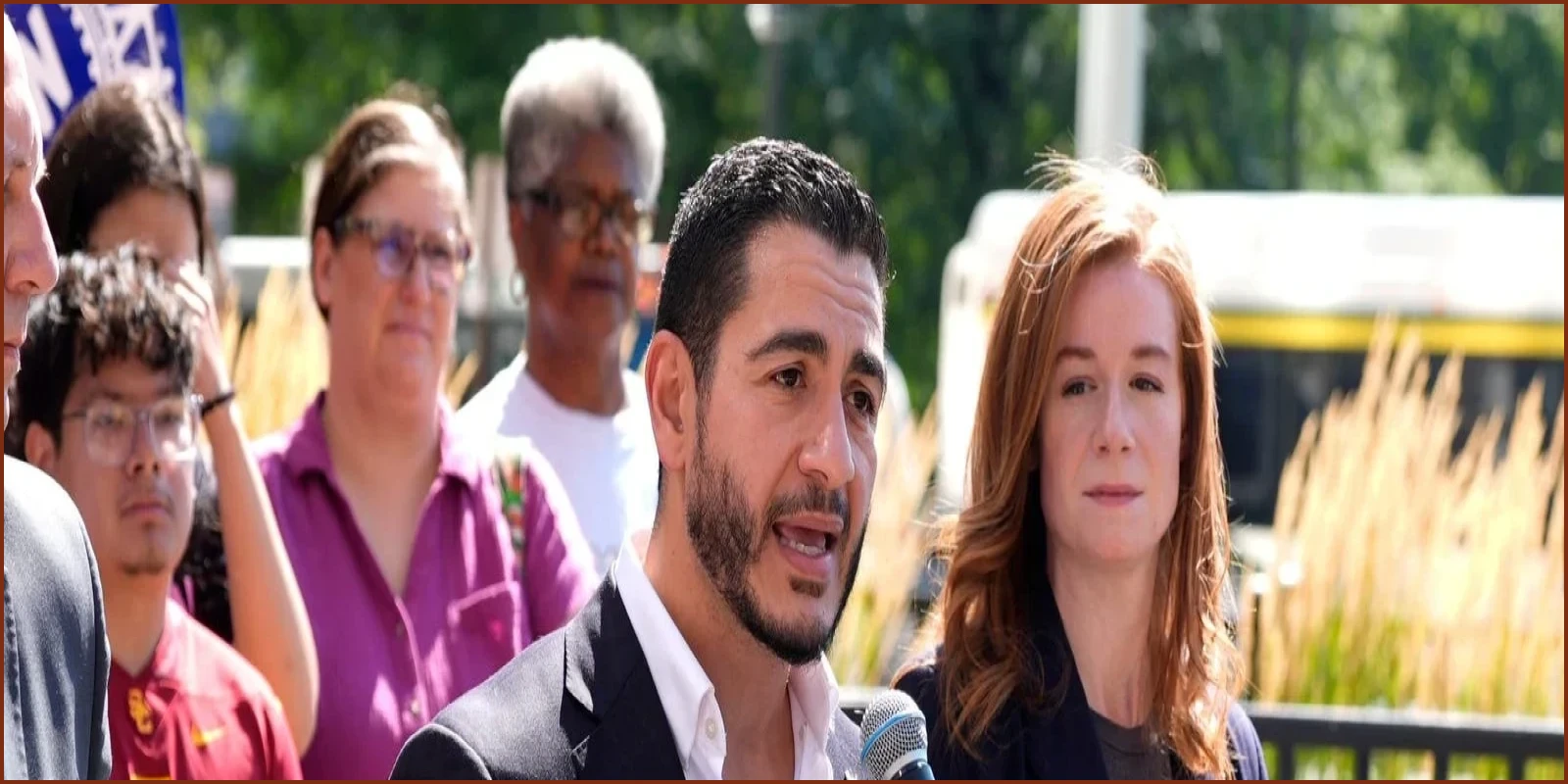
Abdul El-Sayed, an unabashed progressive who campaigned on empowering the working class, secured the Democratic nomination for Michigan's pivotal U.S. Senate race by winning big among a different demographic: college-educated voters. Now to defeat Republican nominee Mike Rogers in November, the anti-establishment El-Sayed needs to coalesce the support of Democratic constituencies who backed his opponent, particularly older Black voters, while expanding his coalition to independent, moderate voters who could decide the election.
Winning the Michigan seat, which Democratic Sen. Gary Peters is vacating, is a virtual must for Democrats to have any shot at reclaiming control in the Senate, where Republicans have a 53-47 seat advantage. Democrats could flip Republican-held Senate seats in Maine, Texas and North Carolina, but it would not give them control of the chamber if they lose any of the seats they occupy, including Michigan. Progressive candidates have been on a roll this midterm election cycle, with democratic socialists winning mayoral elections and Democratic primaries from New York to Colorado. But El-Sayed, who is aligned politically with left-leaning Sen. Bernie Sanders, I-Vermont, will test whether a left-wing candidate can win in a key battleground state.
Even many Democrats acknowledge their path to Senate control is a lot more complicated following the Aug. 4 primary victory for El-Sayed, whose first and only win as a candidate was Tuesday's primary. Longtime Democratic strategist Simon Rosenberg noted on his podcast that there has not been a politician who is Bernie-adjacent who has won in a battleground gubernatorial, Senate, or House race in recent elections, as they have typically won in deep blue areas. Still, if there is any year a progressive firebrand can win in a competitive purple state, Democrats have reason for optimism that it is 2026. Democratic candidates have overperformed in a series of special elections and off-year races over the past year in a sign of a potential blue wave in November. Meanwhile, President Donald Trump's approval rating has hovered below 40% for months, with voters expressing widespread dissatisfaction with the state of the economy and the U.S. war in Iran.
Rosenberg noted that El-Sayed has polled the lowest among any Democrat in any of the battleground Senate midterm races this year, adding, "It's an experiment, and we'll see it how it goes. We should be a little worried that this politics has no track record of winning in places like Michigan or in competitive House races, but we need it to win this time." El-Sayed, a fiery, charismatic former public health official in Detroit, campaigned on expanding Medicare for all and taxing billionaires, but he does not call himself a socialist like several other rising progressive Democrats this cycle. He won the primary thanks to strong support among younger voters and college-educated liberals, especially white voters with college degrees, in communities such as Ann Arbor, home of the University of Michigan, and Grand Rapids, Michigan.
Michigan Rep. Haley Stevens, a moderate Democrat who El-Sayed defeated in the Aug. 4 primary, consistently performed better in polling against Rogers and was widely considered the more competitive general candidate. Stevens beat El-Sayed in Detroit, the state's biggest Democratic stronghold and home to many working-class Black voters. Matt Grossman, a political science professor at Michigan State University, noted that Mike Rogers is likely happy, as El-Sayed's candidacy has exposed Democrats’ inner-party rift over Israel and Gaza. El-Sayed, a fierce critic of Israel, has called the Israeli government "evil."
The National Republican Senatorial Committee quickly released a 30-second ad after El-Sayed’s victory slamming Michigan's Democratic nominee as “the most radical Senate candidate in America” and referring to El-Sayed by his full name, “Abdulrahman Mohamed El-Sayed.” El-Sayed would be the first Muslim elected to the Senate. Trump wasted no time taking aim at El-Sayed, calling him “a Communist loser who hates Jews and Israel” in a post Aug. 5 on Truth Social, adding, “Great news for the Republican party.” Republican strategist Mark Bednar, a former House leadership aide, said El-Sayed's nomination is a "gift" for Republicans, noting that if Trump voters in Michigan needed any nudge of motivation to get out and vote, they now have it.
In addition to Republican attacks painting him as too far left, El-Sayed will have to overcome his newness to electoral politics and a potential bias among voters against Muslim candidates, according to Grossman. "That said, everybody judges the candidates individually, not just based on a few factors, and voters have been pretty positive about El-Sayed in terms of his media presence, in terms of his in-person demeanor," Grossman said. In Rogers, El-Sayed faces an experienced opponent who previously ran for Senate in 2024, losing by just 19,006 votes to Democratic Sen. Elissa Slotkin. A former FBI agent, Rogers served in the Michigan Senate before spending more than a decade in Congress, where he chaired the House Intelligence committee. He questioned Trump’s unfounded election fraud claims after the 2020 election, but has positioned himself as a staunch supporter of the president, receiving his endorsement in the 2024 race and again this cycle.
In a speech after securing the Democratic nomination, El-Sayed sought to rally Michigan's fractured Democrats around the common goal of beating the Republican nominee. "I know everybody is not going to agree with me on everything," El-Sayed said. "But I do know that they agree with me on the need to beat Mike Rogers and the need to hold Donald Trump accountable, and the need to provide people health care and the need to address the affordability crisis." The Democratic establishment, which widely preferred Stevens as the nominee, worked to present a united front as the party seeks to extend its long Senate winning streak in the state. Michigan hasn't elected a GOP U.S. senator since 1994. Senate Minority Leader Chuck Schumer, in a joint statement with fellow New York Sen. Kirsten Gillibrand, who chairs the Democratic Senatorial Campaign Committee, said, "Abdul El-Sayed has run an energetic campaign that inspired thousands of Michiganders across the state, with a clear focus on lowering costs and standing up for working families. Democrats are united by a common purpose: putting a check on Donald Trump by defeating his Republican enablers and taking back the Senate."
Kate deGruyter, a former Democratic congressional staffer who now works as vice president of communications for the centrist group Third Way, said El-Sayed tapped into an "anti-Washington moment" to narrowly win the primary. She noted that El-Sayed has taken a number of positions that are easy for the GOP to cast as extreme, such as wearing an "abolish ICE" shirt and associating with controversial left-leaning media figure Hasan Piker. "Our view is that he needs to ditch the extremism now, and that’s going to take some real work because he’s dug a pretty big hole for himself with general election voters," she said. Conversely, Joseph Geevarghese, executive director of Our Revolution, credited El-Sayed with energizing Democratic activists and said his "economically populist message" will resonate in Michigan, which has seen auto production and other manufacturing jobs decline. Michigan is one of three “Blue Wall” states in the Midwest that Democrats carried every presidential cycle for decades, but Trump won the state twice, in 2016 and 2024. "It was the failure of centrist Democrats to support labor and stand up against offshoring and free trade that helped the Blue Wall collapse, and this is a chance to rebuild that," Geevarghese said.