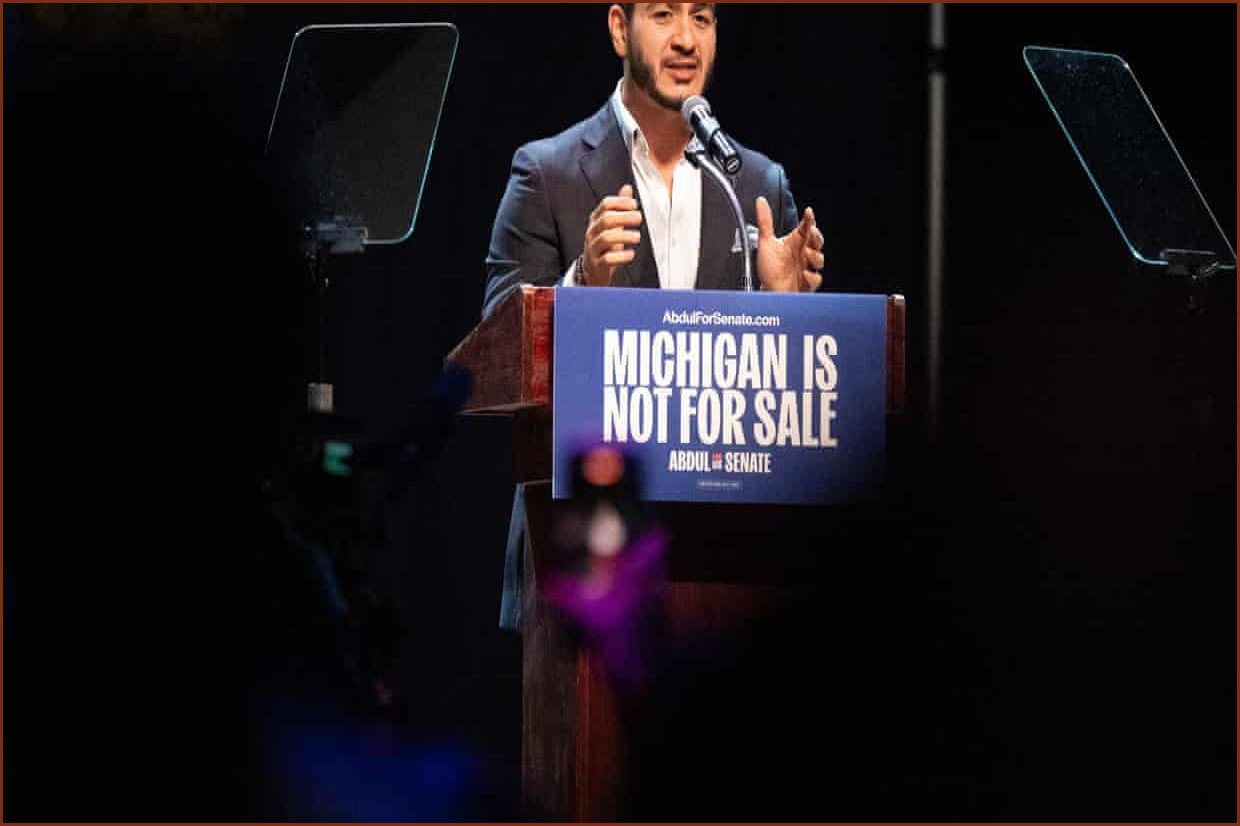
Abdul El-Sayed’s victory in the Michigan Democratic primary for the US Senate has signaled a potential shift in the party’s political trajectory. By defeating moderate congresswoman Haley Stevens, who enjoyed significant backing from the party establishment and tens of millions of dollars in outside financial support, El-Sayed has emerged as a key figure for the progressive wing of the Democratic Party. The primary race concluded with El-Sayed securing 48.5% of the vote compared to Stevens’ 47.5%. The narrow margin, compounded by more than 60,000 votes cast for a candidate who had already withdrawn from the race, highlights the work ahead for El-Sayed as he seeks to unite the party and attract independent or right-leaning voters in the upcoming general election against Republican Mike Rogers.
The race solidified a growing anti-establishment sentiment on the party’s left, where activists and supporters have sought a proactive vision that does not rely on the pre-Trump status quo, apparent in a string of wins for insurgent candidates. There is a sense that systems were already broken before Trump’s rise, and a return to those norms will not serve everyday Americans. Voters are looking for politicians who can call out their own party’s orthodoxies and challenge the big money that haunts US politics. Michigan voters found this in El-Sayed, who centered his campaign around universal healthcare and was not shy about calling the war in Gaza a genocide.
El-Sayed’s grassroots strategy involved extensive outreach, including knocking on over 200,000 doors, making more than 1 million phone calls, and hosting over 500 campaign events, including visits to 150 churches. This effort was supported by organizations like the Working Families Party and various Indivisible chapters. For many voters, such as Racquel Garcia in Dearborn, El-Sayed’s background as a public health official in Detroit and Wayne County served as proof of his commitment to public service over corporate interests. Detroit voter David Sernick noted that El-Sayed’s campaign changes what people think is possible.
Former Michigan congressman Andy Levin, who lost to Stevens in 2022, praised the outcome as a rejection of a static notion of electability. He told Democracy Now that voters want authenticity, truth-telling, and brave policy, not just proposals but action, so they can breathe in their lives. He described the victory as a movement of Americans saying enough of politics as usual. Meanwhile, Detroit voter Roy Harris expressed a desire for change, citing the struggle of first-time homebuyers facing $400,000 price tags and the burden of high gas prices.
The general election in Michigan, a state that has oscillated between voting for Donald Trump and Joe Biden, is being viewed as a bellwether for the future of the Democratic Party. If El-Sayed, an unabashed progressive who notes he has a funny name, manages to win the statewide seat, it could reshape the landscape for the 2028 presidential contest. Conversely, a loss would likely lead establishment figures to frame his platform as too extreme. Nationally, the picture is mixed; moderates like Marie Gluesenkamp Perez in Washington state and Wesley Bell in Missouri won their respective primaries, while Pennsylvania progressive Chris Rabb recently noted the double standard where centrist Democrats are rarely asked to explain losses in purple districts.
The Republican opposition has already begun its campaign, with Mike Rogers releasing an AI-generated video framing the contest as a choice between common sense and what the Republican National Committee described as crazy, while also labeling El-Sayed as Michigan’s Mamdani. Despite these attacks, El-Sayed remains focused on mobilizing voters who have become disillusioned with the political system. He emphasized that the goal is to come together to collectively defeat Mike Rogers in November.