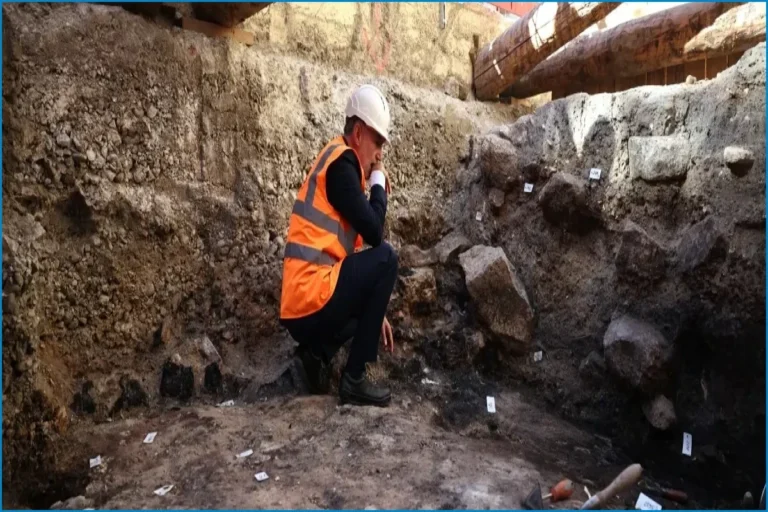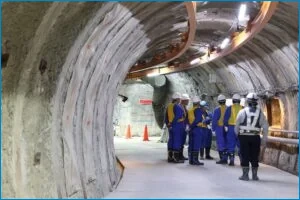
A rare visit to the Horonobe Underground Research Laboratory, where Japanese researchers are testing options for storing radioactive waste. Scientists visiting the Horonobe Underground Research Laboratory in Hokkaido, Japan.
Reindeer pastures and dairy farms stretch across the flat, windswept plain of Japan’s northernmost prefecture, giving little hint of what lies roughly 300 meters below. Inside the Horonobe Underground Research Laboratory, teams of engineers are trying to answer a question no country has fully solved: how to keep highly radioactive waste isolated from the environment for periods measured not in decades, but in tens of thousands of years. In May, I gained special access to the facility through the Japan Atomic Energy Agency (JAEA), touring the underground galleries and observing several of the experiments currently underway. Horonobe Underground Research Laboratory. Photo ©Piergiorgio Pescali.
Horonobe is one of only two underground research laboratories Japan has built to study geological disposal of high-level radioactive waste, and the only one still operating. Its counterpart, the Mizunami Underground Research Laboratory in Gifu Prefecture, was built in crystalline rock and was decommissioned in 2022 after its land lease expired. Horonobe, by contrast, sits in Neogene-era sedimentary rock, giving the JAEA a very different and, officials argue, complementary geological environment to study.
The project traces back to November 2000, when the governor of Hokkaido, the mayor of Horonobe town, and the president of the JAEA signed an agreement to permit research on the deep geological environment at the site. Construction and excavation followed over the next two decades, and the laboratory now includes shafts and galleries used to test how engineered barriers, groundwater, and surrounding rock interact over time – the same combination of natural and artificial safeguards that would, in theory, protect a real repository.
Two of the central experiments underway involve what the JAEA calls the “full-scale engineered barrier system performance experiment” and a “solute transport experiment,” both designed to test, at real scale, how bentonite buffers, canisters, and cement-based materials behave once water and pressure are introduced over years rather than months. The JAEA has also been testing how the surrounding sedimentary rock buffers natural disturbances, earthquakes, and groundwater shifts that could compromise a repository’s isolation over the long term. Researchers conducting tests at Horonobe Underground Research Laboratory. Photo ©Piergiorgio Pescali.