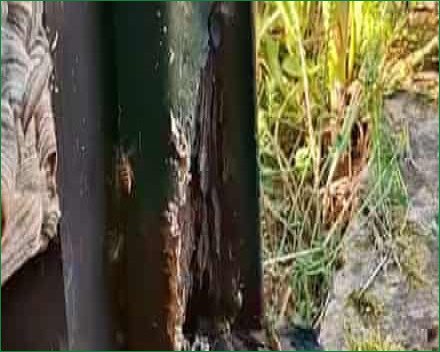
When wasps began appearing through a rusted gap in her converted shipping container office in Norfolk one June morning, Eilish Rothney’s initial reaction was to remove them. As a reserve manager for the Trinity Broads, part of the Norfolk Wildlife Trust, her first thought was to get rid of the colony taking root in her workspace. However, she quickly questioned her instinct, deciding instead to observe the insects.
Two months later, Rothney is sharing her office with a nest that has grown to over a metre in height, consuming an entire bookshelf of ring binders. The nest has covered the interior of her office with intricate layers of wood pulp cells. To accommodate her new colleagues, Rothney keeps the window open, providing the wasps with a clear flight path. She describes her daily routine as calm, strolling past the nest as if she were a browsing cow, noting that the wasps have become accustomed to her presence.
The colony operates as a complex, living organism, with the queen laying eggs while workers forage for food and maintain the nest. Rothney observes a low purring sound, which she attributes to the thousands of wings beating to keep the colony cool. She remains unconcerned about being stung, comparing the potential sensation to a mosquito bite, and advises others to remain calm to avoid appearing as a threat to insects.
Reflecting on her university ecology field trips, Rothney emphasizes the beauty and poetry found in the relationships between species. She expresses frustration with the common tendency to label insects as "pests" to justify extermination. Addressing the common mid-August nuisance of wasps at picnics, she explains that the insects are often desperate for food because the larvae stop producing the sugary secretions they rely on. She suggests that humans should offer sugar sources to the wasps to draw them away from human gatherings.
As autumn approaches, the colony’s cycle will come to an end; the queen will cease laying eggs, and the workers and males will die off, leaving the nest empty for the winter. Rothney admits she will miss them, describing her feelings as "motherly" and noting that the silence will feel strange once they are gone. She intends to carefully dismantle the nest after the wasps depart to study its interior. For now, however, the shelves remain firmly in the possession of the wasp colony, marking a unique coexistence during the Norfolk Wildlife Trust’s 100th anniversary year.
“They just built the nest inside my door,” she says. “My first thought was: ‘Oh no, I have to get rid of that now.’ But then I realised: ‘Wait, why? Why do I have to do that?’”
Until then, the shelves belong to the wasps.