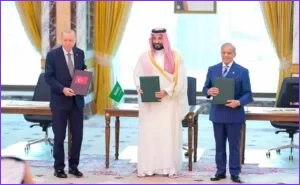
Six months after exploratory talks, Pakistan, Saudi Arabia, and Turkiye have formalized their defense cooperation with the signing of the Mecca Joint Defense Agreement on August 7. This new pact stipulates that an armed attack against one signatory will be considered an attack against all three.
The public details of the agreement leave crucial aspects undefined, including the procedure for triggering the pact, any geographical limitations, and the specific assistance each country must provide. While comparisons to NATO's Article 5 are drawn, the Mecca pact lacks the decades of established military planning and cooperation that underpin the transatlantic alliance. NATO allies also retain discretion over their response, a flexibility not yet publicly clarified for the Mecca pact.
This is not Saudi Arabia's first attempt at forming a broad security coalition. The Islamic Military Counter Terrorism Coalition, announced in 2015, involved 41 states under Saudi leadership, with former Pakistani army chief Raheel Sharif serving as its military commander. However, participation in that initiative remained voluntary, with member sovereignty explicitly preserved, making the label of a "Muslim NATO" for the Mecca pact premature, despite its more direct mutual-defense pledge.
Pakistan has previously demonstrated its commitment to Saudi defense. Earlier this year, during the spring phase of the Iran war, Islamabad reportedly deployed 8,000 troops, JF-17 fighters, drones, and a Chinese HQ-9 air-defense system to Saudi Arabia under a bilateral defense agreement. Pakistani personnel operated the equipment while Saudi Arabia funded the deployment. During this period, Pakistan did not engage militarily with Iran's attacks on Saudi Arabia and simultaneously worked to mediate the Iran-U.S. conflict.
For Pakistan, the Mecca pact signifies a more formal security role in the Gulf. While India remains the primary focus of Pakistani defense planning, with Afghanistan and Iran shaping its western security environment, Islamabad can now leverage its military capabilities for political access, defense sales, Saudi financing, and a broader influence beyond South Asia.
However, the pact introduces potential challenges. A future India-Pakistan crisis could test how Riyadh and Ankara interpret the collective-defense clause. India is closely monitoring the agreement, while Saudi Arabia continues to cultivate its strategic relationship with India, creating a delicate balance for Riyadh to manage its commitment to Pakistan without escalating every India-Pakistan confrontation into a Saudi-Indian crisis.
The presence of Pakistan's nuclear arsenal raises further questions. While the agreement does not publicly extend a nuclear guarantee, Saudi officials have stated the pact is unrelated to nuclear ambitions or an arms race, and Pakistan has previously indicated nuclear weapons are not part of its defense agreement with Saudi Arabia. Nevertheless, Pakistan's nuclear capability remains a factor for the other pact members.
Military cooperation within the pact may face hurdles due to differing equipment origins. China supplied 80 percent of Pakistan's major arms imports in 2021-25, while Saudi Arabia relies heavily on U.S. and Western equipment, and Turkiye uses both NATO-standard and domestic systems. This disparity could complicate cooperation, particularly concerning communications, maintenance, and sensitive technologies.
Pakistan's previous deployment to Saudi Arabia, utilizing Chinese-origin equipment operated by Pakistani units, suggests that full integration of military systems may not be necessary. This approach allowed Saudi Arabia to benefit from the defense capabilities without reorganizing its armed forces around foreign equipment.
The pact's structure could also make the relationship more enduring, potentially surviving political disagreements better than mere summit-level coordination due to long-term procurement, training, and joint production arrangements.
The Mecca pact is unlikely to signal a post-American regional order. The U.S. Central Command established a new air- and missile-defense coordination cell in Qatar in January, and Saudi Arabia deepened its defense ties with Washington in November 2025, reaffirming the U.S. as its primary strategic partner. Regional powers still heavily depend on American military and intelligence support.
Instead, the Mecca pact may offer the three countries greater operational flexibility within the existing international system. Saudi Arabia gains diversified military support, Turkiye secures a regional security channel less directly controlled by Washington, and Pakistan can offer Gulf partners forces and equipment while maintaining ties with both Beijing and Washington. This arrangement could be viewed as burden-sharing by the U.S. and increased flexibility by the signatories.
A distant historical parallel exists in the 1960s when Turkiye, Pakistan, and Iran sought a permanent CENTO command structure, which the U.S. resisted due to potential obligations. Although the U.S. was not a formal CENTO member, it participated extensively.
However, the Mecca pact differs as it was negotiated by regional states without U.S. involvement. Despite this, Saudi Arabia's reliance on American capabilities, Turkiye's NATO membership, and Pakistan's relationships with both Washington and Beijing mean the three countries, while having more room to act independently than in the CENTO era, have not yet achieved full strategic independence.
The Red Sea may soon offer a clearer view of the pact's practical application. On July 30, Saudi Arabia proposed a multinational maritime-defense coalition for the Red Sea, Bab el-Mandeb, and the Gulf of Aden following renewed Houthi attacks. Turkiye and Pakistan were among the 14 countries supporting this initiative.
The three members will likely approach future crises with differing perspectives. Saudi Arabia faces threats from Iran-aligned forces and its energy infrastructure, Pakistan remains focused on India and maintains relations with Iran, and Turkiye has NATO commitments and its own regional priorities. The pact will need to navigate these diverse interests.
The true measure of the agreement will be in its practical implementation, beyond summits. Regular exercises, joint planning, and clear crisis-response procedures are needed to transform the political pledge into a credible defense commitment. The challenge lies in making the agreement effective without sacrificing the flexibility that initially brought the nations together.
For Pakistan, the immediate consequence is an expanded security role, with Gulf and Red Sea crises now influencing its strategic calculations. This could enhance Islamabad's strategic value and economic prospects but also means managing more crises outside its traditional sphere of influence. The ultimate benefit of the Mecca pact for Pakistan will depend on its ability to effectively manage this trade-off.