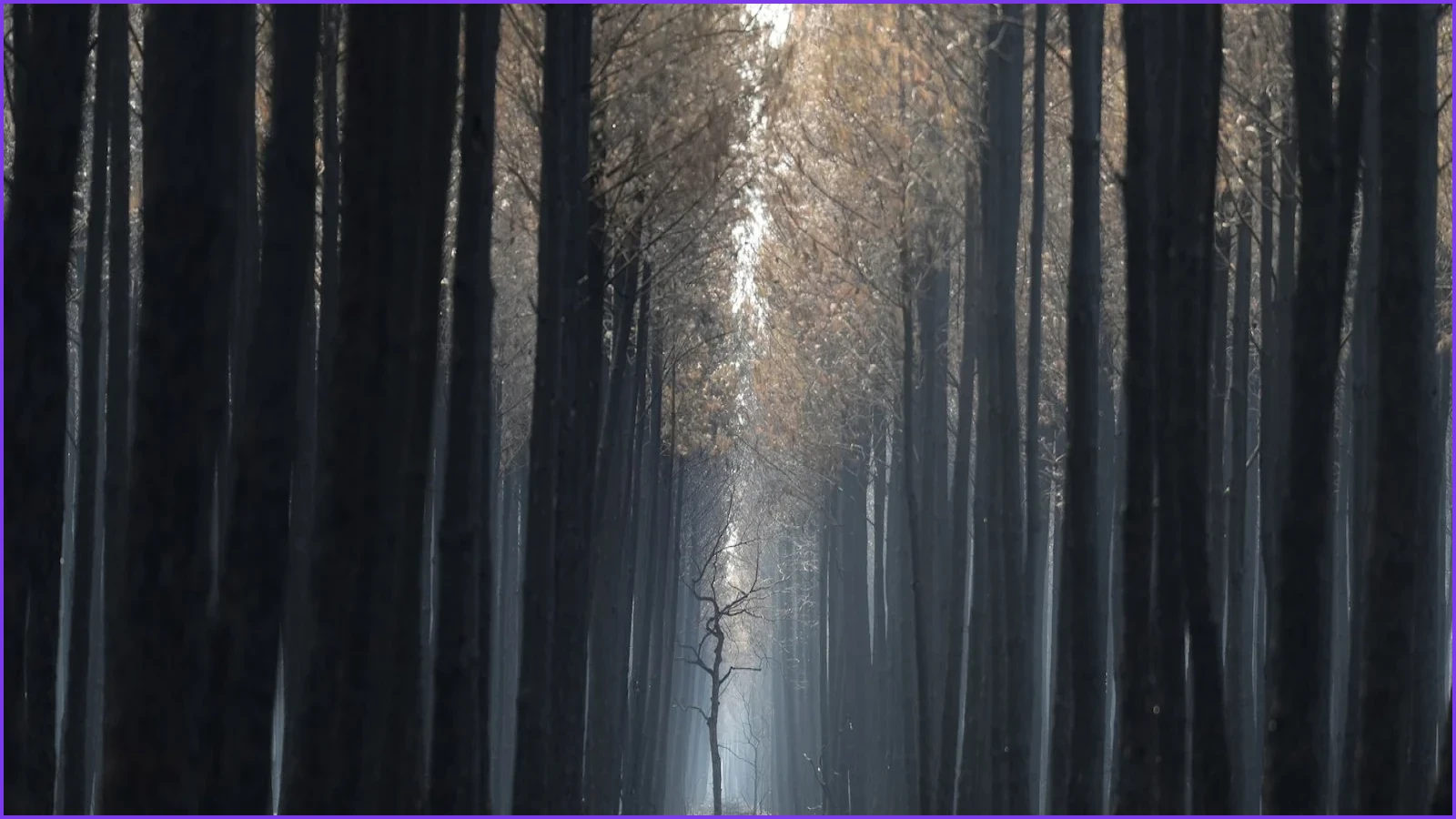
Firefighters in southwestern France have successfully contained a massive wildfire, allowing approximately 198,000 residents to return home following what is believed to be the country's largest peacetime evacuation. The blaze, which scorched 420 square kilometers of pine forest west of Bordeaux in the Gironde region—an area four times the size of Paris—remains within its established perimeter. While the fire is considered contained, officials have not yet declared it “fixed,” meaning active sectors and buried hot spots still pose a threat. Lt. Col. Eric Pitault noted that crews are still navigating roughly 240 kilometers of fire edges where heat can remain trapped underground. To combat this, crews utilized tactical burns overnight, deliberately consuming vegetation ahead of active sectors to deprive the main fire of fuel. Despite the return of residents, several communities remain largely deserted, including the affluent Cap Ferret peninsula, where authorities fear a nearby hot spot could flare again and threaten limited road access.
The broader European crisis, fueled by extreme weather, continues to shift rapidly. According to the European Union’s Copernicus climate service, Europe is warming faster than any other continent, heating at more than twice the global average since the 1980s. This ongoing drought and rising temperature cycle has created conditions where vegetation dries out, allowing fires to spread with increased speed and intensity. At the height of the recent crisis, fires in France and Spain displaced approximately 330,000 people, stretching emergency resources to their limits. The ecological toll is also immense; Allain Bougrain-Dubourg, president of France’s League for the Protection of Birds, reported that the number of animals affected by the Gironde fire already numbers in the millions.
Despite the progress in Gironde, the situation elsewhere remains precarious. In the Mediterranean Var region, a fire that was previously thought to be under control surged on Friday, racing across 10 square kilometers in just six hours. Var Prefect Simon Babre described the movement of the fire as “faster than a horse at full gallop,” noting that the resurgence defied expectations. While defensive lines held overnight and no additional ground was lost, 2,500 people remain displaced, and 1,300 firefighters are currently deployed to manage the threat. Furthermore, twenty French departments were under an orange heat warning on Saturday, with temperatures forecast between 35 and 39 C (95 to 102 F) around the Mediterranean.
The volatility of the situation is further highlighted by events in Greece, where new fires have forced fresh evacuations. A blaze that broke out Friday near the village of Agios Vasileios necessitated the emergency evacuation of about 300 people by sea, with further orders issued on Saturday. Theodore Giannaros, a wildfire meteorologist at the National Observatory of Athens, described the damage near Porto Germeno as “inconceivable.” While official burned-area statistics are pending, estimates suggest 40 to 50 square kilometers have been impacted. Current firefighting efforts in Greece involve 420 personnel, including 20 specialized forest-fire teams, supported by 19 aircraft and 11 helicopters. Powerful winds, with gusts forecast to reach 88 kph (55 mph), continue to hamper aerial operations, and the Athens region and part of nearby Evia remain at the highest wildfire alert level.
The resurgence showed how abruptly apparent gains could disappear: A fire considered “fixed” earlier in the week consumed another 1,250 hectares in a matter of hours.
Reinforcements brought the deployment to 420 firefighters, including 20 specialized forest-fire teams, backed by 19 aircraft and 11 helicopters. Local authorities said homes had been destroyed, but a complete count was not immediately available.