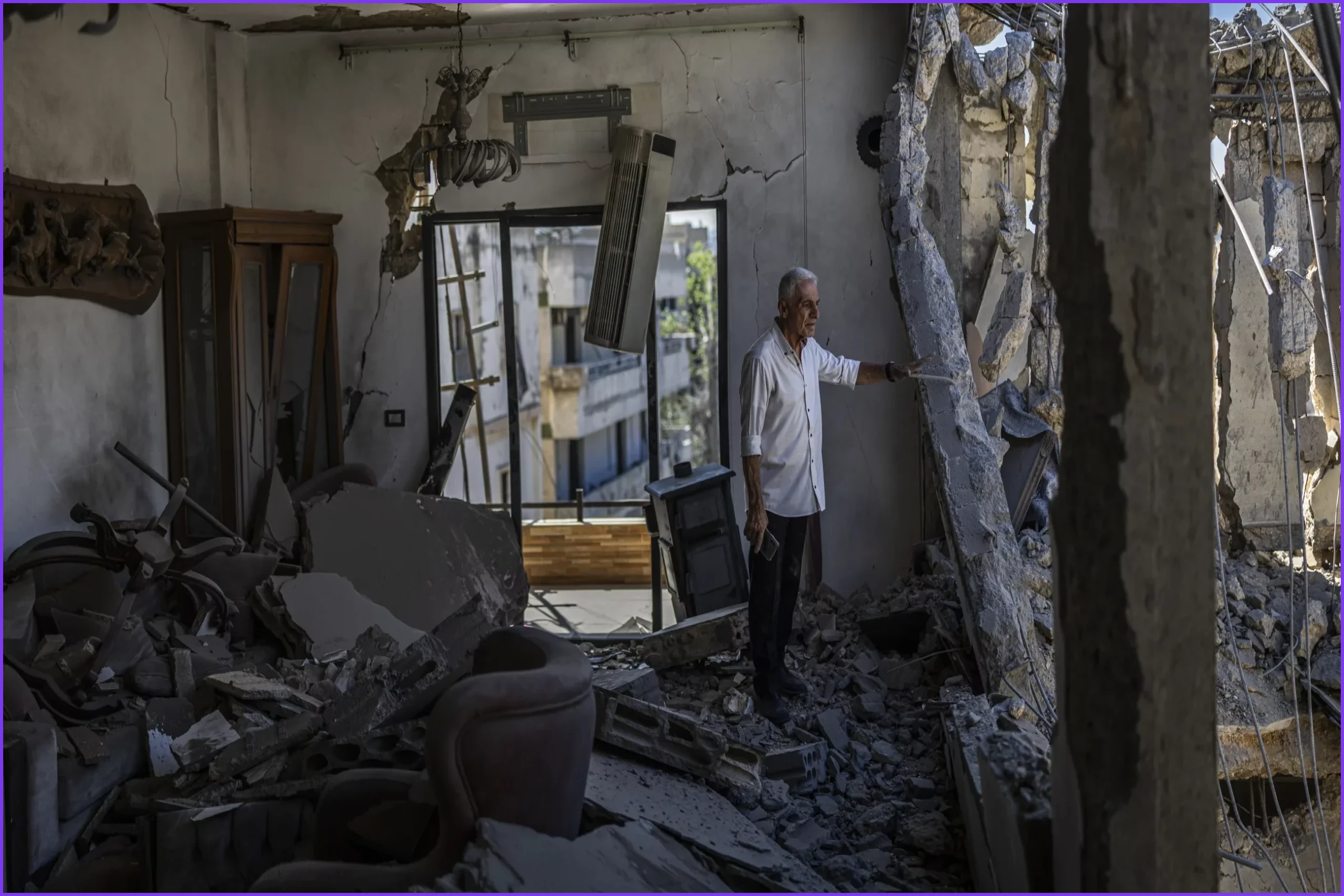
Najib Ayyad carefully navigates the ruined entrance of his apartment building in Nabatiyeh, a southern Lebanese city heavily damaged by ongoing warfare. Chunks of concrete, shattered glass, and piles of ruined furniture litter the staircase, illuminated only by shafts of light streaming through jagged, empty window frames. Ayyad, a parliamentary office worker, has returned briefly to salvage whatever belongings remain for his children. Lacking the financial resources to rent another home, he has been staying in Beirut, sharing a flat with his daughter.
Through the shattered glass of his balcony doors, Ayyad can see Beaufort Castle, a crusader-era fortress of deep personal and national significance. The landmark was seized in May by Israeli forces, who have advanced far beyond the boundaries of what the Israeli government refers to as a security zone in southern Lebanon. From this high vantage point, Israeli forces have a clear view of the city. Ayyad notes that even if his apartment were intact, staying there would be impossible because they can see everything from the castle.
The atmospheric reality of Nabatiyeh is defined by the constant hum of drones overhead and columns of smoke rising from nearby artillery strikes. Despite the devastation, some residents are making tentative attempts to rebuild. Nabatiyeh, a major administrative and commercial hub in the south, has seen nearly all of its 80,000 residents displaced due to intense Israeli bombardments and evacuation orders.
The city serves as an administrative center for Hezbollah, the Iran-backed militant group and political party that also provides local social services. While Israel asserts that its military operations target Hezbollah fighters and infrastructure, much of the physical destruction and loss of life in Nabatiyeh and other southern towns has impacted civilians.
According to Lebanese health officials, at least 4,200 people have been killed since the war began on March 2. Women and children make up at least one-fifth of the dead. On the other side of the conflict, Israel reports that 37 of its soldiers, one military contractor, and two civilians have been killed as a result of Hezbollah attacks.
Nabatiyeh’s historical covered market, known for its red-tiled roofs, stone arches, and vibrant trade in agricultural produce, clothing, and handicrafts, now lies in ruins. For centuries, the market served as a vital commercial center along the transit route connecting Jerusalem, Damascus, and Mecca, later becoming a prominent Ottoman-era town. The city previously experienced Israeli occupation following an invasion in 1982, from which Israeli forces withdrew three years later in 1985.
Mayor Abbas Fakhreddin, pointing out the extensive damage to the historic market, has urged displaced residents to delay their return. He explains that the city currently lacks the basic necessities of life, and the security situation remains highly unstable, meaning an immense amount of work must be done before normal life can resume. Local residents and officials view the widespread destruction of commercial areas as a deliberate attempt by Israel to permanently halt Nabatiyeh's economic life.
This pattern of destruction is mirrored further south, where Israeli Defense Minister Israel Katz stated in July that military forces had demolished more than 15,000 homes in border villages. The Israeli government describes these actions as part of an effort to establish a buffer zone designed to prevent Hezbollah from launching rocket attacks or other incursions across the border.
Despite the warnings, some residents are attempting to resume business. A woman named Hamadi, 40, recently returned to Nabatiyeh from Beirut, where she and her mother, Salwa Hachouch, had sought refuge. Together, they cleared out damaged inventory, restocked their shop, hung a framed photograph of Hamadi's late father on the wall, and hung a plastic sheet to replace their destroyed front door.
The small shop offers essentials such as canned goods, yogurt, flatbread, batteries, and birthday candles—a small symbol of hope for a return to normalcy. When a young boy enters to ask about the price of a candy bar, Hamadi accepts whatever small change he has, later explaining that the boy's father was injured in a military strike. Salwa Hachouch expresses hope for the future, stating her belief that they will rebuild the market better than before and that everyone will eventually return.
Despite such optimism, the grim reality of the war remains visible. Two months after some of the heaviest airstrikes, bodies remain buried under collapsed buildings. Hamadi points to the ruined home of the Basma family across the lane in the Nuns' Quarter. The entire family—the parents and their four children, aged 7 to 16—was killed in an airstrike on March 31. The impact flattened the house, and two of the children, aged approximately 8 and 11, are still buried under the debris.
Hamadi recalls how the four children brought life and energy to what was otherwise a quiet neighborhood populated mostly by older residents. She remembers drinking coffee with the mother, who was in her late 30s and often spoke of her hopes for her children's future. Now, Hamadi laments, there is no one left of the family.
Amnesty International conducted an investigation into the March 31 strike that killed the Basma family and another neighbor. The human rights organization found no apparent military targets in the vicinity and declared the attack a potential war crime. The group noted that the father, an unemployed house painter, had remained in Nabatiyeh with his family simply because they lacked the financial means to flee.
When questioned by Amnesty International, Israel stated it was investigating the incident but offered no further details. In response to recent journalistic inquiries, Israeli authorities declined to provide an update on the case, reiterating their general stance that they implement precautions to mitigate civilian harm, though they did not specify what those precautions were or why they failed to prevent the deaths of the Basma family.
Hamadi, who stayed in Nabatiyeh during the war with Israel two years ago and lived through multiple previous conflicts, notes that the current war is vastly different. She states that during past escalations, residents were able to withstand the strikes, but this time has been unbearable. She observes that the Israeli military is failing to distinguish between civilians and combatants, remarking that "whoever dies, dies." Having taken leave from her job with a non-governmental organization to assist her mother, Hamadi admits she sometimes fails to recognize the hollowed-out streets of her childhood home, noting a profound sense of exhaustion despite the renowned resilience of the local population.
On the outskirts of Nabatiyeh, a local house has been converted into a base for first responders from the Nabatiyeh Emergency Medical Services, an all-volunteer unit. Inside, young men drink coffee and prepare food for local families while watching black smoke rise from distant artillery strikes. The work is exceptionally dangerous; Israeli airstrikes have killed at least 130 Lebanese first responders across the country.
The Nabatiyeh volunteer unit has lost three of its own members, including Jude Sleiman, the 16-year-old son of the unit's commander, Mohammad Sleiman. The teenager, wearing his paramedic uniform, was killed alongside his 23-year-old colleague, Ali Jaber, when an Israeli drone strike hit the motorcycle they were riding to deliver food to local civilians on March 24.
Among the volunteers is Ali Rida, a former software developer who previously worked in Qatar, Thailand, and Turkey before returning to his hometown to serve as a paramedic. Sporting a full-sleeve tattoo depicting characters from the film The Godfather and the Statue of Liberty, Rida shares his dream of one day spending Christmas in New York, a wish inspired by watching the Home Alone movies, though he doubts he can secure a visa. He describes his volunteer work as an absolute duty to his country during its time of need.
Mohammad Sleiman, the veteran paramedic and co-founder of the service, emphasizes that the current conflict is unlike any he has experienced. Paramedics face extreme psychological pressure, particularly because some of their colleagues have been killed in follow-up strikes while attempting to rescue those wounded in initial bombardments. Sleiman recalls that during the war two years ago, residents could still move around and paramedics could visit their families. Now, the volunteers spend weeks confined to their base, waiting for the next airstrike to hit.
Hammadi says she used to drink coffee with the mother, who was in her late 30s. She would talk about waiting for her children to grow up.
"This is our duty," he says. "Whenever the country needs us we must be there."