A severe humanitarian crisis has unfolded in the Spanish enclave of Ceuta, where at least 34 people have died following a mass influx of more than 40,000 migrants from neighboring Morocco. The arrivals, which occurred within just a few hours, have overwhelmed the city of 85,000, with many individuals drowning or being killed in a crush while attempting to scale the border fence or swim across to the territory.
Rachid Sbihi, who represents a local workers association for Civil Guard officers, described the scene as chaotic, noting that many people, including unaccompanied children, have been left without shelter, sleeping in parks and on pavements. Sbihi confirmed that the fatalities included those who drowned and others who died in a crush at the Tarajal beach breakwater.
Spanish Prime Minister Pedro Sánchez visited Ceuta on Friday, characterizing the surge as a violation of Spain’s territorial integrity. He stated that the government would utilize all available state resources to ensure the safety of the local population. Sánchez blamed the influx on human trafficking networks that allegedly exploited a recent Spanish supreme court ruling, which restricted the summary return of migrants intercepted at sea. To address this, he announced that a temporary reception center would be established for documentation and the expedited expulsion of individuals without legal claims, alongside the installation of a line of buoys at Tarajal beach to clearly mark the border.
The surge occurs against a backdrop of diplomatic friction between Madrid and Rabat, historically linked to the status of Western Sahara. While Spain recently shifted its policy to support Morocco’s plan for the territory, tensions remain high. Sánchez visited Algiers on 20 July – the first such visit by a Spanish head of government in four years – marking a thaw in relations with Algeria. Moroccan government sources, however, insisted that their cooperation with Spain remains exemplary and attributed the mass crossing to criminal organizations.
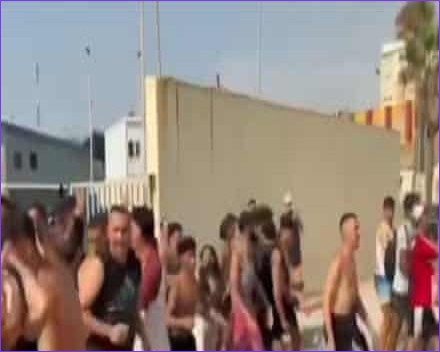
In response to the crisis, the Spanish interior ministry has deployed 60 members of the armed forces and 30 additional Guardia Civil officers to bolster security. Despite demands from the mayor-president of Ceuta, Juan Jesús Vivas, to declare a national emergency, the central government rejected the request, stating such declarations are reserved for natural disasters or specific threats like volcanic activity. Video footage on Thursday showed crowds of people walking around the breakwaters at Tarajal beach on to local roads. While most appeared to be young men, there were also families with women and small children.
The situation has drawn sharp criticism from within the European Union. Events in Ceuta have led some other EU countries to issue threats or rebukes. Italian officials, including the government of Giorgia Meloni, called for Spain to be suspended from the Schengen zone, labeling the event a threat to European borders. Spain’s foreign minister, José Manuel Albares, summoned the Italian ambassador to protest what he termed partisan demagoguery. Meanwhile, other European leaders weighed in, with the Swedish prime minister urging Spain to regain control and the Finnish interior minister supporting Italy’s call for Schengen suspension. Former French prime minister Michel Barnier also criticized the situation, suggesting that migration choices by one member state should not burden others.
Within Spain, the political opposition, including the People’s party and the far-right Vox party, has condemned the government's response as insufficient, with some describing the event as an invasion. As the situation evolves, local authorities continue to struggle with the massive number of arrivals roaming the streets.
That crossing came amid heightened tensions between Madrid and Rabat over Spain’s decision to allow the leader of the Western Sahara independence movement, the Polisario Front, to be treated for Covid-19 in Spain. Morocco and the Polisario Front both lay claim to Western Sahara, which was under Spanish rule until 1975,
That diplomatic crisis ended in 2022 when Madrid reversed its longstanding policy of neutrality and backed Morocco’s plan for Western Sahara – a move that had caused a diplomatic rift between Madrid and Algiers, which had supported the Polisario group.