North Korea is extending its stringent ideological controls beyond perceived enemies like the United States to include its key allies, China and Russia. Despite deepening strategic and economic cooperation with both nations, Pyongyang is actively preventing its citizens from admiring their lifestyles or technological progress, a move that underscores the regime's core strategy for maintaining internal stability.
The country's authorities have long cautioned citizens against harboring illusions about hostile states such as South Korea, the United States, and Japan, fearing that admiration for foreign cultures and living standards could undermine faith in the North Korean system. However, recent directives indicate this vigilance now encompasses even its closest partners.
North Korea relies heavily on Chinese goods and capital and is expanding military and economic ties with Russia. Yet, the state prohibits ordinary citizens from envying China's economic development or Russia's technological capabilities. This apparent contradiction highlights how Pyongyang prioritizes the preservation of its internal system over allowing its people unfettered perceptions of its allies.
Reporting from Daily NK indicates that in June, the Organization and Guidance Department of North Korea’s Central Committee instructed border-area party organizations and workers' groups to tighten discipline. The emphasis was placed on ensuring citizens "must not harbor illusions about Chinese-style socialism." This directive is widely seen as a preemptive measure to curb North Koreans' interest in China's market economy and living standards, especially as cross-border trade and personal exchanges increase. The concern is that citizens might question why individuals in China can run businesses and earn money, why Chinese cities appear more prosperous, and why the state imports Chinese goods and technology while demanding self-reliance from its own people.
A similar pattern is emerging with Russia. In May 2025, after a new destroyer capsized during its launch at the Chongjin shipyard, officials reportedly suggested importing a Russian crane for salvage. This proposal was met with dismissal from their posts, and leader Kim Jong Un reportedly rebuked them, warning against "harboring illusions about foreign countries." Even as North Korea's relationship with Russia approaches a military alliance, treating Russian technology as superior to North Korea's own has become a political risk.
Information controls surrounding North Korean troop deployments to Russia also follow this pattern. Family members of deployed soldiers interviewed by Daily NK stated they were not informed in advance that their sons were heading to a war zone, only that they were going for "study-abroad training" or "training to represent the fatherland." News of the deployment reached families late through unofficial channels like letters and rumors, not official notices. Authorities initially dismissed these rumors as false and attempted to suppress them before officially acknowledging the deployment.
AsiaPress reported that even as Pyongyang withheld official confirmation of the troop deployment, information about casualties among North Korean soldiers in Russia circulated within the country, causing distress among parents. This information is believed to have spread through South Korean broadcasts, Chinese mobile phones in border regions, and word-of-mouth, bypassing official channels. The authorities' efforts to conceal facts were undermined by multiple informal information networks.
While North Korean authorities present cooperation with Russia as a diplomatic triumph for Kim Jong Un, details such as the scale of deployment, casualty figures, soldier treatment, and reciprocal benefits from Russia remain subjects ordinary citizens are not meant to know or question. Pyongyang desires a populace that views Russia through a state-approved lens, not one that develops independent sentiment.
North Korea champions self-reliance and self-determination as fundamental governance principles, asserting that its problems must be solved internally. Within this ideology, admiration for foreign nations cannot be a private matter. Any comparison of wages, consumption, healthcare, education, or freedom of movement abroad with domestic conditions risks leading to unsanctioned conclusions. The system is threatened not just by the possibility of better life elsewhere, but by the existence of alternative societal models.
A study by the Korea Institute for National Unification last year found that marketization and the spread of information technology are quietly but deeply influencing North Koreans' perceptions and desires. Markets serve as hubs for information exchange and the adoption of new lifestyles. In response, authorities have intensified controls on behavior deemed "non-socialist" and "anti-socialist."
The proliferation of smartphones presents a dual challenge. As reported by 38 North, smartphones are increasingly integrated into daily life in 2026, with the expansion of electronic wallets and mobile payments. While these devices offer the state an efficient means of economic and social management, they also empower individuals to exchange information and maintain personal records.
The Korea Institute for National Unification's White Paper on North Korean Human Rights 2025 noted that since 2021, North Korea has strengthened penalties for foreign culture and expression through laws like the Reactionary Ideology and Culture Rejection Law and the Pyongyang Cultural Language Protection Law, some of which carry the death penalty. Access to information and freedom of expression are treated as crimes threatening state security.
This tightening of control suggests that the ideological foundations of North Korea's system may not be as solid as they appear. The necessity of repeated lectures, censorship, punishment, and mutual surveillance stems from the authorities' belief that exposure to life abroad could ideologically destabilize the population. According to the United Nations Office of the High Commissioner for Human Rights, isolation, repression, and fear have intensified in North Korea over the past decade.
The North Korean government's greatest fear is not external information itself, but the subsequent process: a citizen internalizing that information, comparing it to their own lives, discussing it with others, and concluding that alternative solutions exist for North Korea's problems. The authorities aim to monopolize not just information, but the public's right to interpret it.
Efforts to change North Koreans' consciousness face significant challenges. Simply increasing the volume of external information is insufficient. Crucially, concrete information that allows for direct comparison with daily life is needed: how Chinese workers are paid and spend their wages, how Russian workers maintain contact with families, the responsibilities of hospitals and schools in other countries, and governmental responses to disasters or food shortages.
China and Russia offer particularly valuable comparison points. Because Pyongyang officially portrays them as friendly nations, it is more difficult for authorities to dismiss information about them as "hostile propaganda," unlike material concerning South Korea or the United States. While China and Russia are not presented as ideal societies, the fact that their citizens enjoy greater choice in work, income, movement, and communication than North Koreans can prompt critical questions.
The content of this information should focus on practical daily life issues rather than abstract explanations of freedom and democracy. It should address why workers might not receive full wages, why North Koreans bear the operating costs of hospitals and schools, and why the state negotiates freely with foreign countries while restricting citizens' ability to contact family abroad.
Furthermore, there is a need to avoid imposing predetermined conclusions. Instead of asserting that "the North Korean system is wrong," it is more important to provide facts and questions that enable individuals to judge their reality independently. Information providers should offer standards for comparison and judgment, rather than delivering verdicts on behalf of North Koreans.
Media outlets and sources reporting from within North Korea warrant greater attention. Without their work, understanding Pyongyang's double standards regarding China and Russia and the North Korean populace's reactions would be significantly harder. Reporting from inside North Korea serves to amplify North Koreans' voices and realities to the global community, as well as to bring external information inward. Protecting sources remains paramount, alongside developing long-term systems for documentation and cross-verification.
North Korea's acceptance of Chinese and Russian technology and resources, while simultaneously attempting to prevent comparisons with those countries' realities, leads to a clear conclusion: the regime's greatest fear is not external information per se, but the potential for North Koreans to use it to compare and judge their own circumstances. This understanding clarifies the international community's role: not to provide pre-packaged answers, but to furnish facts and safe channels for North Koreans to question, compare, and reach their own conclusions. If comparison is North Korea's greatest fear, then enabling that comparison should be the international community's primary focus.
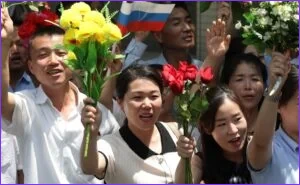
Citizens of North Korea waving at President of Russia Vladimir Putin’s motorcade as it passes by them in Pyongyang during Putin’s state visit to North Korea, June 19, 2024. Only state-sanctioned displays of enthusiasm for Russia are permitted.
You have reached the limit of 2 free articles this month.