The China Coast Guard (CCG) has established a consistent presence in the waters east of Taiwan, a move signaling Beijing’s intent to assert jurisdictional claims over the region. This development follows a period of relative stability in military activity during the first half of 2026, which saw lower tensions due to direct diplomatic engagements between U.S. and Chinese leadership. During the May 13 to 17 summit between Xi Jinping and Donald Trump, Chinese military aircraft sorties around Taiwan dropped to an average of three per day, with no activity recorded on May 14 and 15. This was a notable decrease from the first-half daily average of 7.5 sorties. However, following the summit, the People’s Liberation Army conducted a joint combat readiness patrol on May 19 involving 24 aircraft.
Despite upcoming diplomatic opportunities in September and November, China is actively working to create a de facto advantage regarding Taiwan. Beijing views Donald Trump as a leader who values bargaining leverage, and the CCG has become a primary instrument for applying this pressure. Since 2018, the CCG has been under the direct command of the Central Military Commission, blending militarized capabilities with a law enforcement profile to conduct gray zone operations without triggering open conflict.
The current operational shift began in early June, following the announcement of maritime boundary negotiations between Japan and the Philippines. Because these nations’ claims overlap with waters east of Taiwan, China deployed the CCG to conduct independent law enforcement patrols. These operations, which include vessel inspections and fisheries protection, have become regularized since early July. The area, previously considered a low-pressure "rear area" for Taiwan, is now part of an expanded maritime encirclement strategy. Daily detections of official Chinese ships around Taiwan rose from an average of one per day between January and May to 5.2 in early June, peaking at 10 on June 9.
These gray zone tactics allow Beijing to advance its control while maintaining a narrative of peaceful reunification. For Taiwan, the presence of these militarized police forces necessitates constant high-alert status for its own military and coast guard, despite the inability to engage in direct conflict. For the Philippines and Japan, the CCG’s history of using large vessels and water cannons remains a concern, though coordinating a security response remains complex. Meanwhile, the United States faces a challenge to its First Island Chain strategy, with the administration currently focusing on encouraging regional security cooperation between Tokyo and Manila. Diplomatic pressure remains high, as Beijing continues to link issues like arms sales to the success of future summits, having secured concessions from the White House in previous instances. You have reached the limit of 2 free articles this month.
The operation does not appear to be temporary. In early July, the CCGrotated its formations and continued regularized law enforcement patrols, including inspecting vessels and protecting fisheries.
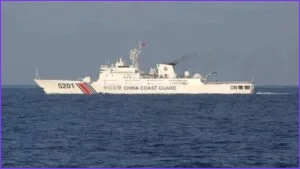
China Coast Guard vessel 5201 operating near Second Thomas Shoal in the South China Sea, Mar. 21, 2023.
China’s military pressure on Taiwan remained generally stable in the first half of 2026, with no major escalation in military aircraft or naval vessel activity. Tensions ran lower than at the end of 2025. This owes largely to the multiple opportunities for direct meetings that the U.S. and Chinese leaders arranged in 2