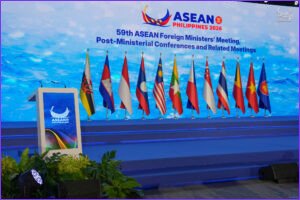
Foreign ministers representing the 11-member Association of Southeast Asian Nations (ASEAN) have voiced "serious concern" regarding the escalating conflict between the United States and Iran. Following the conclusion of the 59th ASEAN Foreign Ministers’ Meeting in Manila, Philippines, on July 21, 2026, the bloc issued a joint statement demanding "a complete and immediate cessation of hostilities across all fronts in the Middle East." The ministers warned that the ongoing violence threatens to undermine international mediation efforts and hampers prospects for a diplomatic resolution.
The current instability follows the collapse of a ceasefire that was initially established in April and formalized in June of this year. Tensions surged earlier this month after both the U.S. and Iran accused each other of violating their agreements. Since the breakdown, the U.S. has resumed air strikes on Iranian targets, while Iran has responded with increased attacks on regional shipping and military installations. One such incident resulted in the deaths of three U.S. military personnel in Jordan. Reports indicate that the conflict has increasingly shifted toward civilian infrastructure, hardening positions on both sides.
Southeast Asian nations remain particularly vulnerable to these developments, as the region relies on the Middle East for approximately 60 percent of its crude oil imports. The initial phase of the conflict, which began with joint U.S.-Israeli strikes on February 28, previously led to a sharp spike in energy prices after Iran blocked the Strait of Hormuz. ASEAN ministers emphasized that the renewed fighting poses immediate and long-term risks to regional trade, energy security, and food supply chains, specifically impacting agricultural production and fertilizer availability.
The ministers further stressed the necessity of upholding freedom of navigation, calling for the restoration of safe, continuous passage for vessels and aircraft through the Strait of Hormuz. During discussions with regional leaders, U.S. Secretary of State Marco Rubio cautioned against allowing Iran to control international waterways, arguing that such a precedent would threaten the global economy. Rubio noted that while the U.S. remains open to a diplomatic settlement, the administration will not permit continued attacks on American personnel or commercial shipping.
Echoing ASEAN’s earlierstatements about the conflict, the foreign ministers noted on Tuesday that the return to fighting, which came after a short resumption of shipping in the Strait of Hormuz, would have immediate and long-term effects on the region’s people, including negative impacts on agricultural production and the stability of agricultural input supply chains, particularly fertilizers. Finally, the ministers stressed the importance of maintaining maritime safety and security, and upholding freedom of navigation in and overflight, calling for the restoration of the safe, unimpeded, and continuous transit passage of vessels and aircraft in the Strait of Hormuz.
While earlier ASEAN statements explicitly identified the origins of the conflict in terms of U.S.-Israeli actions, the most recent communique omitted such language, potentially signaling a shift in the bloc's stance toward the current breakdown in negotiations. Despite the urgent calls for peace, an immediate resolution appears unlikely as both parties continue to escalate their military posturing, leaving Southeast Asian governments bracing for a period of prolonged economic uncertainty.