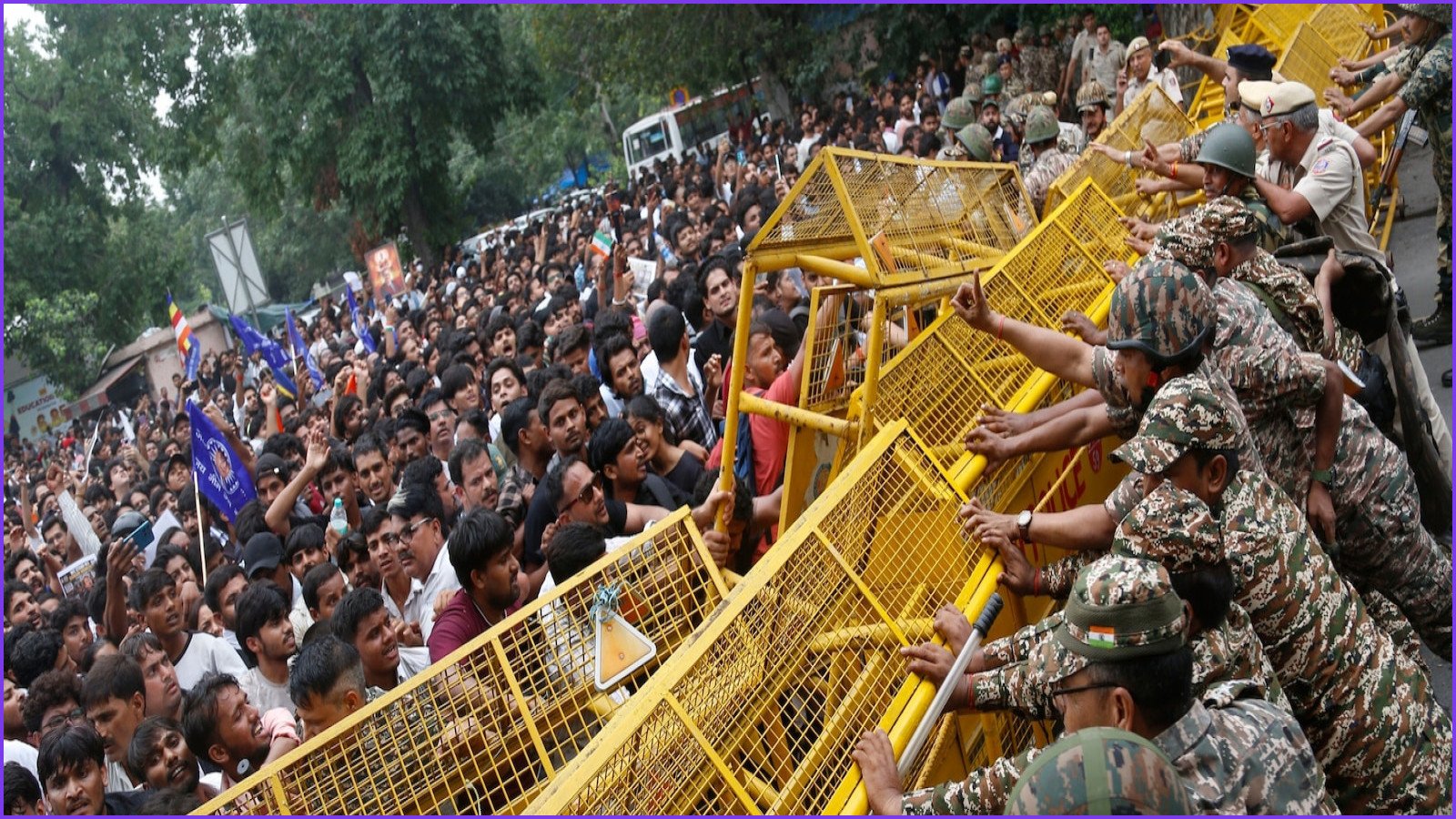
Police in New Delhi utilized tear gas and batons on Monday to halt a march by supporters of the youth-led Cockroach movement, who were attempting to reach Parliament to demand the resignation of Education Minister Dharmendra Pradhan. The confrontation occurred after thousands of demonstrators sought to breach security barricades surrounding their protest site in central New Delhi. Despite the police crackdown, many protesters persisted, continuing their march toward the parliamentary complex in smaller, determined groups.
The Delhi Police stated that the march had not been authorized, citing the necessity of maintaining law and order around the Parliament building during the monsoon session, which officially began on Monday. Saurav Das, a spokesperson for the Cockroach Janta Party, accused the authorities of carrying out a “brutally cracking down” on what he characterized as peaceful protesters. The crowd at Jantar Mantar, a designated protest site located just a few kilometers from Parliament, was diverse, consisting of students, professionals, and families with young children. As the day unfolded, the demonstration spilled beyond the designated area, with protesters filling surrounding roads and streets. Many participants arrived prepared for a long day, carrying backpacks filled with food and water, while waving Indian flags and chanting slogans against both the education minister and Prime Minister Narendra Modi.
The Cockroach Janta Party first emerged in May, following an incident where the Supreme Court chief justice compared some unemployed young people to “cockroaches” during a hearing. Supporters of the movement embraced the derogatory remark, rebranding it into a satirical symbol that has since garnered millions of followers on social media. The campaign gained significant momentum following repeated leaks of high-stakes entrance exams for medical colleges and government positions, which sparked widespread public anger. The movement drew further attention after police forcibly moved hunger-striking activist Sonam Wangchuk to a hospital on Saturday. Protesters have been camping at Jantar Mantar for the past month, joined by various student groups, to demand systemic examination reforms, the resignation of Dharmendra Pradhan, and compensation for the families of students who died by suicide following the paper leaks.
While senior leaders in Prime Minister Modi’s government have previously taken a hard line—with Pradhan accusing protesters of acting against the nation and other ministers insisting that no negotiations were necessary—Monday marked a potential shift. Representatives of the movement, including spokesperson Saurav Das, held talks with Health Minister J.P. Nadda, representing the first sign of government outreach to the protest leaders. During the meeting, Das presented the movement’s core demands, including the immediate removal of the education minister.
Separately, activist Sonam Wangchuk issued a handwritten note from the hospital, appealing for permission to temporarily leave to join the march. He stated that he would only end his nearly three-week hunger strike if the government took responsibility for failures in the education system and exam paper leaks, or if protesters were allowed to reach Parliament and lawmakers pledged to raise the issues in both Houses. These protests represent a rare public challenge to Prime Minister Modi’s Hindu nationalist government in its third term, attracting support from opposition parties, rights activists, and some Bollywood celebrities. Participants like yoga teacher Jyoti Rajput expressed frustration that the “rotten system” refuses to take action or acknowledge the pain of students. For others, such as 26-year-old protester Sneha Eppili, the campaign has evolved into a broader struggle for government accountability, with many expressing concern that the space for dissent has shrunk under the current administration, which has been criticized for jailing activists and using forceful police crackdowns.