Approximately 109 million people across the US Midwest, Mid-Atlantic, and Northeast are facing another day of poor air quality due to smoke from Canadian wildfires. Residents are experiencing smoky skies and irritated eyes as the plumes drift south.
Cities like Chicago and Detroit recorded an air quality index (AQI) reaching a "hazardous" 361 on Friday, prompting warnings for residents to stay indoors and reduce activity. The smoke, largely originating from about 200 out-of-control wildfires in Canada, also led to "very unhealthy" air quality in Baltimore (AQI 281) and Washington D.C. (AQI 247) by 6 a.m. eastern time. New York City, under smoke cover since Tuesday, saw its AQI at an "unhealthy" 184 early Friday, later improving to 124, which is considered "Unhealthy for Sensitive Groups." Philadelphia and Cleveland reported readings around 260, also in the "very unhealthy" category. Parts of Michigan, Minnesota, and Wisconsin also registered readings in the "hazardous" range.
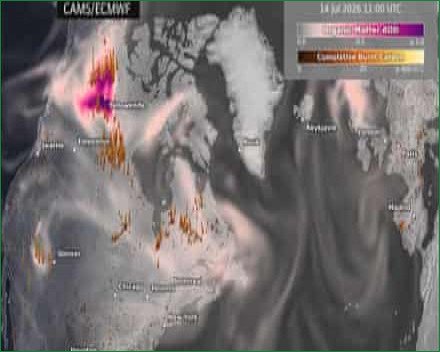
The global air quality index indicated that pollution levels in five major North American cities were higher than those in Kinshasa or Nairobi. Nasa's Fire Information for Resource Management System shows Canadian wildfire smoke reaching deep into the Northwest Territories.
In Michigan, the state's Department of Environment, Great Lakes, and Energy advised closing windows, minimizing door openings, and using HVAC systems with MERV-13 or higher filters. For outdoor activities, the recommendation was to use an N95 or P100 respirator marked with NIOSH.
Some areas in the Northeast and New England are expected to see relief as stronger winds from Quebec, rather than the wildfire zones in northwestern Ontario, are predicted to clear the smoke. Mark Parrington, a senior scientist at the Copernicus Atmosphere Monitoring Service, noted a clear intensification of wildfire activity in Canada over the past few weeks. He stated that smoke from major fires, particularly in Ontario, is having severe air quality impacts across cities in the Great Lakes region and the northeastern United States.
Parrington added that forecasts show the smoke continuing to move eastwards across the North Atlantic, potentially reaching Europe, underscoring the vast scale of wildfire pollution and its ability to travel thousands of kilometers. Organizers for the World Cup final in East Rutherford, New Jersey, are closely monitoring smoke patterns, as smoke currently over the Mid-Atlantic is expected to drift back into the Northeast. An approaching storm system from the west, bringing severe thunderstorms, could interact with the smoke, potentially worsening conditions by dragging smoky air from higher altitudes down to the ground.
Air quality is likely to improve by Sunday afternoon, in time for a 3 p.m. kick-off, after the storm passes late Saturday. However, authorities are monitoring whether smoke plumes will affect the game. Parrington mentioned that another smoky air mass appears to be following the storm system, but its extent and potential impact on New York or New Jersey by Sunday remain unclear. He noted that if fire intensity significantly increases on Saturday, more smoke could enter the atmosphere and quickly follow the rain event.
Canada's largest fire, near Ontario's remote Wabakimi provincial park, has spread across 787,802 acres (318,812 hectares), according to the Canadian Interagency Forest Fire Center. This is among 194 out-of-control and large fires burning as of Thursday. Smoke plumes from large-scale wildfires in Canada's Northwest Territories have reached the Arctic Ocean and other parts of the country. Nearly 6 million acres have burned nationwide, which is less than a quarter of the land consumed by blazes when Canadian wildfire smoke last blanketed the US in 2023. Fires in northern Minnesota have burned over 63,000 acres.
Wildfires are also active in Oregon, Washington, and Idaho. Forecaster Colin McCarthy wrote on Thursday evening that the wildfire situation across North America has worsened, with tens of thousands of lightning strikes igniting dozens of new wildfires across the Pacific Northwest.
A 2025 study by Carnegie Mellon University's Tepper School of Business suggests that wildfire smoke risks reversing gains made from reductions in other pollution sources. Researchers estimated that smoke from wildfires and prescribed burns caused $200 billion in health damages in 2017 and was associated with 20,000 premature deaths. Nicholas Muller, a professor of economics, engineering, and public policy and co-author of the study, stated that many studies have found fire smoke, like other air pollutants, is associated with increased morbidity and mortality risk.
Separately, heavy rainfall across south and central Texas, including the Texas Hill Country, has exceeded 20 inches (50 cm) in some areas since Monday. AccuWeather's Global Weather Center provided a preliminary estimate of damage and economic loss between $11 billion and $13 billion from this extreme rainfall. This is consistent with findings from the company's climate research unit, which indicates that rainfall amounts greater than 4 inches in a 24-hour period have increased by 70% since 1995.
Jonathan Porter, AccuWeather's chief meteorologist, explained that the common description of an extreme rainfall event as a "1-in-1,000-year rain event" relies on probabilities. He added, "In a warming climate, those historical probabilities are changing, meaning these extreme rainfall events can occur more frequently than the statistics from the past would suggest."