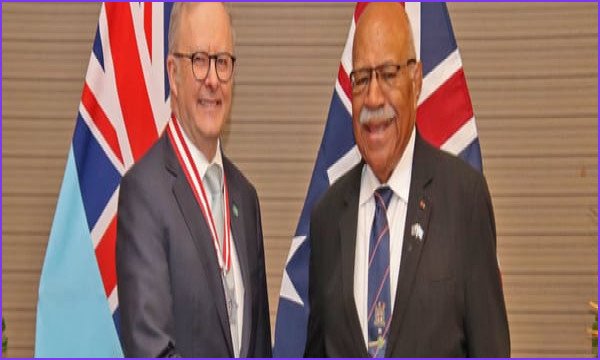
Australia’s historical engagement with the Pacific has often been characterized by long periods of neglect, interrupted by sudden bursts of activity and anxiety. Fiji’s Prime Minister Sitiveni Rabuka greets Australian Prime Minister Anthony Albanese at the Grand Pacific Hotel, Suva, Fiji, July 6, 2026. This inconsistent approach undermines the foundation required for durable regional security. Recent diplomatic efforts, including Prime Minister Anthony Albanese’s signing of security and defense agreements with Vanuatu and Fiji, coupled with visits to the Solomon Islands and hosting leaders from Papua New Guinea, Samoa, and Tonga in Brisbane, highlight a period of intense focus. This flurry of activity occurs against the backdrop of China testing a ballistic missile in the region, a move that serves as a stark reminder of Beijing's growing influence and presence.
While the current Albanese government has fostered stronger relationships with Pacific leaders compared to the previous Morrison administration, critics suggest that Australia must do more to become a truly reliable neighbor. Since the late 2010s, they have rediscovered the Pacific’s importance yet again as strategic competition between China and Australia’s ally, the United States, has intensified. Historians and policy experts note that Australia’s interest in the Pacific has traditionally been reactive, driven by fears of European powers in the 1800s, global conflicts in the 20th century, and now, the intensifying strategic competition between China and the United States. As historian Neville Meaney famously observed, Australian foreign policy has often been defined by a desperate search for security within the Pacific.
This cycle of amnesia and urgency has significant costs. Historically, Australian policy was built on the concepts of terra nullius and dispossession, fostering a settler community that felt inherently vulnerable and sought protection first from Britain, then the United States, and now through the AUKUS security partnership. This mindset often led policymakers to treat Pacific Island nations with a mix of suspicion and condescension, viewing their smaller size as an irritating distraction from Australia's broader foreign policy objectives. Even the shift in 2018 under Prime Minister Scott Morrison, who began referring to the region as Australia’s “family,” did not fully resolve the underlying tension of these relationships.
Despite landmark security treaties with Tuvalu, Nauru, Papua New Guinea, and Fiji, and the Nakamal Agreement with Vanuatu, these improvements face fundamental limits. The Pacific is vast and diverse, making it difficult for a middle power like Australia to exert total influence. When Australia attempts to impose its will, it is often perceived as practicing neocolonial overreach. This dilemma is currently acute, as Australia faces an adversary with military superiority and significant economic resources at a time when the United States appears to be in strategic retreat.
A more effective path forward involves adopting a policy of “good neighborliness.” Terms like the 2023 Falepili treaty with Tuvalu, which emphasizes mutual respect and duty of care, and the 2025 statement of intent with Tonga, illustrate a desired shift in language. To succeed, Australia’s engagement must be guided by four core principles: respecting sovereign boundaries, learning to disagree constructively, fostering self-awareness, and prioritizing cooperation over coercion. Successful historical precedents, such as the 1980s Pacific Patrol Boat Program and joint stances on climate change and nuclear nonproliferation in the 1990s, demonstrate that such a relationship is achievable. Ultimately, policymakers must ensure that this commitment to the region remains steady even after current anxieties regarding China subside, as geography is a constant factor in Australia’s long-term security.
You have reached the limit of 2 free articles this month.
But those improvements will always be limited if Australians don’t grapple with our complex history with the region and how it influences our ideas about the region and its people.