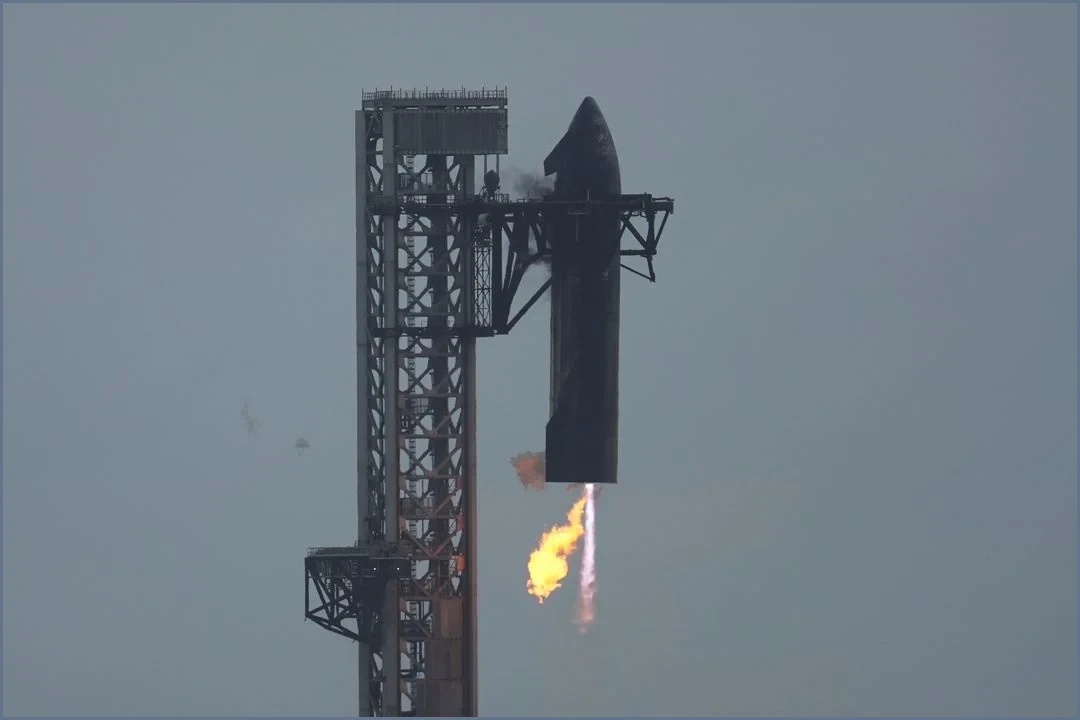
In a major engineering step toward full rocket reusability, SpaceX successfully recovered the upper stage of its Starship spacecraft at its Texas launch tower after completing a landmark 22-hour orbital mission. The two-stage launch system took off on Friday from the company's Starbase facilities situated along the Gulf coast of southern Texas. Although plans to recover both segments simultaneously were thwarted when the towering Super Heavy booster failed to execute its pad return about 10 minutes after liftoff, the Starship centerpiece vessel completed 14 orbits around Earth in its longest flight to date.
During the orbital phase of the mission on Friday evening, Starship deployed 26 Starlink satellites into orbit while cruising at an altitude of approximately 260 kilometres. On Saturday, the spacecraft ignited an engine to begin its descent into the atmosphere, enduring extreme heat and friction as it reduced its orbital speed of roughly 27,360 kilometres per hour into a supersonic glide above south Texas. Starship then fired three Raptor engines to flip itself into a vertical orientation, maneuvering toward the launch structure where two mechanical "chopstick" arms caught the hovering vehicle in mid-air.
The successful mid-air catch marks a critical milestone in the multibillion-pound development of Starship, which billionaire Elon Musk envisions as the primary transportation system for SpaceX's satellite network and future crewed expeditions to the Moon and Mars. Musk aims to achieve rapid turnaround times comparable to commercial aviation operations. SpaceX's current market leadership relies heavily on its Falcon 9 rocket, which has logged more than 700 flights since 2010; however, while the Falcon 9 recovers its first-stage booster, its payload-bearing upper stage is discarded in the ocean following each launch.
Despite Saturday's successful aerial recovery of the upper stage, SpaceX has yet to recover both the booster and the upper stage during a single test flight. Furthermore, the spacecraft's protective heat shield—which consists of hexagonal ceramic tiles engineered to withstand atmospheric re-entry—will require additional refinement before Starship can achieve true full reusability without requiring extensive refurbishment between missions.