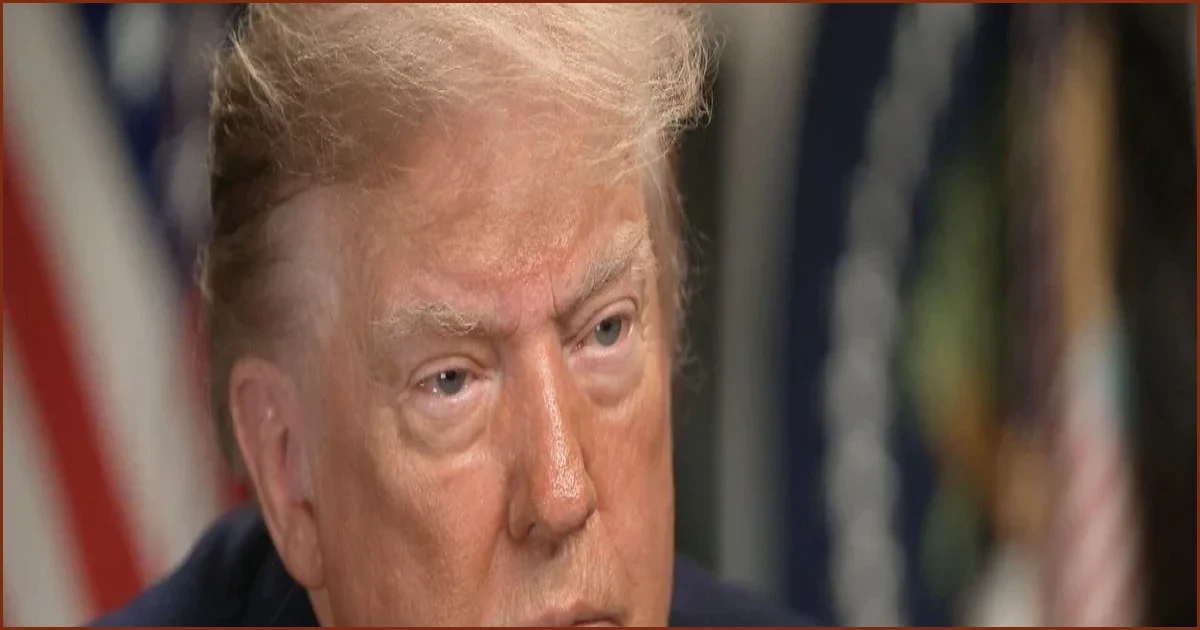
Days after Republicans faced significant midterm election setbacks, President Trump acknowledged some "bad messaging" on economic issues and conceded that his immigration crackdown had been "too tough" at times. Speaking with 60 Minutes correspondent Ross Douthat on November 8, 2026, at 7:00 PM EST, the president also hinted at impending personnel changes, announcing just one hour later that White House chief of staff Susie Wiles would be replaced by Stephen Miller.
Analyzing the losses, Mr. Trump told 60 Minutes that voters "didn't like the war" with Iran or the subsequent surge in gas prices. However, he maintained that the primary reason for the Republican defeats was his absence from the ballot, an explanation he has offered repeatedly. He suggested his pre-election endorsements and rallies had brought many people "a lot closer to victory." Despite his frequent urging for supporters to "pretend that I'm on the ballot" before Election Day, Mr.
Trump speculated, "I think they didn't vote, really. I think they didn't vote. I think in some cases, they didn't like the candidates. And that's, you know, their prerogative." He defended his endorsement of Texas Attorney General Ken Paxton over incumbent Senator John Cornyn in the state's bitter GOP Senate primary, stating, "Cornyn would have lost also." He also endorsed Senator Darline Graham, who was appointed to fill her late brother's South Carolina Senate seat.
The morning after the election, Vice President JD Vance attributed the losses on social media to "the broadly unpopular Iran war." Mr. Trump confirmed Vance had informed him of his plan to write the post, to which he responded, "You write what you want." While stating he didn't disagree with Vance's diagnosis "other than one thing," Mr. Trump posed, "if you had … to do again, would you do it? And that's Iran. Would you go and attack Iran?" He answered with an "emphatic yes," arguing that Iran's conventional military had been degraded and its nuclear program set back. "I think historically, this will be a very good decision. Is it a good decision for today and tomorrow? Maybe not? But … I have to go with what's right for our country," he said, adding, "If they had a nuclear weapon during my term, I would be excoriated far worse than what's happened." Later in the day, during an Oval Office visit, Mr.
Trump reiterated his belief that historians would judge the Iran war more favorably than voters, drawing a parallel to former President Ulysses S. Grant, whose reputation has improved over time. "I think as an example — the fact that I have taken the nuclear weapon away from Iran will not be good, short-term. But long-term, I think it's going to be very important." Since September, Iran and the U.S. have largely avoided major attacks, though the U.S. conducted limited defensive strikes on Iranian targets earlier this week. Asked if he planned to escalate the war post-midterms, the president replied, "Well, I'm not looking to. I don't think there's any reason to."
Regarding the economy, Mr. Trump defended his administration's stewardship, hours after a stronger-than-expected jobs report. He declared, "the numbers are phenomenal," asserting, "We're doing numbers that have never been done before. 401(k)s are at their all-time high by a lot. Under other presidents, they were a disaster. 401(k)s have made people rich." When pressed that not all Americans possess large retirement accounts, he responded, "But a lot of people do." However, exit polling revealed that three-fourths of midterm voters viewed the economy as either poor or not so good, with 70% of this group voting for Democratic House candidates.
Voters expressed particular concern over the prices of gasoline, food, utilities, and healthcare, and two-thirds believed Mr. Trump's tariff policies had harmed the country's economy. Mr. Trump attributed this perception to a failure to "get the word across," stating, "I think it was bad messaging, maybe by me, but I would talk about it all the time. So I don't know, how much can I talk about it?" He predicted that Americans would "notice it in the next two, three, four months" as his policies would lead to a resurgence of manufacturing jobs.
On immigration, which partly fueled his 2024 victory, Mr. Trump acknowledged it "both helped and hurt." While he believed he earned an "A+ for closing up the border" and "very high marks for getting the bad ones out," he admitted to being "hurt because we also took people that had good jobs, that created one violation, or breaking of the law, and that was that they came into the country illegally." He noted the country's division on whether such individuals should be removed or allowed to stay if they are "good people working in a landscaping company, or working in a hotel, or doing something, right?
And in some cases, paying taxes." Ultimately, he concluded of his deportation policies, "I think it was too tough." This year's exit polling showed 58% believed the Trump administration's actions on immigration had gone too far, with many Latino voters in battleground states like Texas shifting back to Democrats due to these concerns.
Despite this, his new chief of staff, Stephen Miller, is widely seen as an architect of the administration's immigration enforcement strategy and last year pressed Immigration and Customs Enforcement (ICE) to conduct at least 3,000 arrests per day. Mr. Trump expressed a desire to "love to do something on immigration" with congressional Democrats.
Regarding his personal wealth, Mr. Trump, the wealthiest person to hold the presidency, whose net worth has grown by billions partly due to his family's cryptocurrency ventures, denied prioritizing his business interests. Polls suggest many voters believe he does. When asked about Forbes reporting his net worth soared since returning to the White House, he responded, "So did everyone." After Douthat noted his net worth hadn't increased by nearly $3 billion, Mr. Trump quipped, "Well, you should've had stock." He claimed, "I devote almost no time to my net worth.
I don't care. I have a lot of money, and far more than I ever thought I'd have. And I guess it's gone up. I don't even know." He explained his stock holdings are in broad indexes and his sons manage his company, making it "hard to say to them, 'Don't do anything anymore for four years because I'm president.'" He added that "every president has had this problem" where former administration officials move to private industry, creating a perceived "conflict."
Looking ahead to the 2028 presidential election, with Vice President JD Vance and Secretary of State Marco Rubio seen as potential successors, Mr. Trump said he would "probably," but "not necessarily," endorse a Republican primary candidate. He noted the Republicans "have a tremendous bench" and "I have so many people that I have great relationships with," including "some senators that are excellent." He concluded, "I may or may not get involved. I don't know. Maybe I'm better off not getting involved. I think it would play a big role if I did, because my endorsement capacity has been very strong."
Mr. Trump also stated his intention to aggressively use his pardon power before leaving office. "I don't want to have good people that are serving this country and doing a great job spending the rest of their life, like I had to do for four years, defending myself by radical left lunatics, by people that were very nasty and mean. I intend to issue tremendous numbers of pardons," he said, jokingly adding that "anybody that got within a thousand miles of the Oval Office" could receive one. While he doesn't expect to pardon himself, he considers it "certainly not unreasonable." He also mentioned, "I pardoned the J6ers. I don't think any group's been treated more unfairly than them, and to this day, when they see me they cry." When asked about Jan. 6 rioters who attacked police officers, he argued, "there were some that got rough, but, you know, they were rough to them, too."
Among the most frequent questions he receives, Mr. Trump noted, are those concerning unexplained anomalous phenomena, or UFOs. Earlier this year, he signed an executive order mandating the release of sensitive files on UAP sightings, leading to the Pentagon disclosing photos, videos, and investigative reports on these unexplained objects.
Towards the end of the interview, Douthat asked Mr. Trump, who has survived multiple assassination attempts, about his thoughts on what will happen when he dies. "Well, I hope I'm missed," he responded. When pressed for a more spiritual answer, he said, "Well, I'm a religious person, so in theory, I go to heaven. I hope so. I don't want to go to hell." Asked if he could forgive his political foes to enter heaven, Mr. Trump stated, "The answer is no. I want to be honest, no." He acknowledged that while the "easy answer" would be yes, "I probably cannot do that, no, because I do hate some of my enemies and always will."