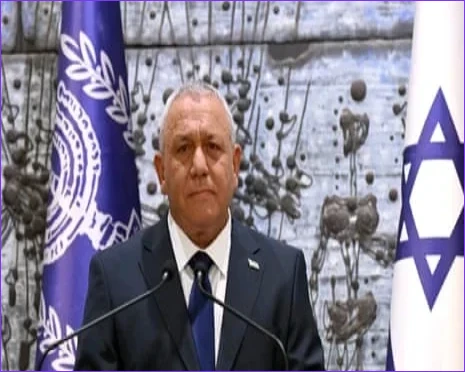
Israel’s former military chief Gadi Eisenkot has officially begun the complex process of forming a government, reaching out to allies of Prime Minister Benjamin Netanyahu as he seeks to address what he describes as a historic crisis. Eisenkot, the 66-year-old leader of the Yashar party, received a 28-day mandate from President Isaac Herzog on Sunday. Despite his bloc failing to secure a clear parliamentary majority in the October elections, Eisenkot is tasked with bridging the country’s deep polarization.
Speaking at a ceremony at the presidential office, a formally dressed Eisenkot warned that Israel is currently in a state of emergency and nearing a point of no return. He emphasized the necessity of forming a national emergency government, noting that such an effort would require unconventional and creative political maneuvers. Eisenkot faces a challenging path to the premiership, with three primary options: negotiating a power-sharing deal with Netanyahu, securing support from Arab-led parties—a move opposed by some members of his own bloc—or forming an agreement with the ultra-Orthodox parties, which demand military exemptions for their community.
Both Eisenkot and Herzog acknowledged that Israel is facing growing international isolation, particularly as Netanyahu remains a target of the international criminal court. Eisenkot further highlighted a diplomatic crisis, noting that even long-term strategic allies are suggesting a reassessment of their relationships with Israel. This comes as Democrats in the US recently swept midterm elections, with increased calls for restraint following the devastation in Gaza and the unpopular war in Iran initiated by Netanyahu and Donald Trump.
To secure a coalition, Eisenkot has extended an invitation to Netanyahu’s Likud party and the far-right party of finance minister Bezalel Smotrich, provided he serves as prime minister. He stated his door remains open to anyone who recognizes the gravity of the current situation. Should he succeed, he would replace Netanyahu, Israel’s longest-serving leader. Currently, Eisenkot’s opposition bloc holds 48 seats in the 120-seat parliament, while Netanyahu’s camp holds 53, leaving both short of a majority.
During consultations, Arab-majority lists endorsed Eisenkot, potentially positioning them as kingmakers. However, Eisenkot has set specific conditions for their participation, including the recognition of Israel as a Jewish state and the classification of Hamas as a terrorist organization. One of his partners, the Yisrael Beiteinu party, has already stated it will not join a coalition with Arab-led parties. Meanwhile, Netanyahu has alleged that the election was stolen by Arab parties, though he has provided little evidence, and he continues to pressure Eisenkot by labeling any potential alliance with these parties as an act of betrayal. While the Shin Bet security agency has investigated potential foreign interference, both the Central Elections Committee and President Herzog have confirmed the validity of the vote.
Eisenkot, who served as military chief of staff from 2015 to 2019, has vowed to unite the country and address extremist violence in the West Bank, which he characterized as Jewish terror abetted by Netanyahu’s government. While he opposes a Palestinian state, he remains committed to ending Hamas’s rule in Gaza and destroying the Islamist movement’s military wing. Eisenkot also previously devised the Dahiya doctrine, which involves using massive force against civilian infrastructure in areas controlled by Hezbollah. If no coalition is formed, Israel faces the prospect of fresh elections, having already held five between 2019 and 2022.