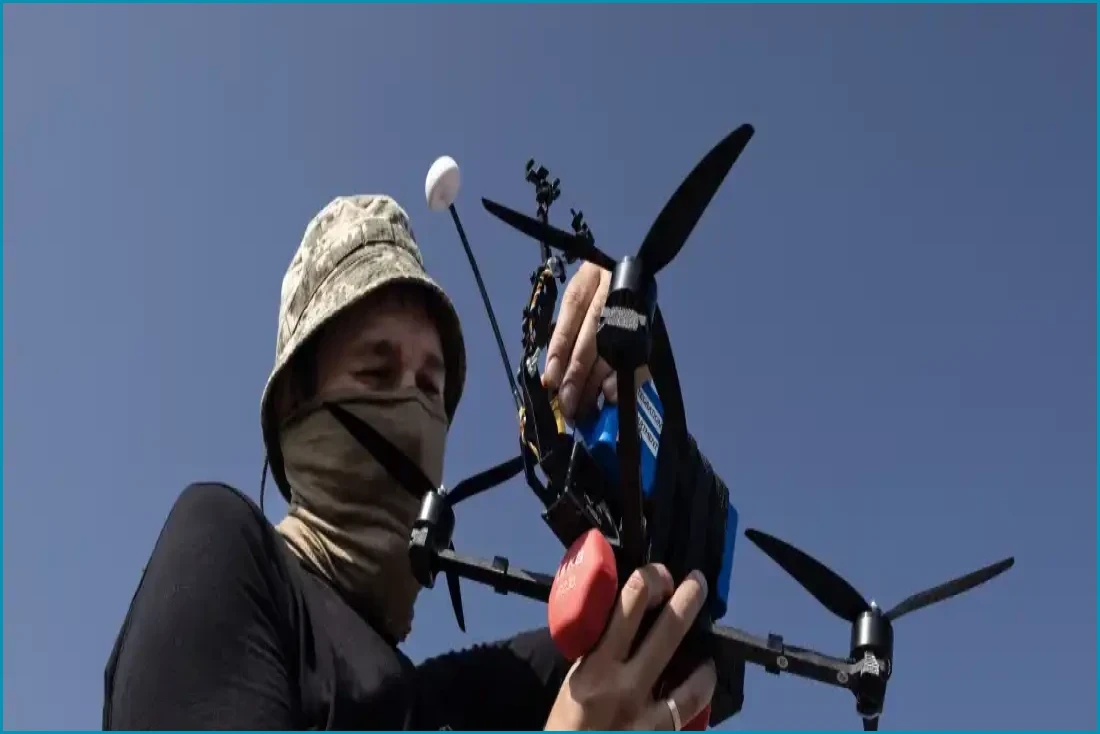
KYIV, Ukraine — The landscape of modern warfare is being reshaped by artificial intelligence, with Ukrainian tech entrepreneur Yaroslav Azhnyuk at the forefront of developing advanced AI-powered drones since Russia's full-scale invasion in 2022. Azhnyuk, who previously worked in Silicon Valley and founded companies like Petcube, which used AI for pet cameras, shifted his focus to defense to protect his country.
Azhnyuk, 37, a computer scientist from a family of scholars, now runs Ukraine-based defense firms The Fourth Law and Odd Systems. These companies are among the leading producers of AI-powered drones in Ukraine, with their autonomous Lupynis-10-TFL-1 drone already in use by dozens of Ukrainian military units.
Highlighting the transformative potential of AI, Azhnyuk stated, "When the other side has orders of magnitudes higher capabilities, it gives you an asymmetric advantage. It can make you 10,000 times more effective." He noted that his firms are "leaders in autonomous drones and thermal cameras." He also drew a stark contrast between his previous work and his current mission: "I was like, OK, I've got to move on from Petcube and do something to protect my country.
And so now we're making not cameras that fling treats but cameras that fling explosives at people who came to occupy our land."
The deployment of AI-enabled drones by both Ukraine and Russia has intensified a high-tech arms race, prompting concerns from various quarters, including Ukrainian President Volodymyr Zelenskyy. President Zelenskyy has cautioned that AI could be making battlefield decisions as early as next year.
Azhnyuk acknowledges the apprehension surrounding destructive weapons but argues that such concerns are not unique to AI. "It has been with humanity since the invention of fire or steel," he explained. "Any kind of tool can be used for good or for bad. And in the end, it's the human that decides how to use that tool."
The Lupynis-10-TFL-1 drone, named after 20th-century Ukrainian poet and political activist Anatoliy Lupynis, embodies this new era of warfare. The Fourth Law names all its weapons after Ukrainian intellectuals and artists persecuted by Russians in the last century, a practice Azhnyuk says helps "resurrect those people" whose "ideas are still with us. And now they're fighting back."
This autonomous drone integrates a small, affordable first-person-view (FPV) drone with an autonomous terminal guidance unit. This system features an onboard computer and AI technology that assumes control during the final 500 meters (0.3 miles) of flight. Azhnyuk clarified that this AI is distinct from large language models like Claude or self-driving systems in Tesla vehicles.
Instead, it employs "simple tools to recognize images and make smart software which then allows you either to navigate autonomously without a human or to choose a target autonomously or to fly toward the target autonomously."
Teams from The Fourth Law conduct daily tests of the Lupynis TFL-1 drones. During one such test in an overgrown field outside Kyiv, a team leader using the call sign Stab demonstrated the drone's capabilities. He pointed to the drone's microcomputer, stating, "All of the mind is here." This microcomputer utilizes a deep-learning neural network, trained with hours of combat footage to identify targets such as vehicles, light-armored vehicles, tanks, and flying objects.
The demonstration involved a pilot, identified by the call sign Professor, who guided the drone initially with a control stick. After selecting a target and confirming a lock with a red flash on a video monitor, Professor released the controls. The drone then autonomously flew towards a dilapidated car driven by an employee along a dirt road, with its microcomputer continuously running algorithms to maintain its course.
"See, Professor is doing nothing, and the drone is doing everything itself," Stab observed. While the test drone did not carry an explosive, a battlefield version would.
Stab emphasized the utility of AI drones due to their resistance to jamming and assured that safeguards are in place to prevent The Fourth Law's drones from operating without human oversight, as humans select the initial target. Azhnyuk further dismissed fears of "killer robots," asserting that his company's AI-powered drones are "very far from a Terminator kind of scenario." He likened them to "calculators," no more prone to an uprising "than a warehouse with artillery shells."
However, Azhnyuk acknowledged the rapid advancement of AI, admitting it's "not unthinkable" that "some years in the future there will be drones that will be able to make their own decisions on designating targets or not." For now, his focus remains on Ukraine's immediate needs.
He stressed the critical imperative for Ukraine to adopt AI defensively: "Our adversaries are using the very same technologies, and if they use AI for decision-making in an offensive scenario, and if we refuse to use AI in decision-making in a defensive scenario, we've lost, right?
Because their systems are capable of making decisions in microseconds, and human control takes minutes, hours and sometimes days." He concluded that if Ukraine loses, "there's no way for us to argue about the ethics of AI," prioritizing survival as "the most important thing."