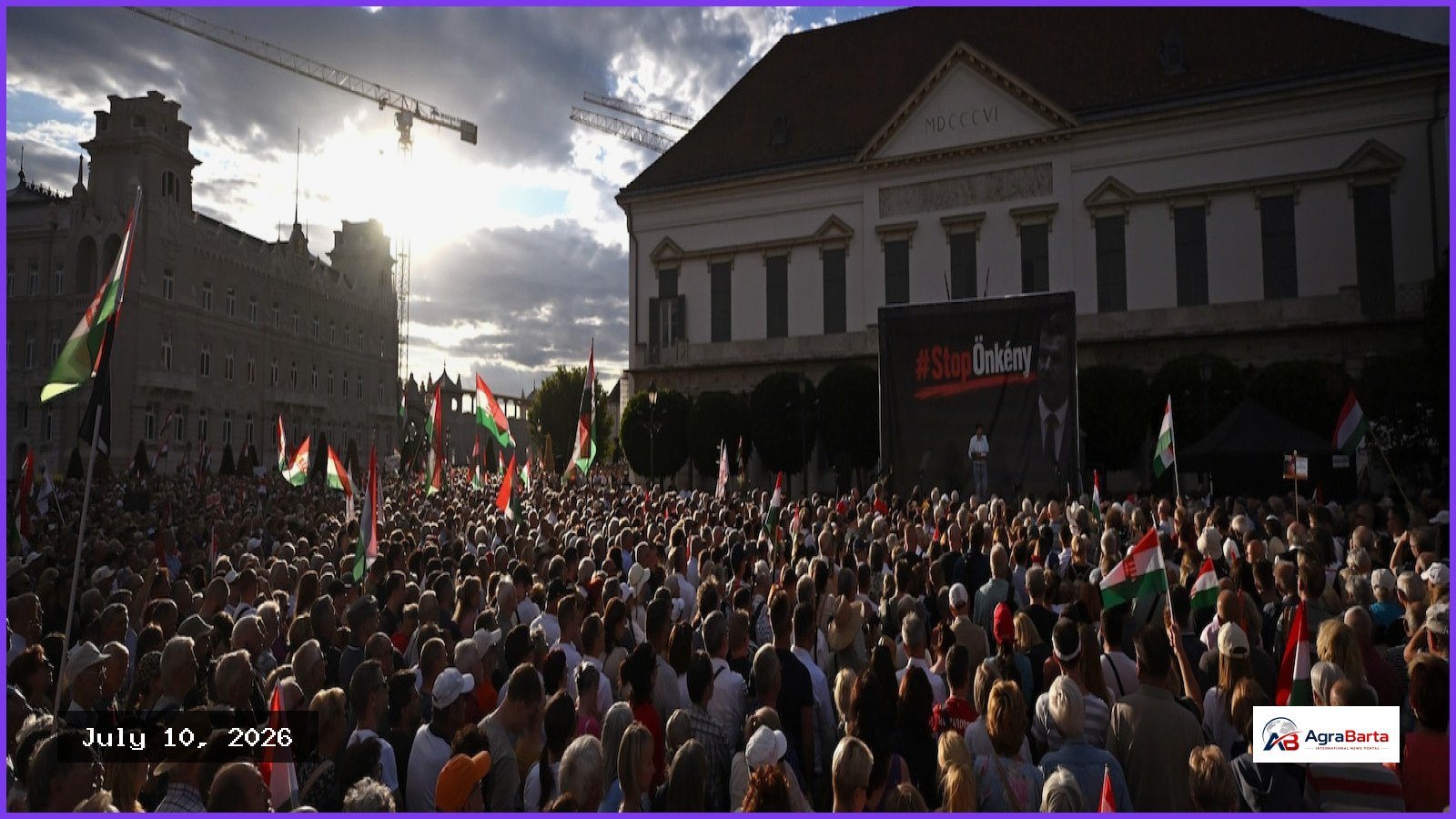
Several thousand demonstrators gathered at the Sándor Palace in Budapest’s Castle District on Thursday to protest the Hungarian government’s efforts to remove President Tamás Sulyok. The rally was prompted by an urgent call to action from former Prime Minister Viktor Orbán, whose Fidesz party organized the event, titled “Stop Tyranny.” Although Orbán vigorously promoted the protest on social media, he did not attend in person.
The demonstration comes as the new center-right government, led by Prime Minister Péter Magyar, prepares to put a constitutional amendment to a vote next week. The measure aims to terminate Sulyok’s presidential term, implement parliamentary term limits, reform the judiciary, and establish a new authority to investigate alleged financial abuses during Orbán’s tenure. Magyar, who defeated Orbán in April after his 16-year rule, has accused Sulyok of failing to uphold his presidential duties by not challenging the antidemocratic measures enacted under the previous administration.
While the Hungarian presidency is largely a ceremonial role, the office is responsible for signing legislation and can refer bills to the constitutional court. Supporters of the new government fear that Sulyok, an appointee from the Orbán era, could use these powers to obstruct their reform agenda. Magyar has cited his party’s two-thirds parliamentary majority as a clear mandate to fulfill his campaign promise of removing Sulyok.
Conversely, Orbán and his Fidesz party have characterized the move as an assault on the rule of law and a step toward dictatorship. Fidesz lawmaker János Pócs defended his party’s history of passing 15 constitutional amendments since 2011, stating at the protest that their actions were always intended to protect the country rather than establish a dictatorship. Protester Krisztina Nemerkényi emphasized that the demonstration was intended to defend the office of the president rather than Sulyok personally.
Since taking office in May, Prime Minister Magyar has moved rapidly to dismantle what he describes as Orbán’s “mafia”-like influence. His administration has suspended the news services of public television and radio, labeling them propaganda tools for Fidesz, and removed the heads of national security and intelligence agencies. These efforts, alongside judicial reforms, have already succeeded in unlocking 16.4 billion euros (approximately $19 billion) in European Union funds for Hungary.