Ukrainian President Volodymyr Zelenskyy and U.S. officials are at odds over recent disruptions to the Starshield satellite communications service, a vital tool for the Ukrainian military. President Zelenskyy stated his belief on Sunday that the U.S. government is responsible for his military's loss of normal access to both Starshield and Starlink services. He alleged that tech firm SpaceX imposed these restrictions following a "message from [the] American government."
Zelenskyy warned that any U.S. alignment with Russian President Vladimir Putin would constitute a "historic mistake." He further claimed that the Starshield system has not been fully restored, contrary to public statements by U.S. government officials. The Ukrainian leader described over the weekend the consequences of these restrictions as "very painful and unpleasant," noting they have hampered Ukraine's ability to intercept weapons launched by Russia.
The Starshield system, a high-powered military version of Elon Musk's SpaceX-operated Starlink internet network, has been shared with Ukraine by the U.S. Defense Department since 2024, costing the Pentagon billions of dollars. Ukraine relies heavily on this network for its defense operations against Russia. Zelenskyy elaborated on its importance, stating, "We use Starlink to intercept the jet fighters that are hitting our civilians and killing families." He added, "We also use Starlink for middle strikes on enemy military targets in our temporarily occupied territories. We were unable to do this when there were restrictions. And the third, most important thing is people. Our soldiers, who have been on the front line for weeks and months, are being delivered food and water using appropriate drones with Starlink."
The disruptions, which Zelenskyy said came without warning last week, left Ukraine's military frontlines vulnerable. He reiterated that the network's speed remains unrestored.
U.S. officials have rejected Zelenskyy's accusations. President Trump, speaking to reporters on Friday, denied any interference with Starshield. "I don't know if it was anybody because it wasn't me, and I don't think it was Elon. And from what I understand, it's the same as it's always been," Trump said. Secretary of State Marco Rubio echoed this sentiment on Saturday, telling reporters, "It's just categorically false. No one at the White House ordered anyone to slow down internet or slow down speed so that certain drones couldn't use it." Rubio also mentioned that Ukraine had requested access to the system for deep strikes inside Russia, a matter currently "under conversation." SpaceX CEO Elon Musk stated that the U.S. government is responsible for the system, and "any limits on speed or usage are decided by the US military and ultimately POTUS."
Amid the conflicting claims, a bipartisan group of senators is calling for the Defense Department's inspector general to investigate how the system was disrupted.
The Starshield dispute has intensified questions regarding the United States' commitment to supporting Ukraine, with tensions between President Trump and President Zelenskyy escalating in recent days. Earlier this month, Trump moved to ease U.S. sanctions against Russia, a decision Zelenskyy criticized as a "weak decision by strong partners." Trump responded by lashing out at Ukraine for striking Russian refineries, which he claimed were affecting U.S. diesel prices, and suggested, "I think it's time for Ukraine to get a new president."
The war of words continued, with Zelenskyy revealing on Sunday that U.S. intelligence sharing with Ukraine concerning Russian ballistic missile attacks had been blocked for three days before resuming. Ret. Navy Adm. Mark Montgomery stated he believes the Starshield disruptions are a signal from the White House to halt attacks on Russian oil refineries. Montgomery described this as an "extremely vulnerable moment for Ukraine," noting that more Russian drones are now able to penetrate defenses.
Over the past week, Russia has launched more than 4,000 strike drones, bombs, and missiles against Ukraine, according to Zelenskyy. Russian attacks on Saturday night specifically targeted energy substations, leaving tens of thousands without electricity. In response, Ukrainian forces hit a major refinery southeast of Moscow last Thursday, after Zelenskyy had declared he was "done" following Trump's calls for an "energy ceasefire." On Sunday, Ukrainian strikes set an oil export terminal and a depot on fire in St. Petersburg, Russia, as Kyiv launched over 1,000 drones at Russian targets.
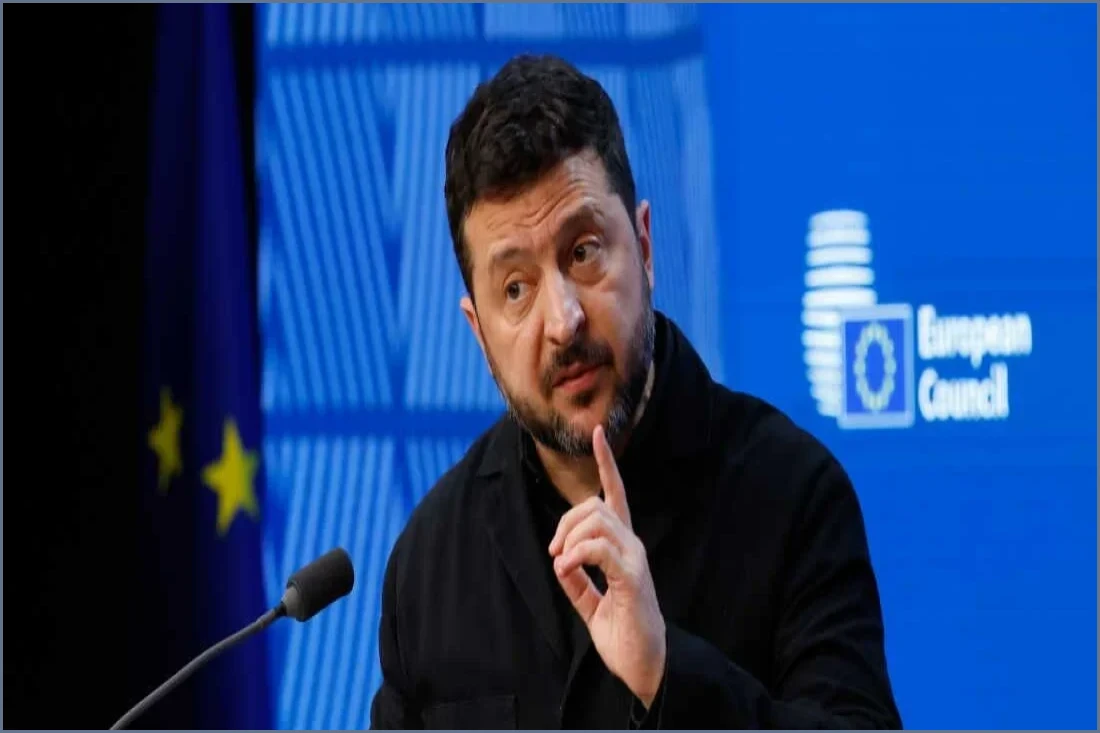
Ukraine's President Volodymyr Zelenskyy speaks during a media conference at the EU summit in Brussels, Friday, Oct. 16, 2026. Geert Vanden Wijngaert/AP hide caption
A policeman helps an elderly woman to walk out from a residential building damaged by a Russian airstrike in Zaporizhzhia, Ukraine, Saturday, Oct. 17, 2026. Kateryna Klochko/AP hide caption