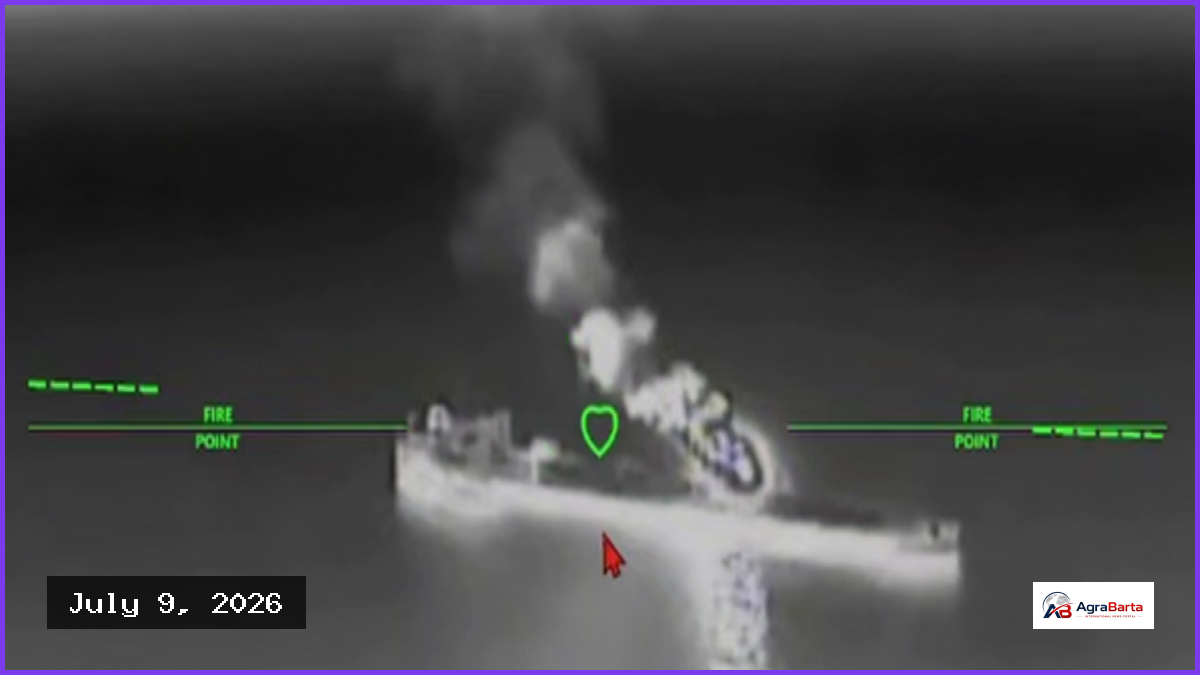
Ukraine’s military has significantly intensified its aerial and naval drone operations near Russian-annexed Crimea, shifting its focus from land-based supply corridors to critical maritime fuel routes. According to Robert Brovdi, the commander of Ukraine’s drone force, at least 25 vessels have been struck and ignited over the past four days within the Sea of Azov, a waterway connected to the Black Sea via the Kerch Strait. Ukrainian military estimates suggest as many as 36 ships have been hit, many of which are identified as part of Russia’s “shadow fleet” of commercial oil tankers, though exact figures remain difficult to verify independently.
The strategic importance of these waters is high, as the port of Kerch on the Crimean peninsula houses an onshore oil loading facility. Following a Ukrainian strike on the port last month, satellite imagery analyzed by BBC Verify showed a marked reduction in tanker traffic. More recently, Yuri Slyusar, the governor of Russia’s Rostov region, confirmed that two empty tankers were attacked in Taganrog Bay on Wednesday, with reports indicating they remained on fire into Thursday. Brovdi noted that two other tankers hit earlier in the week were transporting approximately 7,000 tons of fuel each from the Taganrog area toward Crimea.
Satellite imagery from Wednesday revealed a large plume of smoke rising from a vessel roughly 2.5 miles (4.2 km) off the Crimean coast. NASA data indicates this fire has been burning since July 6, likely resulting from the initial wave of Ukrainian drone strikes. The head of Ukraine’s Unmanned Systems Forces identified several of the targeted ships, including the Venera-3, Sanar-1, Sanar-17, Klimena, Thetis, Alexey Savrasov, and Penelopa. Additionally, social media footage showed attacks on the passenger ferry SKS One and a bulk carrier at Kerch port.
Ukrainian operations have extended beyond the Sea of Azov. The General Staff released footage on Wednesday depicting a naval drone strike on the sanctioned tanker “Blue” near the Crimean resort city of Yalta. These maritime attacks coincide with broader Ukrainian strikes on Russian oil refineries, which have exacerbated fuel shortages across Russia, including Moscow and St Petersburg. President Volodymyr Zelensky has defended these actions, stating that Russians must “feel that it is their state that is waging war,” while citing additional strikes on oil depots in the Tver and Stavropol regions, as well as an terminal in the Rostov region believed to be Yug Rusi.
During a NATO summit in Ankara, US President Donald Trump characterized the drone strategy as an escalation, while noting it could potentially help lead to an end to the conflict. Meanwhile, Russian military commentators have expressed concern over the vulnerability of their maritime logistics. The “Military Informant” Telegram channel described the tankers as a “shooting gallery” for Ukrainian operators, and Mikhail Zvinchuk of the “Rybar” channel noted that the Black Sea Fleet has effectively “shut itself in at Novorossiysk.”
These losses represent a significant challenge to Vladimir Putin’s commitment to maintaining fuel supplies for Crimea. In late June, Putin estimated the region’s monthly requirement at 70,000 tons, promising to bolster deliveries via land and sea. With fuel rationing or shortages currently affecting over 90% of Russian regions and a ban on diesel exports in place, the disruption of these maritime routes adds to the mounting logistical pressure on Russian-appointed authorities in Crimea, who are already struggling with power and transport instability.