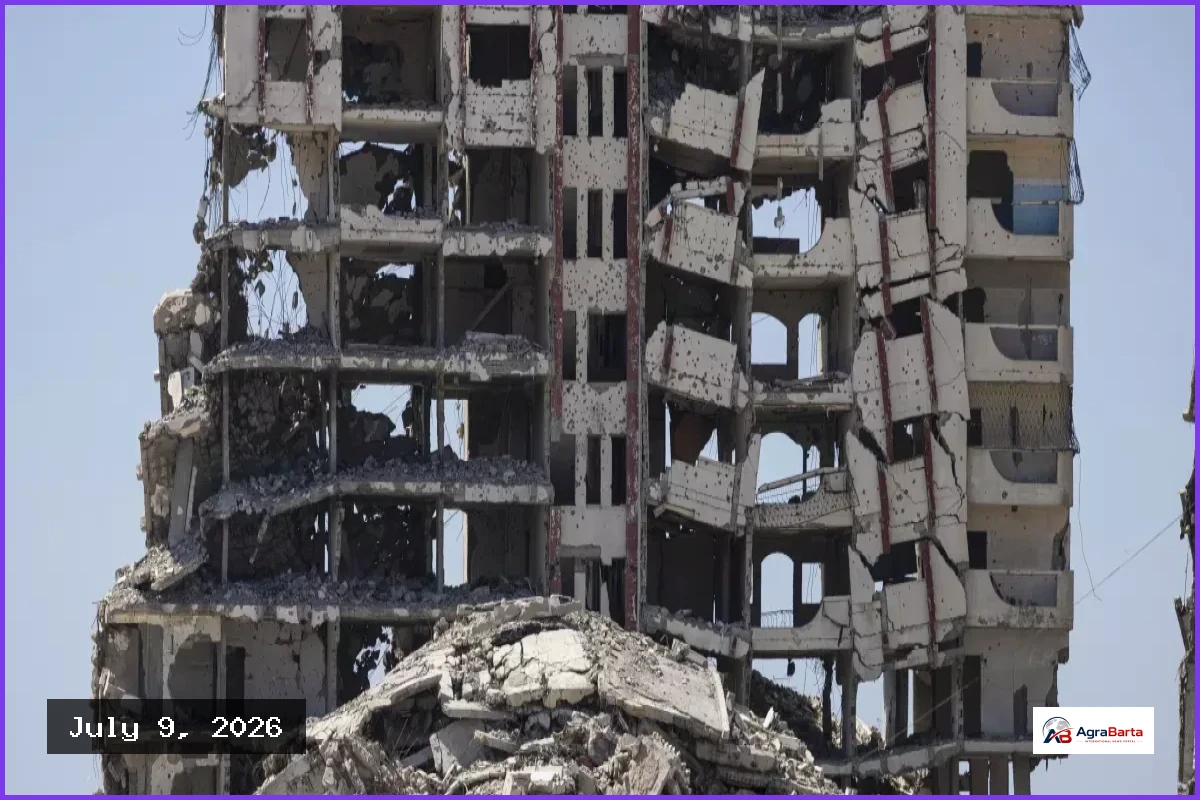
GAZA CITY — Yusef al-Zaharnah, a weary 56-year-old father, stands transfixed as an excavator scoops through piles of crushed masonry in Gaza City. For nine grueling months, he has lived in painful uncertainty, hoping a single scoop of debris will finally yield the remains of his 26-year-old son, Mutaz, and allow him to grieve fully. Each heavy haul of the machine's bucket, however, has brought only shattered concrete rather than the closure he desperately seeks.
Al-Zaharnah's agonizing vigil began in October when an Israeli missile demolished the five-story building where his family had sought shelter. The devastating airstrike claimed the lives of more than 40 people, including three of his sons: 31-year-old Munther, 26-year-old Mutaz, and 21-year-old Abdul Karim. While Al-Zaharnah managed to recover and bury the bodies of Munther and Abdul Karim in the days immediately following the attack—placing them beside a fourth son, Munir, 28, who was killed in a June 2025 Israeli strike—Mutaz remained entombed deep beneath the ruins.
Without the heavy machinery required to clear the pancaked concrete layers, recovery was impossible.
The Al-Zaharnah family's plight is a fraction of a massive humanitarian crisis gripping the Gaza Strip. Local Civil Defense authorities estimate that between 8,500 and 14,000 bodies remain buried under approximately 61.5 million tons of rubble. This volume of debris is roughly 20 times the total amount generated by all global conflicts combined since 2008.
Gaza Civil Defense spokesman Mahmoud al-Basal noted that his agency receives dozens of daily pleas from families hoping to search the ruins of their homes. He described the thousands of missing citizens waiting under the debris as one of the most devastating, yet largely unseen, emergencies of the conflict.
The current war erupted on October 7, 2023, when Hamas-led militants launched an assault on southern Israel, killing 1,200 people—two-thirds of whom were civilians, according to Israeli authorities—and taking 251 hostages. Israel responded with a relentless military offensive that has killed more than 73,000 Palestinians, approximately half of whom are women and children, according to Gaza's Health Ministry. The United Nations, medical experts, and the Israeli military generally consider the ministry's death toll to be accurate.
The offensive, which has damaged or destroyed over 80% of Gaza's buildings, has drawn accusations of genocide from the U.N., human rights organizations, and Israeli advocacy groups, charges that Israel denies by stating its campaign aims to dismantle Hamas. For many Palestinians, the devastation evokes the Nakba, or "catastrophe," of 1948, when 750,000 Palestinians were expelled or fled from their homes during the war surrounding Israel's creation.
Recovery efforts across Gaza ground to a halt during the height of the fighting due to fuel shortages, active combat zones, and the widespread destruction of heavy equipment. Even after a ceasefire took effect on October 10, 2025, search operations remained severely restricted because 80% of the Civil Defense's machinery had been destroyed. Although the first phase of the Trump-brokered truce called for the unrestricted entry of rubble-clearing machinery, Israel has heavily restricted imports of excavators, bulldozers, and cranes, allowing only six of the 500 requested machines into the territory, according to a Hamas official.
Israel defends these restrictions by arguing that construction equipment is "dual-use" and could be utilized for military purposes by Hamas, adding that major reconstruction will not start until Hamas is disarmed.
Meanwhile, despite a reduction in fighting, near-daily Israeli strikes have killed at least 1,072 people since the ceasefire took effect. Israel maintains these actions target active militant threats. Amid the ongoing instability, Hamas announced it has dissolved its government in Gaza and is preparing to hand over administrative power to a U.N.-backed technical committee.
In late June, a breakthrough coordinated by the International Committee of the Red Cross allowed the Civil Defense to resume recovery operations for a limited number of hours in specific approved zones. This agreement brought a single, heavily outmatched excavator to the ruins of the Al-Zaharnah home, where Mutaz and at least six others remain missing. The airstrike that destroyed the building occurred on the evening of October 9, just hours before the ceasefire was scheduled to take effect.
“We were all waiting,” Al-Zaharnah recalled. “Nobody wanted to move if the ceasefire was only hours away.” Al-Zaharnah recalls deciding to flee the area with his wife and youngest son as combat intensified nearby, while his older children chose to stay behind. There was no evacuation order or warning, and Al-Zaharnah noted there was simply nowhere safe for them to go.
The force of the missile strike was so severe that it pulverized the structure and scattered human remains over a wide area, making immediate identification impossible. In the initial days, rescuers had to rely on shovels, pickaxes, bare hands, and even stray dogs to locate remains. The passage of nine months has only compounded these difficulties. Any surviving biological remains have decomposed to the point where DNA testing is nearly impossible, particularly with no functioning laboratories left in Gaza.
Personal items, clothing, and accessories that might identify the victims have often been incinerated or torn away. Furthermore, the crude excavation methods carry the risk of destroying the very remains they seek, a fear that deeply troubles Al-Zaharnah as he watches the excavator work.
According to a June report by the Palestinian news agency Wafa, Gaza officials have recovered 784 bodies since the truce began. To manage the influx of unidentified remains, authorities established a designated cemetery in Deir al Balah. There, recovered bodies are documented and buried in numbered graves, allowing families the chance to eventually identify and reclaim their loved ones. For now, however, Mutaz's remains have not been found, and Yusef al-Zaharnah continues his daily watch by the rubble.
Special correspondent Shbeir reported from Gaza City and Times staff writer Bulos from Beirut.
Once it disgorged its haul, Al-Zaharnah, a burly, weary-looking 56-year-old, climbed over the detritus and bent low for a closer look. But his search yielded only crushed masonry; no bones, and no sign of his son, or the others killed with him.
The survey from the Associated Press-NORC Center for Public Affairs Research makes clear that for many U.S. Jews, support for Israel remains a bedrock of their religious identity, its existence a guarantee of Jewish self-determination and safety.