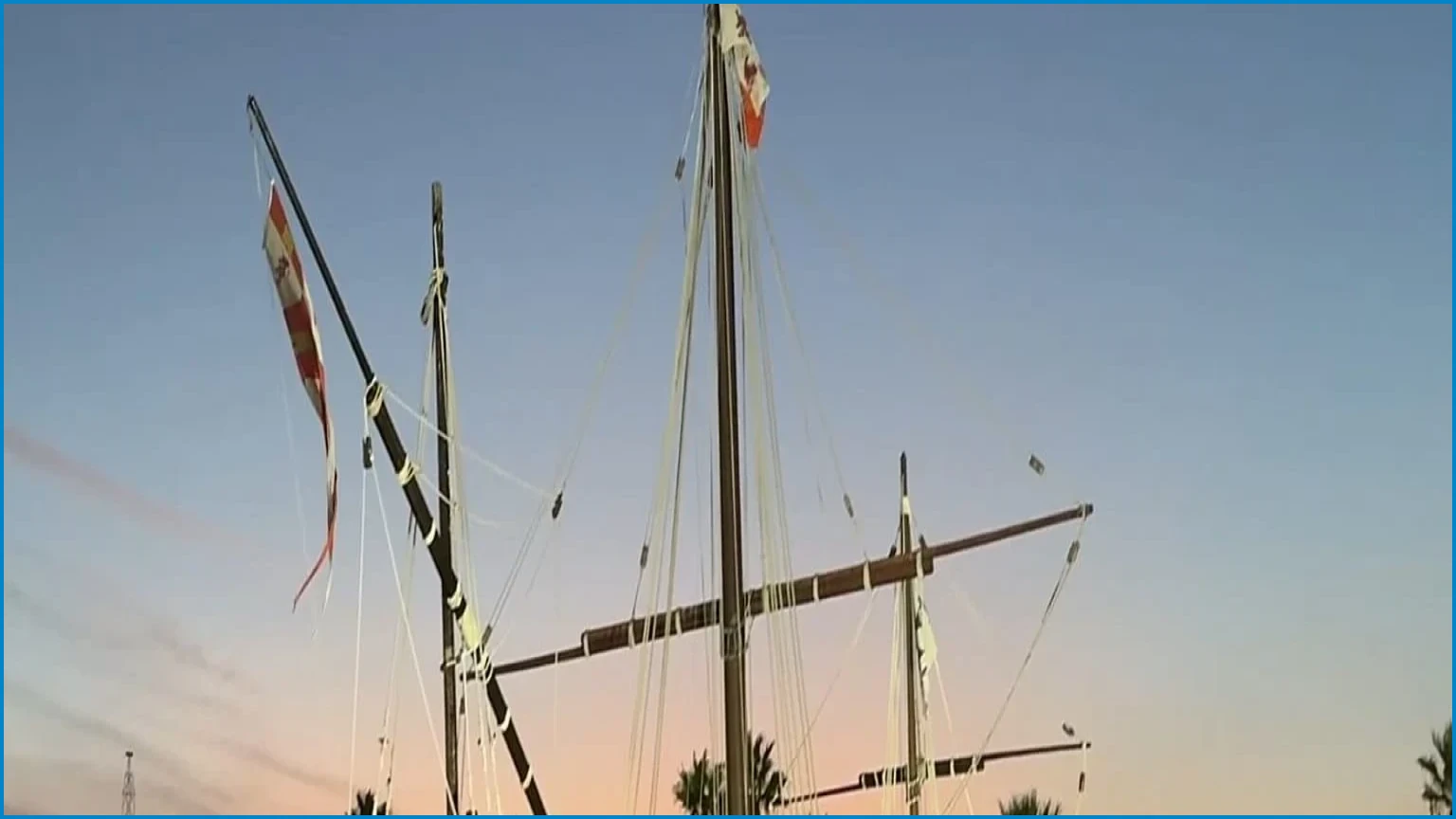
Spain's 15th-century history of seafaring navigation carries a narrative scale rivalled only by the Portuguese empire, anchored by the voyage that established the first Spanish foothold in the Americas. When Christopher Columbus set sail on his first transatlantic voyage, he commanded three ships—the Pinta, the Niña, and the Santa María—though only two would ever return to Castile. Following the famous sighting of land from the Pinta on October 12, 1492, a fateful sequence of events on Christmas Eve led to the founding of a short-lived garrison whose precise geographic location remains an unsolved mystery more than 500 years later.
At 23:00 on December 24, 1492, an exhausted Columbus went to sleep after staying awake for two straight days. In his logbook, the admiral noted that the calm sea resembled "like a bowl"—referring to a handleless wooden cup—as the Santa María navigated slowly along an unfamiliar stretch off the northern coast of Hispaniola. Around midnight, near what is today the bay of Cap-Haïtien, a chain of human errors caused the vessel to run aground. Columbus had left the ship sailing in a light wind, and the helmsman on duty similarly retired, delegating the helm to a cabin boy despite Columbus having explicitly forbidden inexperienced boys from steering during the voyage.
Subtle currents drifted the flagship onto a reef almost soundlessly. The cabin boy felt the rudder strike the bottom and heard the rushing water, shouting aloud to wake Columbus. By the time the admiral rushed onto the deck, the tide had already fallen. Columbus ordered the main mast cut down to lighten the load and instructed Juan de la Cosa, the vessel's owner and master, to take an anchor out in a skiff to attempt to haul the ship free. Disobeying orders, de la Cosa instead rowed the boat toward the nearby Niña. Unsupported, the Santa María listed on the shoal and its hull planks sprang apart. Columbus evacuated his crew to the Niña to await daylight.
When morning broke, Columbus dispatched messengers to Guacanagarí, one of five dominant Taíno chiefs on Hispaniola. The cacique wept upon learning of the disaster and immediately dispatched his people in large canoes to assist in salvaging the ship alongside his brothers and relatives. The Taínos emptied several of their own houses to safely store the ship's cargo and goods. Moved by their hospitality, Columbus wrote to the Catholic Monarchs that he believed there were no "better people or better land" anywhere in the world.
Around December 26, Columbus directed his crew to dismantle the ruined vessel, using its wooden planks and iron nails to build a fort named La Navidad, commemorating the night of the shipwreck. As historian Carlos Martínez Shaw notes, the expedition log records that the Santa María was beyond repair and had to be broken up, yielding enough material to construct a fortification capable of housing 39 men. Before departing, Columbus fired artillery at the remaining ship hull to demonstrate European military power to the local population. On December 30, Guacanagarí placed his own crown on Columbus's head while seating him on a platform made of palm.
Columbus left 39 men at La Navidad under the command of Diego de Arana, the expedition's constable. The garrison includedPero Gutiérrez, the king's pantry steward, Rodrigo de Escobedo, a surgeon, three craftsmen, a gunner, and a tailor. Their instructions were to trade peacefully with the Taínos and discover the location of the local gold mine. Columbus then set sail for Castile aboard the Niña in early 1493.
Upon his return to Hispaniola on November 27, 1493, during his second voyage backed by 17 ships and roughly 1,500 men, Columbus discovered La Navidad burned to ashes and all 39 Spaniards dead, many of them disfigured. Chief Guacanagarí attributed the massacre to a rival chief, the lord of the gold mines, though historians continue to debate whether Guacanagarí himself played a role in the attack. Rather than rebuilding the destroyed outpost, Columbus moved to a different area of the island to establish a new settlement named La Isabela.
The search for the lost site of La Navidad made significant progress through the work of William Hodges, an American missionary doctor and amateur archaeologist. After patients presented him with elaborate Taíno pottery, Hodges identified the site of En Bas Saline in northern Haiti in 1977, recognizing it as a major Taíno population center located close to where the Santa María met its end. Excavations conducted by the Florida Museum of Natural History in collaboration with Haiti's Bureau National d'Ethnologie between 1983 and 1988, and again in 2003, cleared 276 square meters of land. The 2003 campaign confirmed that a large central mound was a major structure destroyed by fire at the end of the 15th century. Researchers identified En Bas Saline as Guacanagarí's village and the most probable location of La Navidad, finding among animal remains the island's earliest recorded traces of the Old World black rat. However, definitive physical proof remains lacking, as no structural timber from the fort has been positively identified beyond dispute.
Efforts to locate the underlying shipwreck have yielded conflicting claims. In 2014, underwater explorer Barry Clifford declared that he had discovered the Santa María on the seabed off northern Haiti. However, Haitian Culture Minister Monique Rocourt stated that available evidence did not support his claim. Erol Josué, director of Haiti's National Bureau of Ethnology, emphasized that the ship's hull could not remain intact on the ocean floor because its timbers had been salvaged to erect the land fort. Historian María Luisa Cazorla suggested an alternative theory: centuries of river sediment have pushed the northern Haitian coastline outward, burying the wreck beneath roughly six meters of soil inland, where geophysical surveys could locate it within a narrow search radius. Despite these debates, outlets like History.com continued to cite the coastal marine site as a purported discovery as late as August 2026. To date, neither the flagship nor the fort constructed from its remains has been verified, leaving the physical foundation of Spain's global empire hidden beneath the earth.