Japan is witnessing a resurgence of internal debate regarding its Three Non-Nuclear Principles as the government of Prime Minister Takaichi Sanae prepares a new National Security Strategy, which is scheduled for completion at the end of 2026. The status of these principles, first announced by Prime Minister Sato Eisaku in 1967 and reaffirmed by the Diet multiple times since, remains a subject of contention. While some view them as the nation's foundational principle, or kokuze, others categorize them as a policy guideline, implying that the government retains the authority to alter them.
The principles explicitly state that Japan will not possess or produce nuclear weapons, nor will it permit their introduction into its territory. Given that Japan is a party to the Non-Proliferation Treaty (NPT), the primary practical debate centers on the third principle: non-introduction. In March 2010, Foreign Minister Okada Katsuya disclosed that a secret agreement, or mitsuyaku, had existed between Tokyo and Washington regarding the introduction of nuclear weapons. Historically, the U.S. interpreted introduction as the permanent deployment of warheads on shore, whereas Japan included transit through territorial waters and port calls by nuclear-armed vessels in its definition. For decades, Tokyo operated under the assumption that U.S. vessels entering Japan were not carrying nuclear weapons, provided no request for prior consultation had been made under the 1960 U.S.-Japan Security Treaty. It is now widely accepted that, under the Japanese definition, the United States introduced nuclear weapons into Japan during the Cold War.
Following the 2010 revelation, Tokyo has asserted there is no cause for concern, maintaining that the U.S. does not currently deploy nuclear weapons on surface vessels that visit Japan. However, successive governments have upheld a formula first presented by Okada: in extreme circumstances where Japan's survival is at risk, the government of the day reserves the right to make a final decision on the introduction of nuclear weapons. This has led some critics to suggest the guidelines have effectively become two and a half principles. This formula, however, leaves significant questions regarding peacetime protocols and the upcoming U.S. development of the nuclear-armed sea-launched cruise missile (SLCM-N), expected to be operational in the mid-2030s and likely carried by attack submarines that frequent Japanese ports.
Once U.S. attack submarines are equipped with the SLCM-N, Tokyo will face difficulties avoiding allegations of nuclear introduction, particularly as Washington maintains a neither confirm nor deny (NCND) policy regarding the armament of its visiting vessels. If Japan chooses not to restrict access to these submarines, it faces three potential paths: abandoning or amending the non-introduction principle, explicitly permitting introduction to facilitate future nuclear-sharing, or revising its technical definition of introduction to align with the U.S. interpretation. Any of these choices will be politically sensitive, requiring strong leadership that many observers feel is currently lacking.
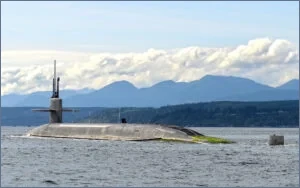
The U.S. Navy ballistic missile submarine USS Pennsylvania (SSBN 735) travels through the Hood Canal as it returns home following a strategic deterrence patrol Oct. 16, 2014, in Puget Sound, Wash.
You have reached the limit of 2 free articles this month.