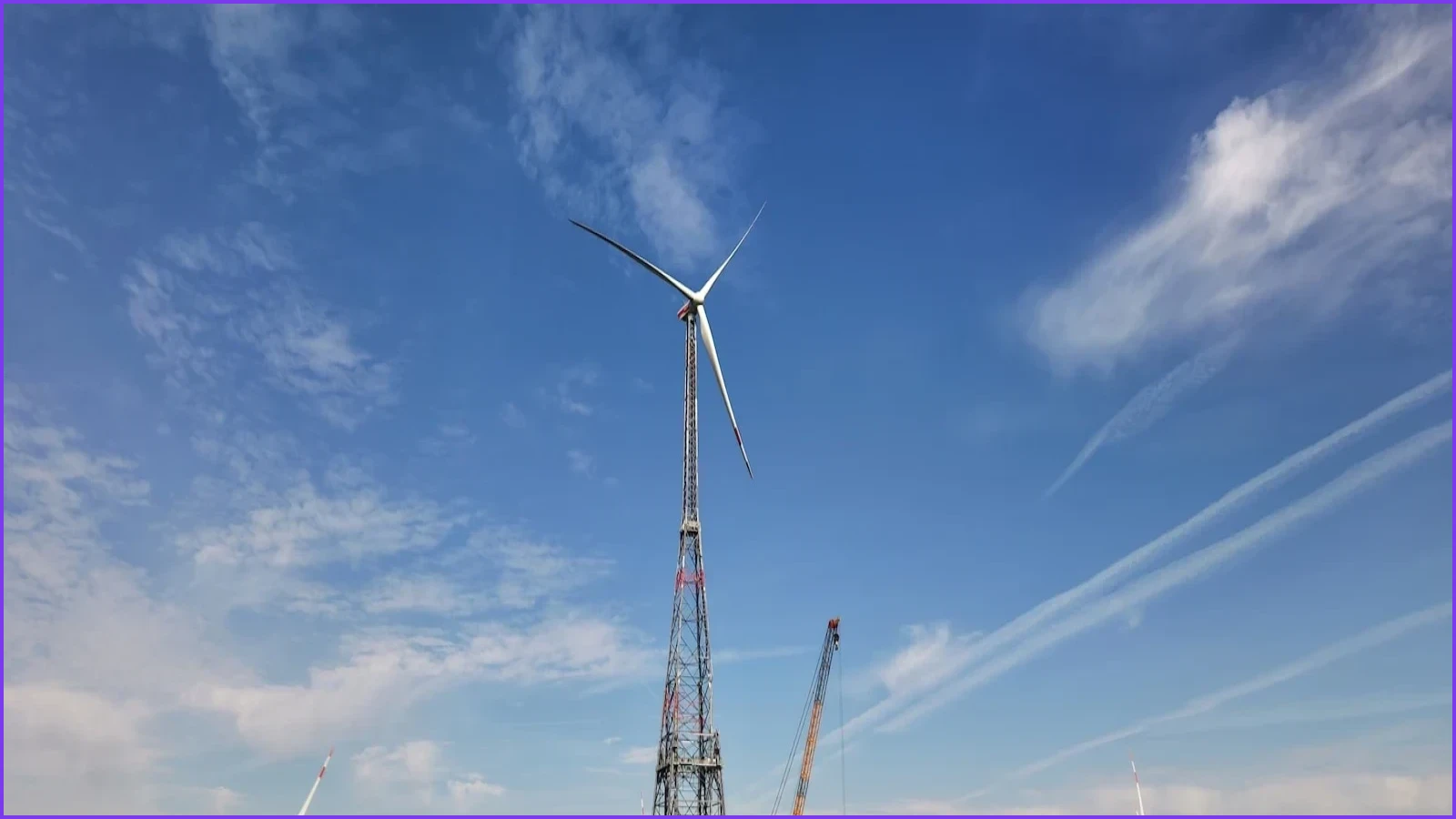
A massive wind turbine, described by its developer as the world’s tallest, has reached its full height in eastern Germany, soaring 365 meters (1,197 feet) above the ground and surpassing the height of Paris's Eiffel Tower. Built at an existing wind farm in the Lusatia region southeast of Berlin, the colossal prototype represents a major milestone for an area that was once a prominent center of lignite mining but has increasingly pivoted toward renewable energy in recent years.
The Dresden-based engineering company Gicon, which constructed the tower, designed the structure to capture the stronger and more reliable winds found at higher altitudes. Standard wind turbines generally feature a hub height—the distance from the ground to the center of the rotor—of well under 200 meters (656 feet). In contrast, this giant prototype boasts a hub height of 300 meters (984 feet), with its rotor blades extending the total height to 365 meters. This makes it taller than the 330-meter (1,083-foot) Eiffel Tower and only slightly shorter than Germany’s tallest building, Berlin’s television tower, which stands at 368 meters (1,207 feet).
Jochen Grossmann, chief executive of Gicon, explained the advantages of the project. He noted that at 300 meters, the wind is so constant and strong that the facility can generate more than double the electrical energy produced by identical facilities at conventional heights. Grossmann added that the increased height will also allow the turbine to generate electricity during a much larger portion of the year than existing models.
While the prototype reached its maximum height this week, construction is not yet complete. Workers still need to install the internal wiring before the planned inauguration on November 19. Gicon intends to use the data gathered from this prototype to measure the exact energy gains of high-altitude wind generation. The company eventually plans to use these findings to construct a wind farm featuring three to five of these extra-tall turbines, which could pave the way for full-scale commercial production.
Beyond increasing energy generation, Grossmann highlighted the giant turbines as a potential solution to the growing shortage of suitable land for wind installations. He suggested that existing wind farms could be expanded into "two-story" operations by combining shorter and taller turbines, a layout that could also be integrated into new sites from the very beginning.
The project aligns with Germany's long-term strategy to expand its reliance on wind, solar, and other renewable sources. The country shut down its last remaining nuclear power plants in 2023, a long-planned transition that faced criticism when energy prices spiked following Russia's invasion of Ukraine. Germany has also committed to ending all coal-fired electricity generation by 2038. According to data from the Federal Statistical Office, renewable sources accounted for 59.1% of the energy produced in Germany during the first half of 2026, with wind power serving as the single largest source at 29.4% of the total.