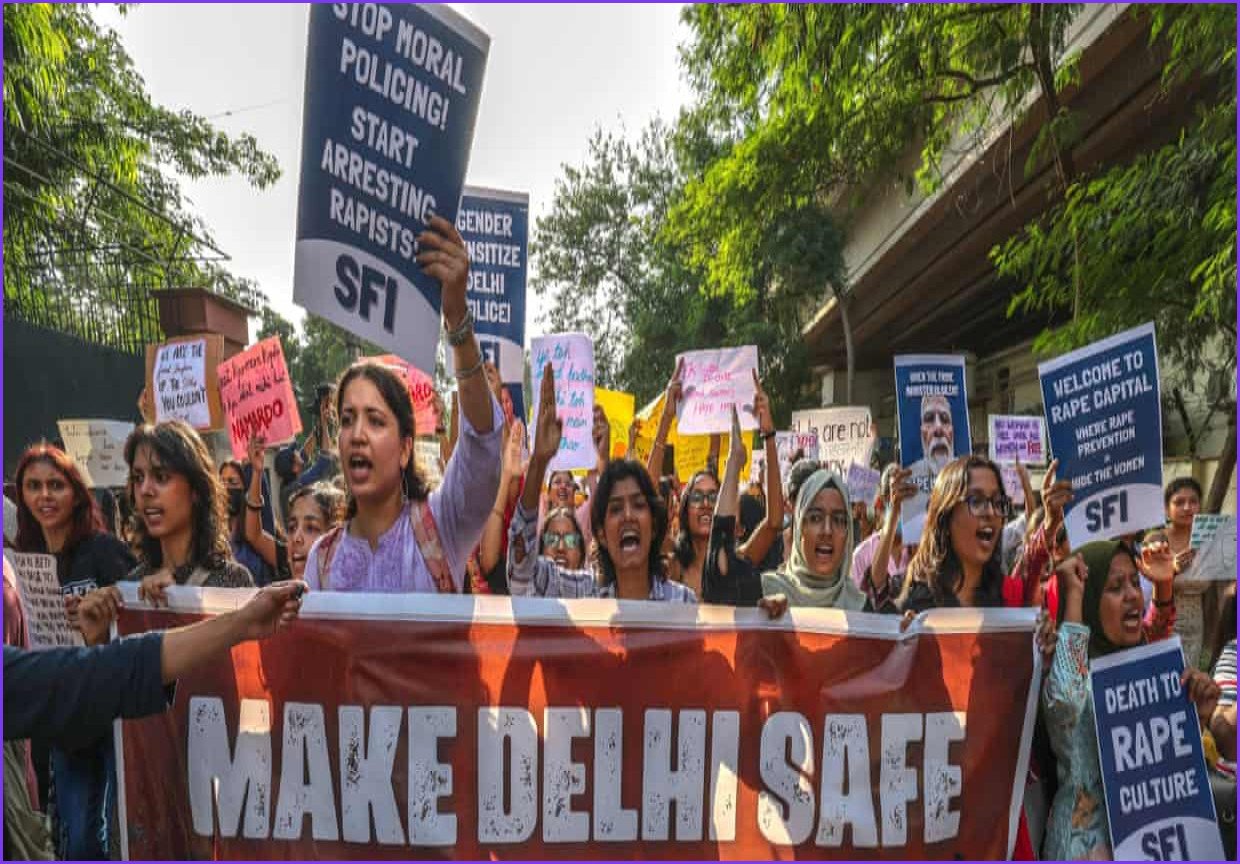
The posters, just like the women holding them, were taking no prisoners. “Girls don’t need curfews, rapists need consequences,” read one. “Lock your dicks rather than your women at home,” read another. As hundreds of women marched from the gates of their university campus into the streets of Delhi, they shouted in a chorus of rage and defiance: “We want justice.”
The fury that has erupted on India’s university campuses over the past week was triggered by a series of brutal rapes in Delhi. Among these was the alleged gang-rape of a 17-year-old in a public park near Delhi University by three men who posed as police officers. Just a week earlier, another 17-year-old was gang-raped and murdered in the Swaroop Nagar neighbourhood after meeting friends; her body was discovered days later in a field, half-eaten by dogs. Additionally, rapes of an 11-year-old and a six-year-old were reported in the same month, and last month, a 16-year-old was allegedly raped by a bus driver and conductor on a sleeper bus.
Protesters condemned these acts as unforgivable, emphasizing that they are not out of the ordinary. Fourteen years after the infamous Nirbhaya bus rape case, women argue that nothing has changed and that Delhi’s streets remain unsafe. While official statistics suggest a woman is raped in India every 20 minutes, the actual scale is believed to be much higher due to chronic under-reporting. This week, the supreme court stated these five successive cases “starkly underlined a systematic failure” and drew “painful parallels to the Nirbhaya incident of 2012.”
Vaishnavi Dhruw, a 21-year-old history student at Delhi University, participated in the “smash the patriarchy” march on Wednesday. “I don’t know a single woman who lives in this city and feels safe,” she said. Dhruw argued that the country needs a deep societal shift where men no longer claim ownership over women’s bodies. “We are not marching for safety, we are here to protest for our freedom, for the most basic right to walk in our own streets,” she added. “Again and again, women are told to stay indoors, to not go out at night, to cover ourselves, to protect ourselves. When will society tell men in our country not to rape?”
Much of the anger is directed at the authorities, whose response has been to police women’s freedoms, such as telling them to avoid parks at night, halting classes at a prestigious female college, and imposing strict hostel curfews. Aranya Rathore, a 25-year-old student, criticized this approach: “Instead of going after criminals, you’re going to tell women to sit at home. A demand for more surveillance is not a solution. In fact, it’s going to curtail our freedom more.”
Female students spend significant time on safety logistics, such as wearing modest clothes, avoiding travel at night, and maintaining live location tracking. Ananya Wig, a 26-year-old graduate and founder of the initiative Her Huq, noted that harassment is constant, recalling an incident where a driver masturbated in front of her and her friends in broad daylight. She explained that many women choose their education and jobs based on proximity to home rather than aspirations, simply to ensure safety. As one poster at Wednesday’s march pointed out, “no one ever asks what the rapist was wearing.”
Students also reported that sexual harassment is prevalent on campus, with Devyani Sarkar, a 24-year-old master’s student, noting that women are sometimes assaulted by professors, occasionally in exchange for grades. The university has not responded to these claims. Many participants linked these marches to the recent “cockroach” movement for education reform. “My generation is not afraid to stand up and protest. We know that society has to change,” said 17-year-old Subhani. “The days of women being silent is over.”