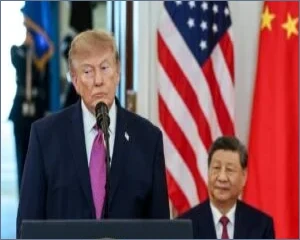
The recent summit between U.S. President Donald Trump and Chinese President Xi Jinping, held at the White House on September 24, 2026, is widely perceived as having produced little of substance. While the two leaders extended their trade truce and discussed artificial intelligence, many observers concluded that the U.S. position on Taiwan remained unchanged because Trump did not explicitly concede new ground. However, this interpretation ignores the significant shift in the U.S. stance that has already occurred under President Trump’s leadership.
The island of Taiwan was placed on the negotiating table by the president himself. In February, Trump informed reporters that he was discussing U.S. arms sales to Taiwan with Xi, a move that broke with the precedent established in 1982 when President Ronald Reagan promised Taipei that Washington would not consult Beijing on such matters. Following the Beijing summit in May, Trump explicitly referred to a $14 billion arms package for Taiwan as a “negotiating chip.” Although this package has been ready for his signature since March, it remains unsigned. During his flight home from the Beijing summit, Trump confirmed that he and Xi had discussed the sales again, dismissing the historical significance of the Reagan-era commitment as “ancient history.”
These actions represent unilateral concessions made by the United States without receiving any durable benefits in return. Entering the September summit, President Trump faced significant domestic pressure, including rising inflation, the ongoing war with Iran, and approval ratings near the lows of his presidency just weeks before the midterms. While he did not make further overt concessions during the most recent meeting, the damage was already done. By lavishing praise on his guest and declining to sign the arms package, Trump allowed Beijing to solidify a new status quo where merely holding the line is now viewed as U.S. firmness.
The situation is further complicated by the lack of transparency regarding private discussions. Following the summit, Trump offered an enigmatic response when asked about Taiwan, stating, “We didn’t talk about it too much.” He added, “Right now, it’s fine. It’s just moving along,” and noted that Xi “understands very much how I feel.” These comments suggest that a private understanding may have been reached but not disclosed. With two additional meetings between the leaders scheduled for November at the APEC summit in Shenzhen and December at the G20 in Miami, Beijing has further opportunities to test U.S. resolve.
This diplomatic wavering carries real costs for the United States and Taiwan. For the U.S., the price is to its international reputation. A security commitment maintained by every administration for nearly 50 years is now treated as a “negotiating chip,” signaling to allies like Japan and South Korea that Washington’s promises are unstable. In Taiwan, where 85 percent of the population favors the status quo, the U.S. is now perceived as retreating from its commitments, which weakens the island's security. The necessary corrective is for the president to state plainly that Washington’s Taiwan policy has not changed and to sign the arms package, as the Taiwan Relations Act directs that such sales be decided based solely upon Taiwan’s needs, not Beijing’s approval.
You have reached the limit of 2 free articles this month.
Taiwan was not bargained away at the Trump-Xi summit. But it was left on the table, within reach, and it will stay there for as long as an American president treats Taiwan as something he might one day be willing to sell.