U.S. President Donald Trump's public remarks and diplomatic engagements are inadvertently bolstering China's active disinformation campaigns, particularly those targeting Taiwan. These actions are being leveraged by Beijing to advance its cognitive warfare objectives and solidify President Xi Jinping's domestic standing, according to a recent analysis.
The impact of such messaging was evident in September, when a post claiming former U.S. Senator and Secretary of State Hillary Clinton had urged Taiwan to surrender rapidly spread across Taiwan’s Chinese-language social media, garnering tens of thousands of likes and thousands of shares. Upon investigation, the claim was found to be a mistranslation and fabrication.
The truth was that on September 10, Hillary Clinton appeared on “Morning Joe,” an MS NOW program’s September 11 anniversary special, to discuss U.S. President Donald Trump’s national security strategy. During the interview, approximately 15 minutes in, Clinton stated: “We have to look at our potential dangers, especially what Xi is thinking, that they can’t defend anybody anymore, because they don’t have the capacity to defend. Maybe we can coerce Taiwan into just giving up because there’s not going to be any support.” She was describing what she believed Xi Jinping might be calculating, not expressing her own view. Her words were subsequently mistranslated and spliced to create the false narrative: “Hillary Clinton urges Taiwan to abandon resistance to China.”
This type of disinformation is a critical component of 21st-century warfare, which operates on both physical and cognitive battlefields. As a former spokesperson for Taiwan’s Cabinet and Presidential Office, the author spent years intercepting such disinformation, recognizing it as the front line of defense. Cognitive warfare weaponizes information to reshape an adversary’s thoughts, values, and beliefs, ideally undermining a target from within before any kinetic attack is even considered.
Earlier in May, President Trump publicly suggested that arms sales to Taiwan could be used as a bargaining chip in negotiations with Beijing. Regardless of his intent, this remark played directly into Beijing’s long-standing narrative that Taiwan is an internal Chinese affair and that outside powers, specifically the United States, have no legitimate role. Since then, Trump’s words have been repeatedly used as raw material for Chinese cognitive warfare, fueling narratives such such as “America will abandon Taiwan,” “American troops are pulling out,” and “resistance is futile.”
This approach is seen by some as a serious miscalculation, as it appears the Trump administration is willing to accept Beijing’s framing of Taiwan’s defense as something to be traded away. While some may argue Trump’s remark was merely tactical posturing, Beijing interprets such ambiguity as weakness. China’s playbook over the past decade demonstrates that such statements are seized upon, amplified, and repeated until they solidify into a settled narrative, compressing Taiwan’s room for defense and enlarging the stage for Beijing’s cognitive warfare across the Western Pacific.
China’s use of Trump-Xi summits for cognitive warfare is a well-established pattern. During their meeting in Beijing in May, Taiwan’s National Security Bureau identified approximately 100 suspicious accounts spreading over 9,000 coordinated messages across social media platforms. These messages, often disguised as pleas for peace, included statements like “Taiwan is part of China” and “Taiwan is the real provocateur.” They were timed to align with Beijing’s official messaging, aiming to sow doubt about U.S. commitment and portray Taiwan as the aggressor.
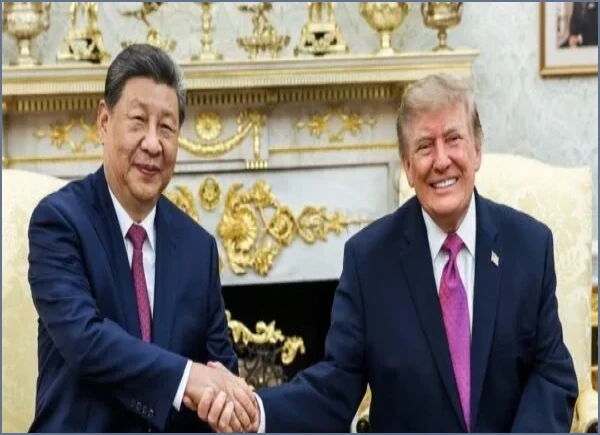
The same pattern re-emerged in September as the next Trump-Xi summit approached. Chinese President Xi Jinping is utilizing these meetings to re-stage Beijing’s long-running “peace” narrative for three distinct audiences: domestically, to bolster his own standing and secure continued leadership at the Communist Party’s 21st National Congress in 2027; globally, to promote the narrative that Taiwan is part of China; and within Taiwan itself, as a direct cognitive assault. President Trump’s hesitation on arms sales, whether intended or not, has further bolstered these propaganda campaigns.
Beijing views the United States not as a friend, but as an adversary to be defeated. Communist Party leaders are convinced that the 1991 collapse of the Soviet Union was not merely an economic or political failure, but the result of a deliberate U.S. ideological campaign that hollowed out Soviet identity. This belief has led Beijing to spend decades studying U.S. information warfare and integrating cognitive operations into its own military doctrine, using it to secure the Party’s grip at home and advance its interests abroad.
Facing mounting domestic challenges to his authority, Xi Jinping needed a display that positioned him on equal footing with the U.S. President, and Trump’s actions provided exactly that. Chinese state media has hailed the summit as “the first head-of-state reception of its kind in 60 years” and a “milestone,” portraying Xi as the “anchor of stability” in China-U.S. relations and a “great power leader steering the relationship ‘onto the right course,’” according to a CCTV program.
Concurrently, Beijing has dispatched scholars and researchers to publish op-eds in major American outlets, introducing a new narrative of “constructive strategic stability” to U.S. policy circles. This messaging subtly recasts Taiwan not as a democracy under threat, but as the problem that could draw China and the United States into war.
This intensified cognitive warfare coincides with a pivotal moment in Taiwan’s domestic politics, as the island heads into local elections. Beijing and its local collaborators have escalated efforts to undermine confidence in Taiwan’s government, targeting both its domestic governance and its relationship with Washington. The ultimate goal is to create anxiety that Taipei cannot protect its people and that Washington will not provide assistance, thereby paralyzing Taiwan’s democratic system and lowering the future cost of a potential invasion.
Maintaining the balance of power in the Indo-Pacific is not merely a favor to Taiwan; it is the crucial factor standing between a fragile peace and a war with unimaginable consequences, extending far beyond the Taiwanese people.