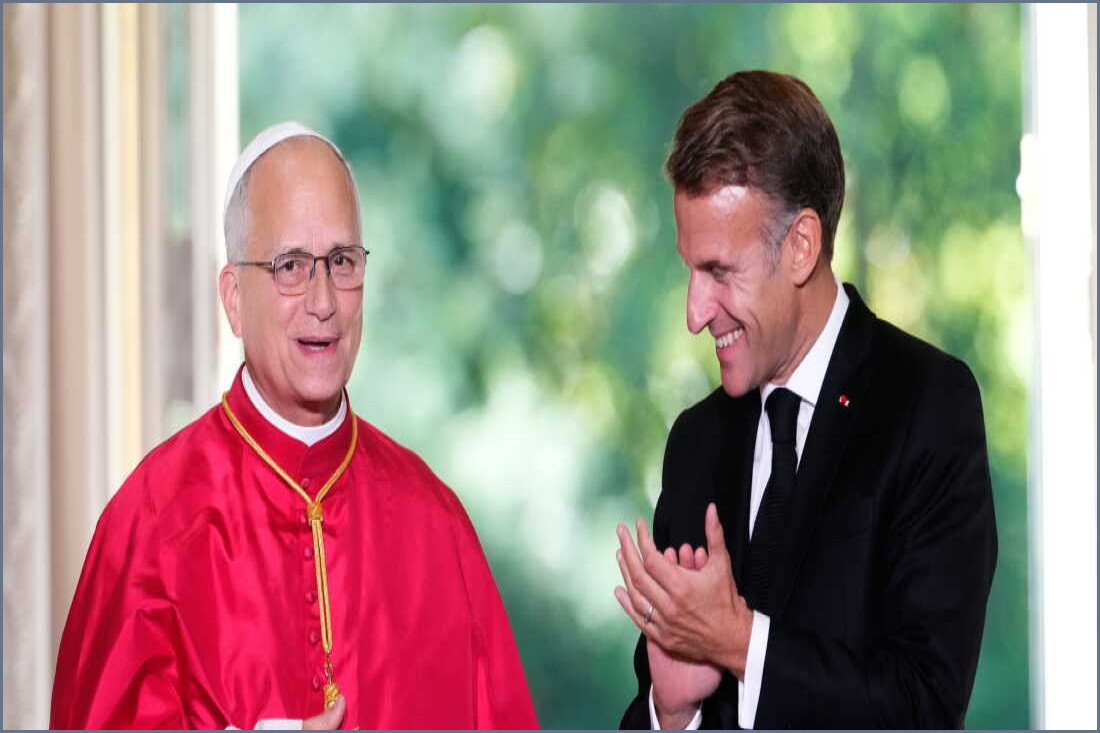
PARIS — Pope Leo XIV issued a stark warning Friday that a “paradise of machines” could undermine humanity, as he commenced a four-day visit to France. During his opening addresses, the Pontiff raised fundamental questions about human existence in an era marked by artificial intelligence, a nuclear arms race, and other threats to life itself.
Speaking first to President Emmanuel Macron and other authorities at the Élysée Palace, and subsequently to diplomats and United Nations employees at the UNESCO headquarters, Pope Leo XIV articulated deep concerns regarding scientific progress, the sanctity of life, and human rights.
Amid ongoing conflicts in Europe and the Middle East, Pope Leo XIV reiterated the Vatican's firm opposition to nuclear weapons, denouncing the nuclear deterrence doctrine as “mistaken” for merely fueling a new arms race. He emphasized, “Peace is not a balance of power; rather, it is built day by day through dialogue and justice.”
The Pope's arrival, marked by the tolling of church bells across the country as his charter flight landed at Paris' Orly airport, drew significant public interest. More than a million people are anticipated to see him during his visit, with crowds lining the streets of the capital as his motorcade passed. This marks the first official state visit by a pope to France in 18 years.
President Macron, who is barred from seeking a third term in the May elections and whose approval ratings are near record lows due to public anger over the rising cost of living, national debt, and deteriorating public services, welcomed Pope Leo XIV. Macron stated that the visit offers “a source of hope” to many French citizens. He affirmed France's commitment to “peace, effective multilateralism, respect for international law and the United Nations Charter … because every life has equal value, and all peoples must be defended.” Macron also thanked the Pope for his extended visit, calling it “moving.”
Charles Mercier, director of history and sociology of Catholicism studies at Paris EPHE university, noted the significance of the visit for Macron, suggesting it could be important for a president nearing the end of his mandate “to be aside the pope and to capture a part of his popularity.” Pope Francis had previously declined a proper state visit to France during his 12-year pontificate and notably refused to attend the inauguration of the rebuilt Notre Dame cathedral in 2024.
The Rev. Aristide Ahidote from Ivory Coast, who planned to attend the Pope's vespers service in Notre Dame later Friday, expressed admiration, saying, “God has given us a pope with vigor and strength.” Despite acknowledging a decline in the French church's popularity, Ahidote found its “small remnants” to be “edifying.”
Unlike his predecessor, Pope Leo XIV has actively sought to reawaken Europe's Christian roots and promote the church's message on the value and dignity of human life. This focus is particularly poignant in France, where the right to abortion was enshrined in the constitution in 2024, and lawmakers recently approved a bill allowing adults with incurable illnesses to receive lethal medication. The French Catholic hierarchy has strongly opposed these measures, consistent with Catholic teaching on protecting human life from conception to natural death.
In his address to French authorities, Pope Leo XIV reminded France of its “deep Christian roots” and urged them to remember that the right to life is the “indispensable foundation of every other human right.”
His concerns about human dignity extended to the challenges posed by artificial intelligence. “The paradox has become increasingly evident: while 'intelligence' is attributed to computational systems, we struggle to recognize the inalienable dignity of human persons, whose lives are judged according to the criterion of efficiency and, when deemed no longer productive, are rejected and discarded,” he stated.
Since the beginning of his pontificate, Pope Leo XIV has identified AI as a major challenge, dedicating his first encyclical, “Magnificent Humanity,” to the topic. He called for robust regulation and urged AI developers to prioritize the common good over profit.
The Pope also appealed to AI developers and political leaders responsible for regulation to proceed with caution, an appeal that, he noted, several top AI companies appear to be heeding. “If we are to avoid losing our humanity amid a 'paradise of machines' invading and conditioning our daily lives, there is an urgent need for education in ethical discernment and the capacity to acknowledge the moral good,” he warned.
Speaking to reporters en route to Paris, Pope Leo XIV expressed satisfaction that his message was being heard and hoped the Vatican's dialogue with tech companies would continue. He observed that many companies are “very much open to looking for ways of making sure that AI does not displace or ultimately destroy humanity, but rather than be a tool for human beings.” He concluded, “Good things are beginning at least.”