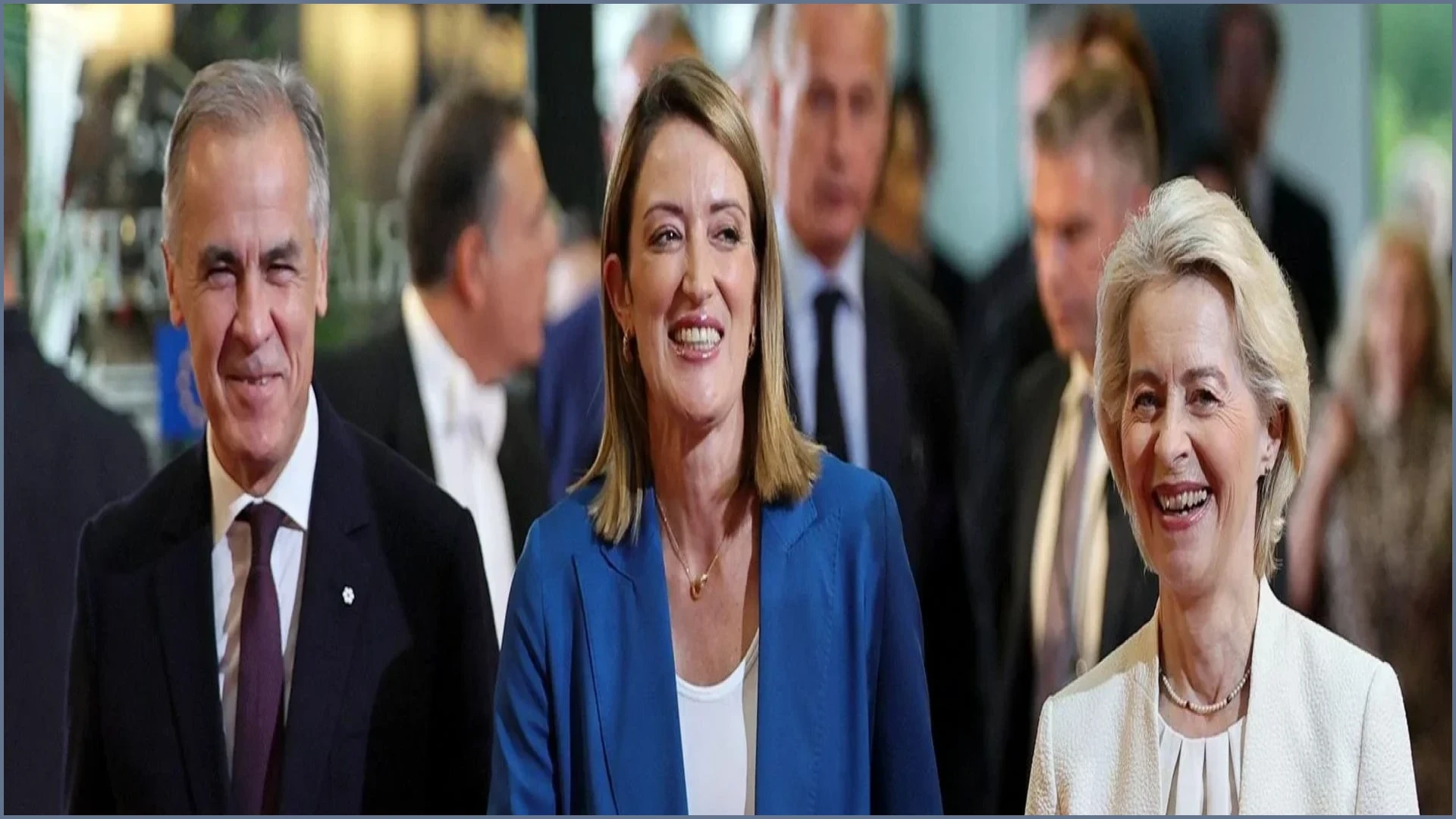
European Commission President Ursula von der Leyen has formally endorsed a proposal to establish Canada as the European Union’s first "associate member." Speaking during her annual State of the Union address before the European Parliament on Wednesday, von der Leyen expressed a desire to work on "opening the door" to Canada, paving the way for significantly closer ties across several critical sectors.
The announcement comes as Canadian Prime Minister Mark Carney seeks a "unique alliance" with the European bloc. Canada is currently navigating highly strained relations with its southern neighbor, the United States, following the collapse of bilateral trade negotiations last month. The breakdown of those talks triggered a series of new tariff measures, further compounded by Donald Trump's repeated remarks suggesting Canada could become a "51st state."
Carney attended the address in Strasbourg on Wednesday and is scheduled to speak directly to the European Parliament on Thursday. Highlighting the strategic alignment between the two powers, von der Leyen emphasized that partnerships are a vital strategic choice for Europe, particularly in response to the growing fractures within the international rules-based system. She noted that the EU and Canada "see the world with the same eyes" on a wide array of global challenges, including artificial intelligence, climate change, and geopolitics.
The European Commission chief pointed out that the two entities have consistently stood together on critical issues such as the war in Ukraine, defense initiatives, raw materials, and the security of supply chains. Above all, she stated, Europe and Canada share a fundamental belief in democracy. This solidarity is particularly relevant as both have had to navigate Trump's aggressive tariff policies and his previous threat to annex Greenland, which is a sovereign territory of EU member state Denmark.
The concept of associate member status is gaining traction within European political discourse. Earlier this year, Germany's Chancellor Friedrich Merz suggested that Ukraine could be granted this newly envisioned status, a proposal that met with a mixed reception at the time. Additionally, Eastern European nations Georgia and Moldova are also actively applying for this status. Von der Leyen declared that the time has come to elevate the EU's relationship with Canada to the highest level possible.
Beyond the Canadian partnership, von der Leyen's wide-ranging address outlined the EU's strategic and political priorities for the upcoming year. Chief among these is a proposal to establish a European Security Council. This body would include non-EU partners such as the United Kingdom, Canada, Norway, and Ukraine, creating a united front against the persistent threat posed to the continent by Russia. Von der Leyen noted that discussions regarding a leaders' format focused on continental security have been ongoing for a long time, but the nature and scale of current risks make the realization of a European Security Council an urgent necessity.
Calls for a dedicated European security body have intensified since Russia launched its full-scale invasion of Ukraine in 2022. Originally conceived as a joint French-German initiative, the proposal has garnered broader support as Trump has repeatedly questioned the viability of the NATO military alliance. While some nations have expressed concern that a new council might create an unhelpful rivalry with NATO, von der Leyen sought to alleviate these fears. She clarified that the EU is actively strengthening its collaboration with NATO and that any expanded defense spending would be fully aligned with the alliance.
At the heart of the proposed security council would be a mechanism allowing any member to trigger an emergency meeting if they perceive a threat to their security. Von der Leyen described this as a tool to "flank" NATO's Article 4, which could be seen as either a complementary function or, in a military context, a way to bypass traditional NATO channels.
Turning her attention to domestic issues, von der Leyen acknowledged the economic anxieties of European families, particularly regarding the rising cost of living and the rapid pace of technological change affecting jobs and society. To address these concerns, she proposed inviting the world's largest artificial intelligence laboratories for discussions on pacing the frontier of technology while simultaneously working to slash bureaucratic red tape for businesses operating within the EU.
In a move that mirrors the rhetoric of increasingly popular right-wing and hard-right European politicians, the Commission president also proposed strict new measures to limit social media access for children. The plan includes an outright ban on social media platforms for children under the age of 13. Furthermore, teenagers aged 13 to 15 would only be permitted to establish social media accounts under direct parental supervision.
Finally, von der Leyen introduced a new emergency tool designed to be activated only under a strictly defined set of criteria and for a limited duration, while promising that fundamental rights would be safeguarded. However, this proposal has already drawn criticism from human rights organizations. Advocates express deep concern that such a mechanism could lead to vulnerable individuals, including women and children, being turned away at borders and denied the essential protections guaranteed to them under international law.