The Nepali government has deployed more than 20,000 security personnel—including members of the Nepal Army, Nepal Police, and the Armed Police Force—in a massive disaster response operation following devastating floods that struck the Bhotekoshi and Trishuli rivers on August 26. This deployment, potentially the largest since the 2015 earthquake, was prompted by the collapse of local government infrastructure and the inaccessibility of the affected regions. The disaster, triggered by a massive avalanche, wiped out roads, bridges, customs facilities, and entire settlements along the riverbanks near the China-Nepal border.
As of one week after the incident, 85 security personnel remain missing, including 45 from the Nepal Army, 28 from the Nepal Police, and 13 from the Armed Police Force. Many were performing critical duties when the floods occurred; some police officers disappeared while issuing warnings to downstream communities, while others were stationed at border posts or hydropower projects. Three police posts in Timure, Rasuwagadhi, and Syafrubesi were destroyed or swept away by the surge. The lack of an early warning system and the absence of cross-border disaster communication significantly complicated the initial response.
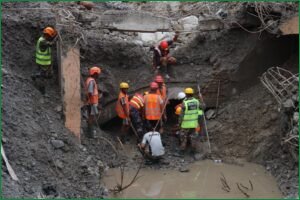
Rescue efforts remain ongoing, particularly within hydropower tunnels at sites such as Upper Trishuli-1, Rasuwagadhi, Chilime, Langtang Khola, and Upper Trishuli-3A, where hundreds of workers are believed trapped. Progress has been slow, and some operations have been halted due to the inability of teams to navigate debris-filled tunnels. Nepali Prime Minister Balendra Shah, addressing parliament on September 2, noted that these tunnels present a distinct and difficult problem, requiring specialized skills that the country currently lacks. He emphasized that while security forces have been mobilized at short notice, their success remains dependent on weather conditions.
While the courage and willingness of security personnel to risk their lives have earned widespread praise, there is a growing consensus that the government and military lack the necessary technology and specialized equipment for effective tunnel rescues. In response to these deficits, the Nepali government has sought international assistance, reaching out to India, China, and South Korea for critical support and forensic expertise. This reliance on security forces for disaster management is not new, as the 2015 Constitution and the 2016 National Security Policy both recognize environmental disasters as matters of national interest. However, the current situation highlights a growing concern that such ad hoc assignments expose security forces to severe vulnerabilities as environmental disasters in the Himalayan region become increasingly frequent and intense. Experts, including those at the International Center for Integrated Mountain Development (ICIMOD), warn that the recent floods serve as a sobering indicator of the changing security landscape, necessitating a transformation in how military institutions adapt to the climate crisis.