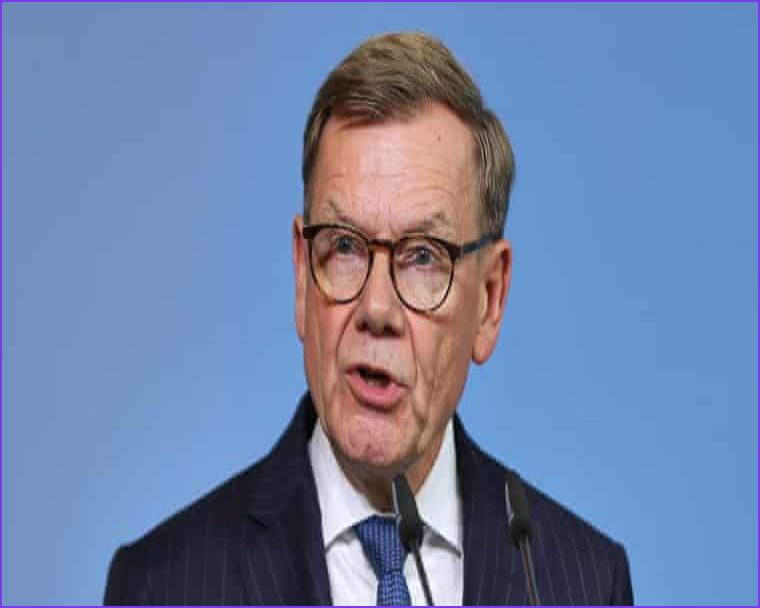
The German government has formally blamed Russia for a drone attack that occurred at Leipzig/Halle airport last month, describing the incident as an act of “dangerous behaviour.” Officials in Berlin characterized the event as part of a systematic, concerted effort by Moscow to inflict significant damage through a series of hybrid attacks. Interior Minister Alexander Dobrindt and Foreign Minister Johann Wadephul addressed the matter during a 10-minute briefing in Berlin, ending weeks of government hesitancy regarding the source of the threat.
Authorities confirmed that all evidence points to the Russian state providing the necessary know-how and equipment for the operation, which was carried out by recruited “low-level agents.” The incident took place on 4 August, when a drone loaded with 600g of explosives was discovered attached to the wing of a Ukrainian Antonov cargo plane within the airport's security area. While the device failed to detonate, officials emphasized that it could have caused a catastrophe had the detonator functioned correctly. A second drone was initially suspected to be involved, though investigators have since expressed doubt regarding that theory. Furthermore, traces of the military explosive hexogen were identified at the airport perimeter on 14 August, alongside the discovery of an additional drone.
Foreign Minister Wadephul stated that Russia will face a package of penalty measures, noting that Germany intends to respond to this hybrid attack with “proportionate and measured, yet equally resolute, action.” He added that while Germany is not at war, it remains a “daily target of hybrid warfare,” encompassing disinformation, threats, sabotage, and aggression. As a direct consequence, the Russian consulate in Bonn is scheduled to close later this month. Additionally, Russian House, a sprawling cultural and science institute in Berlin accused of housing spies and serving as a launchpad for past hybrid attacks, is being evicted from its premises.
Berlin is also planning a clampdown on the so-called “shadow fleet”—a network of vessels carrying Russian oil and supplies through the Baltic and North seas. Furthermore, the government intends to update blacklists of individuals and implement tighter border controls for Russian citizens. Germany is also supporting the European Commission’s 22nd sanctions package, which targets 1,600 companies and organizations linked to Russia. In response to these developments, Russian foreign ministry spokesperson Maria Zakharova stated that Moscow would react to what she termed Berlin’s “anti-Russian action.”
While the German government has chosen not to invoke Article 4 of the Nato treaty, partners in the EU and Nato have been kept informed of the investigation. Both Nato Secretary General Mark Rutte and European Commission President Ursula von der Leyen have expressed full solidarity with Germany. The incident has intensified political debate in Germany ahead of upcoming elections in Saxony-Anhalt and Mecklenburg Vorpommern, where the far-right Alternative für Deutschland party has accused the government of double standards. Meanwhile, intelligence sources cited by the German press suggest links between the Leipzig incident and similar drone or explosives-related events across Europe, including in the UK, Romania, Italy, Poland, and Bulgaria.
It marks the lowest point in decades for relations between Russia and the EU’s largest member, which had already plunged after Russia’s full-scale invasion of Ukraine.
The chancellor, Friedrich Merz, who last week said whoever was behind the attack “will pay”, did not attend the briefing to the press and public on Tuesday.