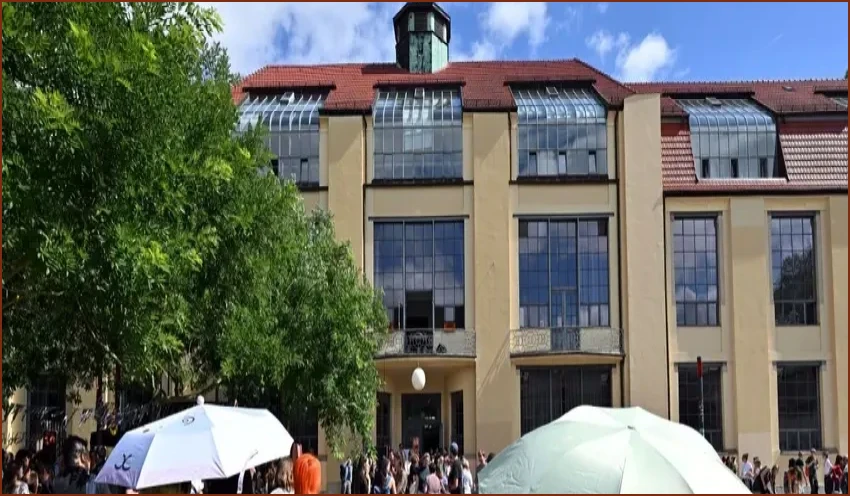
The Alternative for Germany (AfD) has sparked controversy by outlining plans to defund and distance the country from the globally influential Bauhaus movement, one of Germany's most successful cultural exports. In its 150-page election manifesto for the state of Saxony-Anhalt, the far-right party took aim at the regional government's "#modern thinking" image campaign, which seeks to associate the identity of Saxony-Anhalt with the famous design school.
The Bauhaus movement revolutionized modern architecture and product design by emphasizing minimalist utility. Its lasting legacy is visible in numerous everyday items, such as the dome desk lamp, the fitted modular kitchen, Sans-Serif typography, and even the design of the Apple computer mouse. Despite the movement's deep German roots and unparalleled global reach, the AfD wants to move Germany's public identity away from what it labels as "rootless" or internationalist modernism.
The party's platform calls for cutting state budgets for organizations and institutions that promote modern, avant-garde, and progressive art, advocating instead for redirecting taxpayer money toward what it considers to be more "traditionally German" culture.
This political opposition to Bauhaus is not without historical precedent, and critics have pointed out that the AfD's rhetoric closely echoes the arguments used by the National Socialists in the 1930s. The Nazis also rejected the liberal, cosmopolitan, and progressive aspects of the Bauhaus movement, choosing instead to promote traditional German art and literature.
This hostility culminated in the Nazis shutting down the Bauhaus school in Berlin in 1933, which forced many of the movement's most prominent artists to flee the country to escape persecution.
Today, the Bauhaus campus and museum in Dessau stand as major tourist attractions and economic drivers in a region that has struggled with de-industrialization for decades, leading to fears that an AfD victory in upcoming state elections could jeopardize these cultural institutions.
In another recent development in the capital, Berlin was the site of a striking demonstration marking Ukrainian independence day on August 24th. Activists constructed an installation featuring a large mesh net suspended over a street, mimicking the anti-drone nets deployed across roads and military bases in Ukraine.
In conflict zones, entire towns utilize these nets to block explosive FPV (first-person view) drones, which detonate on impact. Surprisingly, simple mesh netting has successfully prevented structural damage and saved lives in many targeted areas.
The Berlin installation was designed to raise public awareness of ongoing Russian drone attacks. The demonstration occurred as Ukraine's international allies renewed their pledges of support. Germany is now Ukraine's largest military supporter, having overtaken the United States about a year ago after President Donald Trump reduced American military deliveries.
Adding a lighter touch to recent events, Berlin's public transit operator, Berliner Verkehrsbetriebe (BVG), has launched a playful marketing campaign asserting that the real capital of love in Europe is located on the banks of the River Spree, rather than in Paris. While the reliability of Berlin's U-Bahn subway system is often hit-or-miss, the transit company is widely recognized for its consistently clever marketing.
BVG released a promotional video on YouTube that has captured public attention, offering German language learners a humorous opportunity to test their listening comprehension skills while showcasing the city's unique charm.
READ ALSO: Who can vote in Germany's high-stakes state elections this September?
READ ALSO: Where in Germany are you most likely to catch an STD?