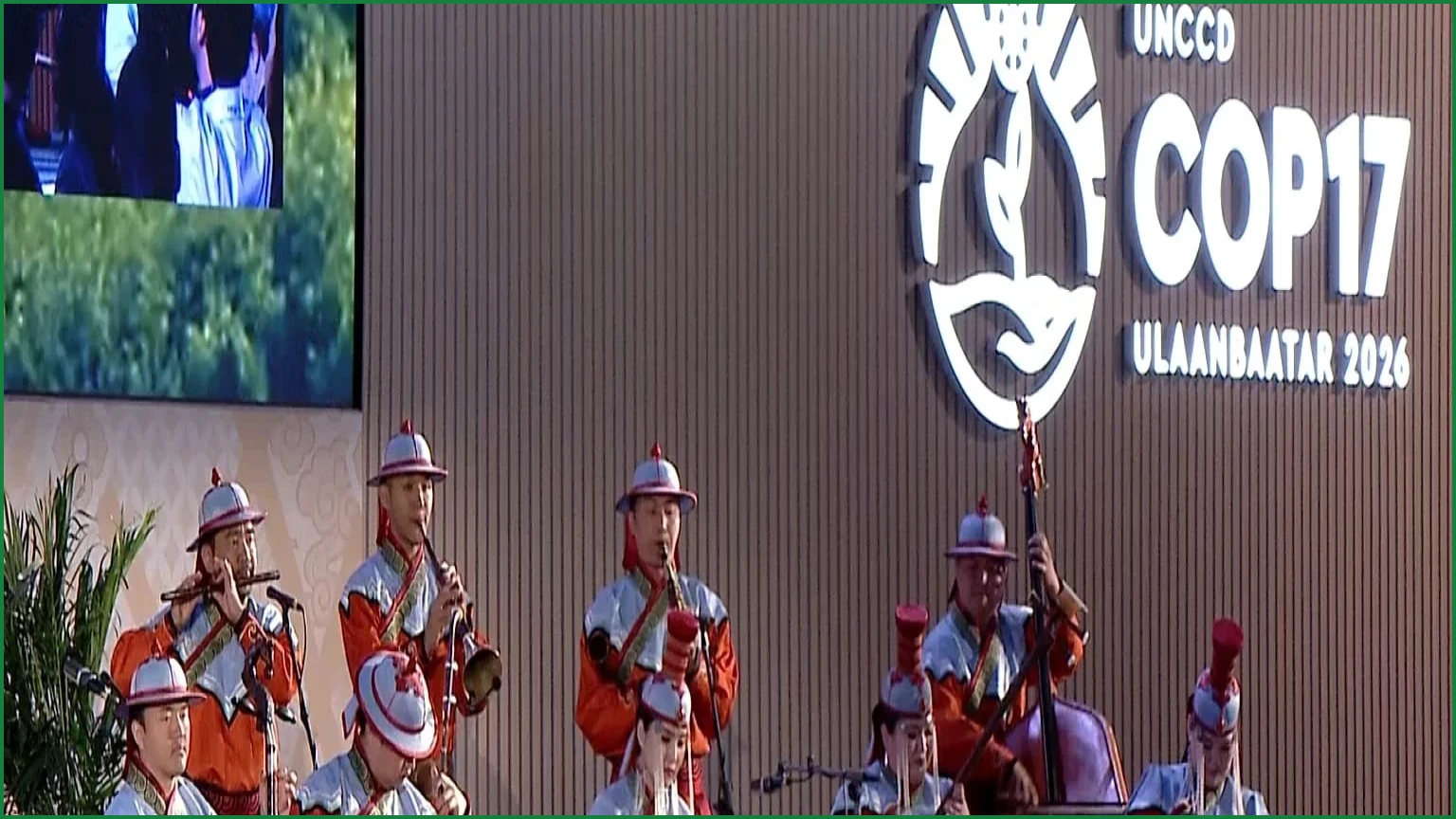
ULAANBAATAR, Mongolia — The 17th Conference of the Parties (COP17) of the United Nations Convention to Combat Desertification (UNCCD) officially opened in the Mongolian capital of Ulaanbaatar on August 17, launching a 12-day summit dedicated to finding solutions for the world's rapidly accelerating land degradation crisis. Organizers expect more than 30,000 people to attend the global gathering before it concludes on August 28, making it one of the busiest and most active conferences in the convention's history.
Geography dictates that approximately 70 percent of the Earth's land mass is suitable for human habitation, while the remaining portion consists of extreme environments where survival is nearly impossible. However, this balance is shifting dangerously. Today, 40 percent of the soil humanity relies on for sustenance is already degraded and turning barren. Driven by climate change, persistent droughts, the misuse of agricultural land, and various other human activities, habitable regions are rapidly transforming into deserts, while existing natural deserts expand daily.
This environmental emergency is not a recent discovery; its systemic effects were scientifically documented and recognized in the 20th century. Recognizing that every community requires healthy land to sustain life—and that its loss triggers poverty, mass migration, and violent conflict—the United Nations approved the UNCCD in 1994. The convention officially entered into force in 1996 and currently has 197 signatories who meet regularly to establish mechanisms to halt desertification.
The urgency of COP17 is underscored by stark global statistics. Nearly 3.5 billion people worldwide are directly affected by land degradation. Combating this crisis and protecting populations from losing their incomes and food sources costs local communities and governments an estimated 900 million dollars every year. Furthermore, the frequency and severity of droughts have surged by two-thirds since the year 2000. By 2030, global demand for water is projected to exceed available supply by 40 percent. This crisis disproportionately impacts vulnerable populations, with 85 percent of affected individuals living in medium- and low-income nations, where land degradation serves as a primary driver of mass migration.
The host nation, Mongolia, serves as a clear example of these escalating pressures. Over the past decade alone, the cost of producing a single loaf of bread in the country has tripled. This economic strain is being mirrored in other participating regions worldwide. At the opening ceremony, international leaders emphasized that COP17 is not addressing a distant environmental threat, but rather an active disaster that worsens by the month.
“This summer we saw across different parts of the world, also in Europe, how drought disrupted river transport and strained energy production,” said Dr. Yasmin Foudh, Executive Secretary of the UNCCD, during the opening ceremony. “It reduced agricultural yield and induced wildfire with losses of lives. Similar stories are there around different parts of the world that we never thought would be affected. The message is clear, droughts are no longer just an environmental issue, they are not just absence of rain or a geographic environmental issue. They are a systemic risk to food and water security, to international commerce, energy supply, livelihood and, simply to stability and prosperity.”
Mongolia was selected to host COP17 for three primary reasons. First, the country proactively applied for the role four years ago. Second, it is on the frontlines of the crisis; over the last eight decades, Mongolia's average temperature has risen by 2 degrees Celsius, while precipitation has dropped significantly. Strong winds now regularly carry sand from the Gobi Desert across the Mongolian flatlands, reaching as far as South Korea and Japan. Finally, Mongolia has positioned itself at the forefront of global anti-desertification efforts.
“Mongolia, our vast country, is among the most affected by the challenges facing the world today,” said the Mongolian Prime Minister. “On this vast territory, where there are only two people per every square kilometre, 77% of the country, or in another words, eight out of every ten steps of the land, are affected by desertification and is increasingly being covered by the encroaching sands.” He emphasized that since Mongolia joined the UNCCD, it has integrated numerous combat measures directly into its national development plans.
Mongolia’s Foreign Minister, Battsetseg Batmunkh, has assumed the presidency of COP17, pledging her country's absolute commitment to protecting the land that forms the foundation of her nomadic nation. This pledge is backed by concrete domestic actions and a search for viable global solutions.
Addressing desertification requires diverse strategies, as different regions face distinct challenges. While the estimated global cost to fully combat land degradation stands at an astronomical 6,500 billion dollars annually, experts and business leaders emphasize that the effort is highly profitable rather than a lost cause. Financial analyses show that for every 1 dollar invested in soil preservation and restoration, projects can yield between 7 and 30 dollars in return, driven by profitable green initiatives and sustainable food production.
This high return on investment has successfully attracted private capital. Since the UNCCD's inception, countries have committed to restoring 1 billion hectares of land by 2030, and more than 70 nations have submitted formal drought management plans. According to Dr. Foudh, over 100 countries are currently working to translate their land restoration plans into investable projects, representing a potential 2 billion dollars in investment. More than 300 businesses are actively participating in the Ulaanbaatar conference to explore these opportunities.
Corporate engagement is a central focus of COP17 as organizers seek to leverage private funds. Mongolia alone expects to secure more than 1.5 billion dollars in funding to support its domestic programs for re-forestation, green energy, and sustainable agriculture. Beyond financial agreements, the conference serves as a vital platform for marginalized voices. More than 500 representatives from indigenous communities spanning Amazonia, Africa, and the Asian steppes are participating to share their localized problems and traditional solutions. With 60 organizations showcasing active solutions and over 400 cultural and scientific events scheduled, the 12-day event aims to deliver tangible pathways to halt global soil loss.
Geography says that 70% of land mass on our planet is suitable for human life. The rest is an extreme environment where people can hardly survive. But that proportion is rapidly changing. 40% of the soil humanity uses to sustain itself is already degraded and is becoming barren. Brought about by climate change, drought, misuse of agricultural land and other human activity, much of the habitable land is turning into a desert with natural, known deserts expanding every day.
Why they need to do something urgently can be expressed in figures. Almost 3 and a half billion people on the planet are affected by land degradation. According to some estimates, it costs their states and local communities 900 million dollars every year to do something about it and save people from loss of income and food sources.