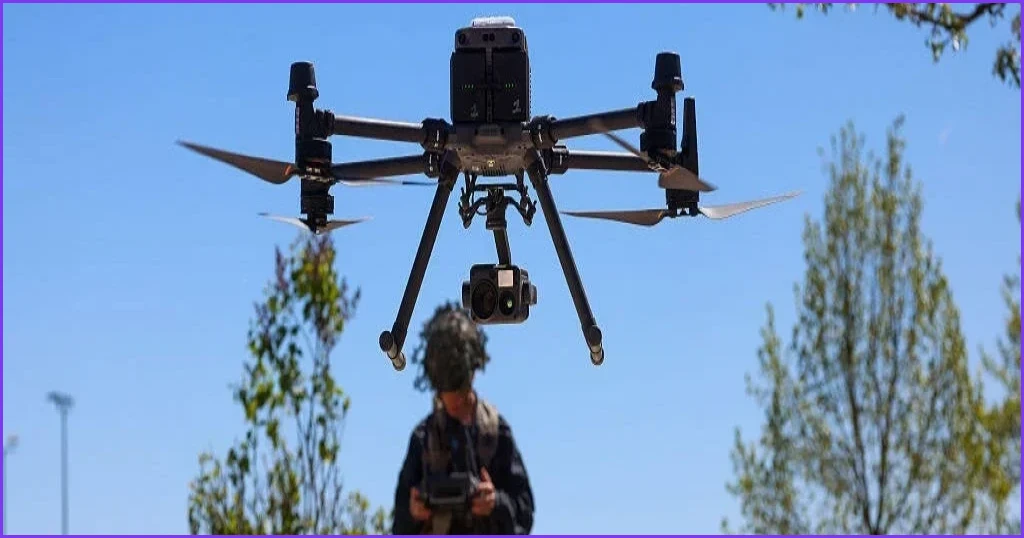
The United States Army is moving to shut down a specialized drone battalion that was established just last year to study and integrate crucial tactical lessons from the war in Ukraine, an Army official confirmed on Thursday. The decision to disband the unit comes amid reported internal friction between the senior military leaders who originally championed the project and the current acting chief of staff.
The drone unit, officially designated as the Unmanned Assault Battalion, was designed to act as an elite, highly trained group capable of deploying rapidly to any theater where unmanned aerial systems were required. Its creation was heavily backed by former Army Chief of Staff Gen. Randy George and the former commander of U.S. Army Europe and Africa, Gen. Christopher Donahue. However, both generals were subsequently fired or forced into early retirement, which cleared the path for Gen. Christopher LaNeve to assume the role of acting Army chief of staff.
According to multiple current and former U.S. officials, the decision to eliminate the battalion was influenced by long-standing, deep-seated tensions between LaNeve and the officers who had pushed for the unit's creation. Specifically, sources pointed to a past conflict between LaNeve and Donahue. This friction traces back to when LaNeve's command of the Army's 82nd Airborne Division was cut short in what officials described as a "soft relief." Following his premature departure from the role, LaNeve was reportedly forced to quickly vacate his quarters at Fort Bragg, North Carolina, to accommodate the incoming commander. Officials noted that this incident generated significant ill will between LaNeve and Donahue.
When asked about the decision, a spokesperson for LaNeve directed all inquiries to the broader Army. The Army itself declined to offer any comments beyond its official statement confirming the plans to phase out the specialized drone unit, which was first reported by The Wall Street Journal.
Currently, the Unmanned Assault Battalion is taking part in a military exercise scheduled to run through September. During this operation, the unit is expected to present the tactical insights and data it has gathered over the past year to help shape the future of American combat doctrine. Once the exercise concludes, however, the unit will be dismantled. An Army official stated that the personnel will "refocus on its core warfighting tasks as an airborne infantry battalion." As part of the 173rd Airborne Brigade, these soldiers will return to standard training focused on parachuting and dropping from aircraft.
The move to dissolve the unit represents a shift from the Army Transformation Initiative, which was launched last year by Gen. George and Army Secretary Dan Driscoll. That initiative placed a heavy emphasis on integrating unmanned systems into the force. During an appearance on "Face the Nation" last year, Driscoll emphasized the importance of studying modern conflicts, stating, "I don't think I've talked to a single person who has said we shouldn't be learning from what's occurring in Ukraine." A spokesperson for the Army secretary said Driscoll had no comment regarding the decision to end the drone unit.
Meanwhile, LaNeve outlined his strategic vision for the service this week in a newly released document titled "The Army Azimuth." The document emphasizes a return to the fundamental elements of soldiering, though it does mention incorporating new capabilities, such as defending against enemy drones. "Every Soldier deserves to know where this Army is headed and what's expected of them. That's what an azimuth is — clear direction," LaNeve said in an accompanying statement. "My focus is simple and it hasn't changed: this Army must fight and win today."
The decision to phase out the specialized battalion comes despite warnings from prominent military figures about the urgent need to prioritize drone technology. In April, retired Army general and former CIA Director David Petraeus said that Western militaries must move faster to integrate unmanned systems. "In some Western countries right now, they think that innovativeness is giving 50 drones to an armored battalion," Petraeus observed. "No. What we should do is scrap the armored battalions and replace them with a drone battalion."
The critical role of unmanned systems has been repeatedly demonstrated in recent global conflicts. Beyond the extensive use of drones in Ukraine, the joint U.S. and Israeli operations against Iran highlighted the threat when Iranian forces launched one-way attack drones targeting U.S. military installations throughout the Middle East.
U.S. Army personnel on the ground have also advocated for a greater focus on these technologies. Capt. Ronan Sefton, who was deployed to Germany with the 2nd Cavalry Regiment shortly after Russia's 2022 invasion of Ukraine, spoke to "60 Minutes" in March about the lessons American forces were drawing from Ukrainian troops. "The first really poignant lesson for us was, there needs to be more drones," Sefton said. "They need to be everywhere involved in the training to add to the realism." Sefton recalled telling every senior commander he could find that the technology was fundamentally changing modern warfare and needed immediate implementation.
Sefton later joined the Army's Ukraine Lessons Learned Task Force—a separate entity from the disbanded Unmanned Assault Battalion—which remains tasked with translating the combat experiences of Ukrainian forces into actionable training for the U.S. military. Sefton noted that while advanced technology will not render traditional military firepower obsolete, the U.S. armed forces must adapt rapidly to counter the increasingly sophisticated drone capabilities of its adversaries.