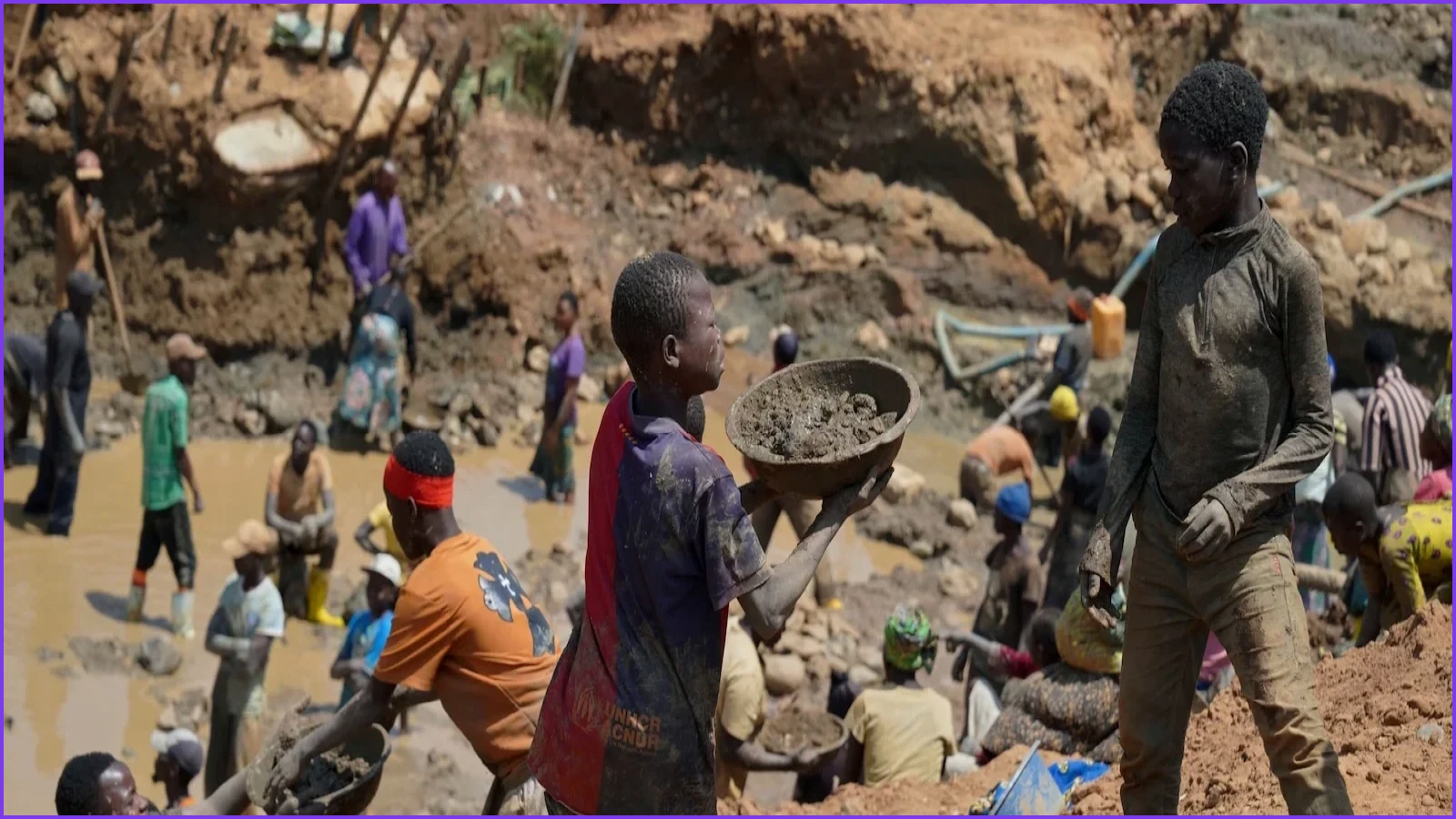
IGA-BARRIÈRE, Congo — Eleven-year-old Isaac Batisa spends his days digging for gold at a mining site in eastern Congo, hoping to earn enough money to support his family. He is among hundreds of people, many of them children, working at an artisanal gold mine in Ituri province, where the country's fast-moving Ebola outbreak is heavily concentrated. For Batisa, however, the immediate concern is not the disease, which has killed more than 2,300 people among at least 5,000 cases. He is simply focused on returning home with his daily earnings, which can be as little as $2 a day. "We don’t know about Ebola here," he said.
As the outbreak spreads and kills people faster than any other Ebola outbreak in history, monitoring efforts are facing severe challenges due to miners who are constantly on the move in hard-to-reach, unsafe territories. A rare look into one of Ituri's largest mines, located in the locality of Iga-Barrière, reveals miners crowded into pits to dig for gold. While there are no known reports of the outbreak officially reaching Congo's mining sites, officials acknowledge it is difficult to assess the true situation in these isolated areas. Most new cases and deaths are being reported among groups that are not currently monitored.
Ebola spreads through direct contact with the bodily fluids of an infected person or through contaminated objects and surfaces. However, preventative measures such as regular handwashing and social distancing are virtually non-existent at these artisanal mining sites, where workers extract gold using basic hand tools like shovels and pans. Many of these mines operate illegally, and miners actively work to evade local authorities.
The current outbreak in Congo is caused by the Bundibugyo virus, a less common strain than others that cause Ebola disease. This is further complicating the response because there are no specific treatments or vaccines available for this strain. At the same time, the constant movement of the mining population makes Ebola harder to contain, hindering efforts to locate infected individuals and trace those who may have been exposed, according to Mari Ndika, an Ebola response worker involved in disease monitoring.
"Artisanal miners may come into contact with several communities as they move from one place to another, which can facilitate the transmission of the virus if a person is infected," Ndika said. Recently, health workers lost track of two miners who had been identified as Ebola contacts after they relocated to another mining site. Anna Ndroy Kansime, a community worker who helps educate people about the disease, confirmed that "they left for a destination that, to this day, remains unknown."
The danger is particularly acute because health authorities are already struggling to keep up with the virus. People can contract the virus in one location and travel elsewhere before monitoring teams realize they have been exposed, potentially establishing new, untraceable chains of transmission. Kansime noted that there is no reliable system for registering mine workers and tracking their movements.
The minerals in eastern Congo, including gold, coltan, tin, and tungsten, have been a source of decades-long conflict and remain a key economic lifeline for residents. Batisa shared that his parents and two of his brothers were killed in an attack by Congolese rebels. He now lives with his aunt and five siblings, and said he was encouraged to work at the mine by his aunt.
More than 100 militant and armed groups operate in eastern Congo, including the ADF and CODECO militia in Ituri. This ongoing violence has displaced large numbers of people and deepened the poverty that drives families toward artisanal mining. According to a 2024 report by the Organization for Economic Cooperation and Development (OECD), about 2 million people work in artisanal and small-scale mining across Congo. There is no reliable recent estimate of how many of these miners are children, but UNICEF estimates that 15% of children aged 5 to 17 in Congo are engaged in child labor.
At the Iga-Barrière site, the search for gold takes miners underground through shafts that can extend dozens of meters. Tunnels are dug largely by hand, often with little to no reinforcement. Above ground, others work in open pits, sorting through earth in search of gold. Children work alongside adults, and pregnant women can also be found working in the open pits, sometimes late into their pregnancies.
Singoma Aimé, a 36-year-old miner, said workers lack adequate protection at the sites. "We especially need hand-washing facilities because everyone comes from home to work at the site," Aimé said.
The outbreak, which is unfolding across six provinces in eastern Congo, is already the fastest-growing Ebola outbreak in history. It is on track to become the deadliest if it surpasses the 2014-2016 West Africa Ebola outbreak, which claimed more than 11,000 lives. Nearly 5,000 people have been infected in Congo, resulting in 2,325 deaths, with Ituri accounting for nearly 90% of the cases. Experts believe the virus was already spreading in the mining town of Mongbwalu as early as February, months before authorities officially declared the outbreak on May 15.
Recently, the aid group Mercy Corps warned that Ebola cases have been reported along a major travel route about 35 kilometers (22 miles) from Congo’s border with South Sudan, raising concerns over the outbreak’s "widening footprint." Trish Newport, an emergency coordinator with the humanitarian group Doctors Without Borders (MSF), stated that the speed of the outbreak remains "extremely concerning" as it continues to outpace tracking and containment efforts.
"We see family members that come in who have had 15 people in their family die. We rapidly need to scale up to be able to prevent more deaths from happening, more families and communities from being impacted," Newport said. Ndika emphasized that the response must include educating miners about prevention and collaborating with local authorities, mine managers, and communities to track suspected cases. However, major challenges persist, including impassable roads, the presence of armed groups, and the movement of displaced populations. "For many families, gold is what pays for food," Kansime added, explaining why it is so difficult to slow down the movement of the miners.